Every April, an AC service business in Nagpur, Hyderabad or Ahmedabad is flat out. The phone does not stop, the technicians are booked three days ahead, and the owner is sure this will be a record year. Then October comes, the calls dry up, and the business starts the next summer from zero — paying for JustDial and Google ads to find customers it already served last year.
Most of those customers would have come back. They just were not asked, or were asked too late, when another business had already answered their call. This post is about keeping them: what to record, when to call, and how to turn a one-time repair into a customer for years.
Why repeat customers matter more in AC service
An air conditioner needs attention every year. Filters clog, coils get dirty, gas leaks slowly, and a unit that was not serviced before summer breaks down in the first heatwave. So the same household needs you again and again — if you are the one they remember.
Repeat customers are also cheaper to win. There is no ad spend, no competition from four other listings, and the customer already knows your technician. A business where half the summer work comes from last year’s customers is far calmer than one that starts from zero every March.
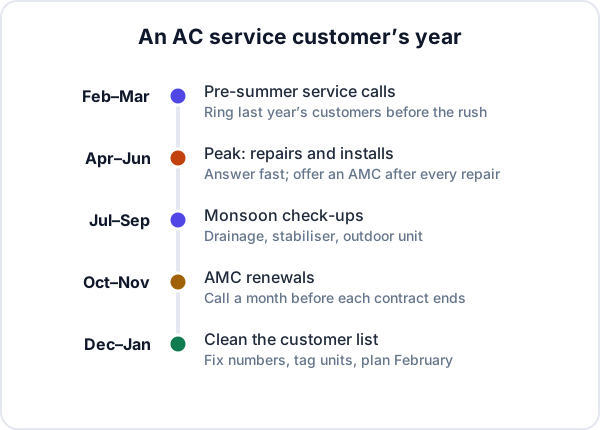
Step 1: Keep a real service history
You cannot call last year’s customers if last year lives in a register nobody can search. For every customer, keep:
- Name, phone and full address, with a landmark. Technicians waste more time finding flats than fixing units.
- The units: how many, brand, split or window, tonnage, and the year each was installed.
- Every visit: date, what was wrong, what was done, parts used, and what it cost.
- Anything to watch: “outdoor unit on a tin roof, gets very hot”, “gas topped up twice in a year — likely leak”.
That history is what lets you say, when the customer rings, “Your bedroom split was last serviced in March and we changed the capacitor.” Customers notice that. It is also how you spot the unit that is due to be replaced — a sale in itself.
Step 2: Call before the summer, not during it
The single most profitable habit in AC service is the pre-summer call in February and early March. Go through everyone you served last year and ring them:
“Namaste, this is Suresh from Cool Care. We serviced your two splits last April. Summer is coming — shall we book a service this month, before the rush? We have slots on Saturday.”
A few things make this work:
- Start with AMC customers, then last year’s repair customers, then installations older than a year.
- Offer a specific slot, not “call us whenever”.
- Book the visit on the call, and write down who said “call me in March” with that date.
- Keep a small pre-season rate if you like, but you do not need a discount — being early is the offer.
Calls convert better than messages, but a WhatsApp message to people you cannot reach is fine. Use your own WhatsApp Business number, and only message people who are actually your customers.
Step 3: Turn every repair into an AMC offer
The best moment to sell an annual maintenance contract is at the end of a repair, when the customer has just seen what a breakdown costs. Before the technician leaves:
- Explain what an AMC covers — for example, three services a year, priority visits in summer, labour included, parts extra.
- Give the price per unit per year, in writing, on WhatsApp.
- Follow up once, within a week. Most people who are going to say yes say it then.
An AMC customer is a repeat customer by definition, and the contract fills your technicians’ calendars in the quiet months. Our post on AMC contracts for service businesses covers what the contract should say and how to price it.
Step 4: Make every visit worth remembering
Customers come back to technicians they trust. Small things build that:
- Arrive in the slot you promised, or call if you will be late.
- Show the dirty filter before cleaning it. People believe what they see.
- Leave the place clean — no water on the floor, no packaging left behind.
- Send a short report of what was done, with a photo, on WhatsApp. It is proof of work and a reminder of your name next year.
- Put your number on the unit with a small sticker. When it breaks at 11 PM in May, that sticker is what they call.
Step 5: Ask for referrals and reviews at the right moment
The moment to ask is when the cooling is back and the customer is relieved. “If anyone in your society needs AC service, please share my number.” Apartment complexes are where AC service referrals spread fastest — one good job in a building often brings three more.
Ask happy customers for a Google review too, by sending them your review link. Reviews help new customers choose you in summer, when they search “AC service near me”. Never write reviews yourself or pay for them; ask real customers only.
When a referral calls, record who sent them. After a season you will know which customers and which buildings send you the most work. Tracking lead sources explains why that matters.
Step 6: Use the quiet months
December and January are when you fix the customer list: correct wrong numbers, merge duplicates, fill in missing unit details, and tag customers — “AMC”, “installed 2021”, “three units”. It is dull work, and it is what makes the February calls quick. A clean list of 400 customers is worth more than any ad campaign.
Each summer, count how many jobs came from customers you served before. If it is under a third, the repeat-customer habits above have room to grow. If it is over half, protect it — those customers are your business.
How Enkay CRM helps
Enkay CRM, from Enkay Technologies, keeps each customer as a record with their address, tags, quotations, invoices, jobs and AMC contracts in one place, so the service history is there when they call. Repair, maintenance and installation jobs carry a checklist, photos and a report you can send on WhatsApp. An AMC contract schedules its visits automatically and creates a renewal follow-up 30 days before it ends.
It does not send SMS or automatic WhatsApp reminders to customers. For the February calls, work through your customer list with the one-tap call and WhatsApp buttons on each customer, or export customers to CSV on any plan and sort the list in Excel. Enkay CRM for AC and appliance service businesses walks through the whole setup, and pricing starts with a free plan.
Frequently asked questions
When should an AC service business contact old customers?
In February and early March, before the first hot week. Customers are not yet desperate, your technicians are not yet booked out, and a pre-summer service call is an easy yes. By mid-April the same customer calls whoever answers first.
How do I turn a repair customer into an AMC customer?
Offer the contract at the end of the repair visit, when the customer has just seen the problem and paid for it. Explain what the annual contract covers, what it costs per visit, and leave the price in writing. Follow up once within a week.
What should I record about each AC customer?
At least the phone number, address, number of units, brand, type (split or window), tonnage, installation year, and every visit with what was done. Without that history, a repeat customer is treated like a stranger.
Can Enkay CRM send summer service reminders to customers automatically?
No. Enkay CRM has no SMS or automatic WhatsApp reminders. It keeps the customer list, service history and AMC renewal follow-ups inside the app; you can export customers to CSV on any plan and message them yourself, for example from a WhatsApp Business broadcast list.
Keep reading
Try Enkay CRM free
Every enquiry in one list, a follow-up date on each one, and your whole team on the same page. Free for one user — not a trial, no credit card.