Custom software development means paying someone to build software for your business alone, around the way your work actually moves, instead of renting a ready-made product. For a small Indian business it is worth doing in one situation: a specific part of your work is costing you time or money every week, and no ready-made product handles it.
That is a narrower case than most company websites will tell you. This post covers what custom software is, how to decide between building and buying, what three years of each costs in rupees, how the work should run, and how to choose a custom software development company without losing control of your own code. We build custom software ourselves, so read it with that in mind. We have tried to write the version we would want to read before hiring anyone.
What is custom software development?
Custom software development is the work of designing, building and maintaining software for one business. The screens, the fields, the rules and the reports follow that business’s own process. You pay for the build once and for upkeep afterwards, and you can own the code. Ready-made software is rented, shared with other customers, and changes when the vendor decides.
In a small business it rarely means a huge system. It usually looks like one of these:
- A rental tracker for a firm in Nashik that hires out generators by the day and has to know which unit is at which site.
- A phone screen where technicians enter meter readings on site, so nobody retypes them in the evening.
- A dealer ordering page for a manufacturer in Rajkot, so orders stop arriving as photos on WhatsApp.
- A bridge that pushes finished jobs into Tally in the format the accountant wants.
Each one is a small, specific thing that the business does every day and that no product on the market does quite the same way.
Custom software or ready-made: which one do you need?
Buy ready-made software for work that every business does the same way, such as leads, follow-ups, billing and accounts. Build custom software only for the part that is unusual to you and costs you something you can count. Most small businesses end up doing both: one ordinary tool, plus one custom piece.
| Your situation | What usually fits |
|---|---|
| Fewer than five people will use it | Ready-made. The subscription is smaller than the upkeep on anything custom. |
| “It feels clunky”, but you cannot say what it costs you | Ready-made. Try a second product before you build. |
| You work from Excel and WhatsApp and things slip | Ready-made first. Move off the spreadsheet, then see what is still missing. |
| One step is retyped, re-checked or done on paper every day | Build that one step. Keep ready-made for the rest. |
| Your process is one most software has never heard of (rentals, job work, hourly billing on return) | Build, starting with the smallest version that holds the work. |
| Fifteen or more users on per-user pricing | Price both. See the worked example below. |
| You plan to sell the software to others | Build. It is your product, not a tool. |
| Nobody in the business will own it after launch | Do not build yet. Decide who looks after it first. |
If you are still unsure after that table, the three questions in our buy-or-build post go deeper on the same decision.
What custom software costs over three years: a worked example
These are made-up round numbers, not quotes. Put your own in their place.
Say a ready-made tool charges ₹800 per user per month. A custom system for the same job is quoted at ₹2,50,000 to build, plus ₹5,000 a month to keep it hosted, backed up and patched. Over 36 months:
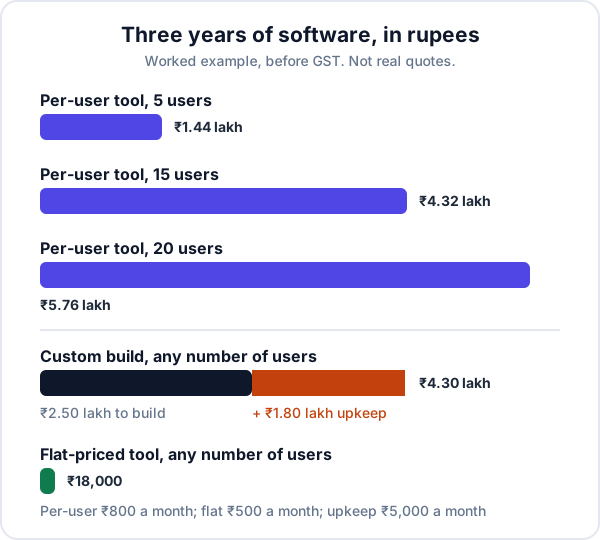
- 5 users: ₹800 × 5 × 36 = ₹1,44,000. Building costs three times as much.
- 15 users: ₹4,32,000. About the same as the custom build at ₹4,30,000.
- 20 users: ₹5,76,000. Building is cheaper by about ₹1.46 lakh, and the gap widens with every person you hire.
Two things this example leaves out, and both matter.
First, not every product charges per user. A tool with a flat price of ₹500 a month costs ₹18,000 over the same three years, whatever the team size. No custom build competes with that on price. If such a tool does the job, buy it.
Second, price is rarely the real reason to build. The reason is what the gap costs you. If two office staff spend an hour a day each retyping site notes, that is about 50 hours a month. At ₹100 an hour that is ₹5,000 a month, or ₹1.8 lakh in three years, before you count a single wrong invoice. That figure belongs on the custom side of the comparison. If you cannot work out a figure like it, you probably do not need custom software yet.
For what moves the build price itself, see what custom software costs in India.
How a custom software project should run
The order matters more than the method. A project that follows these steps can still go wrong; a project that skips one usually does.
- Start from the problem. One sentence about what goes wrong today, and what it costs. You do not need a specification.
- Get the scope in writing. Every screen and every rule, in plain language, with a price and dates. This is the document you will both point to later.
- See the screens before they are built. Changing a drawing is cheap. Changing working software is not.
- Get a working link every two weeks. Not a status report. Something you can open on your phone and click through.
- Let your staff test it on real work. A week of real jobs finds what no demo does. Most software that fails in a small business fails here, because the people using it were never asked.
- Launch with the old data moved across. Agree who cleans the old spreadsheet, and when.
- Take the handover. Code, passwords, hosting, domain and store accounts, all in your name.
- Budget for upkeep. Servers need patching and backups need checking. This is a monthly cost for as long as the software runs.
How to choose a custom software development company
Choose the company that asks about your business before it mentions a price, puts the scope and the ownership of the code in writing, and can show you something it built that is in daily use. Size, office address and the length of the technology list tell you very little.
| Ask this | A good answer | A warning sign |
|---|---|---|
| What do you need to know before you can quote? | Questions about your process, users and data | A price in the first five minutes |
| Will I get a written scope? | Yes, every screen and rule, before any payment | “We will figure it out as we go” |
| How do I pay? | In stages, each tied to something delivered and working | Most of the money upfront, or stages tied only to dates |
| Who owns the code? | You, by a written assignment, on final payment | “Of course it is yours”, with nothing in the contract |
| Whose name are the accounts in? | Yours: domain, hosting, Play Store, App Store | Everything under the developer’s login |
| Who will I talk to? | The person building it | Only a salesperson, then a ticket number |
| What is it built with? | Common tools another developer could take over | A private framework only they understand |
| What happens after launch? | A period of free fixes, then a stated monthly or per-change price | No answer, or a compulsory contract with no price |
| Can I see something you built that is running? | A live system you can open, or a customer you can call | Only mock-ups and logos |
“You own the code” has to be in writing
This is the step most Indian buyers skip, and the law does not help them if they do.
Under the Copyright Act, 1957, a computer programme counts as a literary work, and the author is the first owner of the copyright. The exception that gives ownership to an employer covers staff on a contract of service. An outside firm you hire for a project is not your employee, so the code starts out as theirs.
It becomes yours only by assignment. Section 19 says an assignment is not valid unless it is in writing and signed. The same section sets two defaults that catch people out: if the period is not stated, the assignment is deemed to be for five years, and if the territory is not stated, it is deemed to cover India only.
So the contract should say, in plain words, that all rights in the code, designs and documentation are assigned to you on final payment, for the full term of copyright, worldwide. Paying the invoice is not enough. This is general information, not legal advice; for a large project, have a lawyer read the clause.
Where custom software projects go wrong
- Scope agreed on a call. The developer hears most of it. Six weeks later you disagree about what was included, and neither side can prove anything.
- Building everything at once. A first version with thirty screens takes months and teaches you nothing until the end. Five screens in daily use teach you what the other twenty-five should be.
- The cheapest quote. A price far below the others usually leaves out data migration, testing, or anything after launch.
- Old data left to the last week. Three thousand customer rows with two phone numbers in one cell do not clean themselves.
- No owner inside the business. Somebody on your side has to answer questions within a day and decide. If that is nobody, the project drifts.
- No money for upkeep. Software nobody maintains works until the day it does not, and that day is never convenient.
When custom software is the wrong answer
Do not build if a ready-made product does most of the job for a few hundred rupees a month. Do not build to fix a process that nobody follows; software will only make the mess faster. Do not build if the real problem is that staff do not enter data, because they will not enter it in a custom system either.
And do not build a CRM just because you need one. Leads, follow-ups, a pipeline and GST quotations are ordinary work, and ready-made tools handle them. Our own product, Enkay CRM, is one of those, and it has a free plan. It is cheaper than anything we could build for you.
What Enkay Technologies builds, and what we will not promise
Enkay Technologies builds custom software for small businesses: custom CRMs and internal systems, business websites, Android and iOS apps, dashboards and integrations. The first call is free. You then get a written scope with a fixed price and dates. You pay in stages against delivery, the code and accounts are transferred to you on final payment, and the first 30 days of fixes after launch are free. Custom systems and apps start at about ₹1,50,000 and websites at about ₹25,000, before GST.
What we do not have: published customer names, testimonials or certifications to show you. The proof we can point to is Enkay CRM itself, which we built and run. We also will not quote without a scope, and if a ready-made product would do your job, including someone else’s, we will tell you that instead.
Before you call anyone
Custom software development pays for itself when it removes a cost you can already name. So name it first. Write one page: what goes wrong today, what it costs each month, who will use the system, what it must connect to, and what old data has to come across. Send that page to two or three companies, us included if you like, and compare the written scopes that come back, not the prices on the phone.
Frequently asked questions
What is custom software development?
It is having software designed and built for one business, around how that business works, instead of renting a ready-made product that thousands of businesses share. You pay once for the build and then for upkeep, and if the contract says so in writing, you own the code.
How much does custom software development cost in India?
It depends on how many kinds of users, how many integrations, and whether you need an app in the stores. As a reference point, our own quotes at Enkay Technologies start at about ₹1,50,000 for a working first version of a custom system or app, and about ₹5,000 a month to keep it running, both before GST. Other firms price differently.
How long does it take to build custom software?
For a small business, a working first version of an internal system is usually a matter of 6 to 10 weeks once the scope is agreed in writing. An app on both Android and iOS usually takes 10 to 16 weeks including store review. Anything quoted in days is a template being renamed, which is fine if you know that is what you are buying.
Who owns the source code of custom software in India?
Not automatically the person who paid. Under the Copyright Act, 1957 the author is the first owner, and an assignment is valid only in writing and signed. If the period or territory is not stated, the assignment is deemed to be for five years and for India only. So the contract should assign all rights to you, for the full term of copyright, worldwide.
Is custom software better than ready-made software for a small business?
Usually not. For ordinary work such as leads, follow-ups, billing and accounts, ready-made software is cheaper, already tested and maintained by someone else. Custom software is better only for the part of your business that ready-made products do not cover and that costs you a measurable amount every week.
Do I need a mobile app, or is a web application enough?
A web application that works well on a phone is enough for most internal systems. You need a real app in the Play Store or App Store when staff must work with no signal, when photos and GPS are part of the job, or when push notifications have to reach people. Otherwise the app adds cost and two platforms to maintain.
Keep reading
Have a process that ready-made software does not fit?
Tell us what is going wrong today. The scoping call and the written quote are free, and if a ready-made tool would do the job, we will say so.