The difference between a free CRM vs paid CRM is less about features than about who else can use it and how leads get in. A free plan usually gives one to three people a contact list, follow-up dates and a basic pipeline. A paid plan adds more users, leads that arrive by themselves from portals and your website, automation, reports and support. For one person typing in a few dozen enquiries a month, free is often enough.
Most comparisons stop at a features grid written by a vendor with a paid plan to sell. The more useful question is what the free plan costs you in hours and lost enquiries, because that is the number to put next to the subscription. This post shows how to work that out, what to check before trusting a free plan with your customer list, and the four signs it is time to pay.
Free plan, free trial or free software: three different things
“Free CRM” is used for three different offers, and mixing them up is the commonest mistake.
| Type | What you get | The catch |
|---|---|---|
| Free plan | A cut-down version with no end date | Limits on users, records or features, set so a growing team will upgrade |
| Free trial | The full product for a set number of days | At the end you pay or lose access; data entered is only useful if you stay |
| Free open-source software | The code, to run on your own server | Hosting, updates, backups and fixes are yours, which means paying someone |
This post is about the first: a free plan you can use for as long as you like. If you are weighing building something of your own instead, our posts on buying or building a CRM and what custom software costs cover that route.
What a free CRM plan gives up
Every vendor draws the line in a different place, but the limits come from the same short list. When you read a free plan’s page, look for each of these.
| What is limited | Why it matters to a small business | What to check |
|---|---|---|
| Users | The day a second salesperson joins, everyone needs to see the same leads | How many users, and the price per extra user |
| Records | A busy month of portal enquiries can fill a small cap fast | Contacts or records allowed, and what happens at the cap |
| Lead capture | Leads you type in by hand arrive late or not at all | Whether IndiaMART, JustDial or website form leads can flow in automatically |
| Automation | Follow-up dates set by rules rather than memory | Which automatic steps are on the free plan, if any |
| Reports | Which source and which salesperson actually convert | Conversion and source reports, not just a dashboard count |
| Export | Your customer list is your business; you must be able to take it with you | Whether export is allowed, how often, and which fields come out |
| Support | Someone to answer when leads stop arriving | Email, phone or community forum only |
| Branding | The vendor’s name on forms or messages customers see | Whether removing it needs a paid plan |
What some well-known free plans say
From each vendor’s own page, checked on 14 October 2026. Plans change often, so open the page before you decide.
- Zoho CRM: its pricing page describes the Free edition as free forever for 3 users, with up to 10 custom email templates and data export up to 10 times.
- HubSpot: its free CRM page says the free tools cover up to two users and 1,000 contacts, with no expiry date.
- Bitrix24: its pricing page lists a Free plan with a basic CRM and one sales pipeline; WhatsApp, email and telephony integration are on the paid plans.
- Freshsales: its pricing page shows paid plans and a 21-day trial, not a free plan.
Notice how differently the lines are drawn. One caps users, another caps contacts, a third holds back the integrations. That is why the headline “free CRM” tells you very little: the right free plan is the one whose limit you will not hit soon.
The real cost of a free CRM: a worked example
An example, with made-up figures. A CCTV dealer in Indore has three people taking enquiries and gets about 80 a month from IndiaMART, JustDial and the website. On a free plan without automatic lead capture, every enquiry is copied in by hand from email or the portal app.
| Hidden cost on the free plan | Per month |
|---|---|
| Typing in 80 enquiries at about 3 minutes each | 4 hours |
| Enquiries never copied in because someone was on site | Say 4 |
| Of those, jobs that would have closed at the usual rate | Say 1 |
| Margin on one typical job of ₹45,000 at 25% | ₹11,250 |
Set that against the paid options. A per-user plan at, say, ₹800 a user a month costs ₹2,400 for three people. A plan priced per business costs the same however many people use it. Either way, if the paid plan saves even one job a month, it has paid for itself several times over. If it does not, because your enquiries are few and you are the only one handling them, the free plan is the right answer and you should keep it.
The useful sum is yours, not ours: hours spent copying leads in, and how many enquiries a month never make it into the system. If you do not know the second number, the gap between the enquiries on your IndiaMART Lead Manager and the leads in your CRM is a good place to start counting.
Four signs it is time to pay
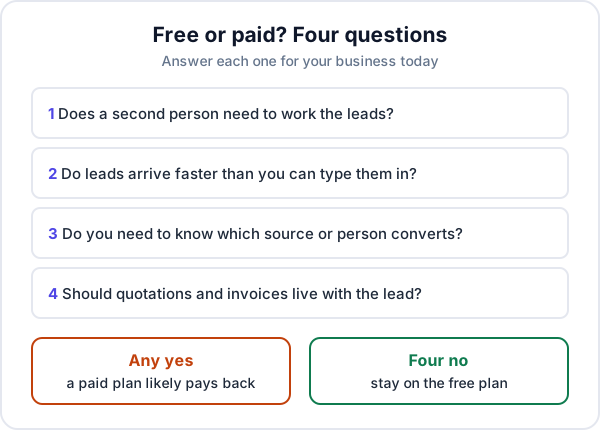
- A second person needs to work the leads. Two people on one login, or one person forwarding screenshots to another, is how enquiries get called twice or not at all.
- Leads arrive faster than you can type them in. Once portal and website enquiries arrive every day, automatic capture saves hours and stops the leaks in the worked example.
- You need to know what is working. Which source brings jobs, which salesperson converts, why deals are lost. Free plans usually show counts, not answers. Our post on CRM metrics for a small business lists the numbers worth having.
- You send quotations or invoices. If the quotation lives in another tool, the lead and the deal never meet, and nobody knows which quotes went unanswered.
Before you trust a free plan: the export test
The cost nobody mentions is leaving. A year from now your free CRM holds every customer you have. Before you put them there, do this once, in the first week:
- Add ten real leads with notes, a stage and a follow-up date.
- Export them to CSV or Excel.
- Open the file and check that names, numbers, sources, stages, dates and notes all came out.
- Read the plan page for how often you can export on the free plan.
If the export is missing fields, limited to a few times, or only on a paid plan, you know what leaving will cost before you have anything to lose. Our guide to moving from a spreadsheet to a CRM covers the same file work in the other direction.
When paying is the wrong answer
Paid plans have their own traps, and a vendor will not point them out.
- Paying for a tier you will not use. Marketing automation and custom modules are wasted on a team that still forgets follow-ups. Get the basics used every day first.
- Per-seat pricing that grows with the team. Adding a field technician or a part-time telecaller can quietly double the bill. Check how the price changes as the team grows, not just today’s figure.
- A year paid up front before anyone uses it. Pay monthly until the team has used it for a month, then switch to yearly if it saves money.
- Expecting the software to fix the habit. A paid CRM nobody opens is more expensive than a free one nobody opens, and no better. Our post on choosing a CRM for a small business starts with the problem, not the product, for this reason.
Where Enkay CRM fits, and where it does not
Enkay CRM, from Enkay Technologies, has a Free plan that costs ₹0 for one user, with unlimited leads and follow-ups, the Today screen of overdue and due calls, one-tap WhatsApp and call from any lead, and CSV export of leads and customers. It is a real plan, not a trial, and it does not expire.
What the Free plan does not have: more than one user, automatic lead capture from IndiaMART, JustDial and your website form, lead assignment, reports, GST quotations and invoices, and CSV import. Those are on the Business plan at ₹499 a month or ₹4,990 a year, priced per business with unlimited users. New accounts get 90 days of Business features, then move to Free unless they upgrade, and nothing is deleted. Online card and UPI checkout is not switched on yet, so upgrading means contacting Enkay Technologies. If you need more than one free user, other free plans allow two or three; see the pricing page for exactly what each Enkay plan includes.
The short version
In the free CRM vs paid CRM decision, a free plan gives up users, automatic lead capture, automation, reports, support and sometimes export. It is enough for one person handling a manageable number of enquiries by hand. Pay when a second person needs the leads, when enquiries arrive faster than you can type them in, when you need to know what converts, or when quotations should live with the lead. Before trusting any free plan with your customers, export ten leads and check they all come out.
Frequently asked questions
Is a free CRM good enough for a small business?
Often, yes, for one person handling a few dozen enquiries a month that they type in themselves. A free plan usually covers contacts, leads, follow-up dates and a basic pipeline. It stops being enough when a second person needs access, when leads should arrive automatically from portals or your website, or when you need reports and quotations.
What is the difference between a free CRM and a free trial?
A free plan has no end date but fewer features or users. A free trial gives you the full product for a set number of days, then asks you to pay or loses access. Check which one you are signing up for, because data entered during a trial is only useful if you will keep paying.
What are the limits of a free CRM?
The usual ones are the number of users, the number of contacts or records, automatic lead capture and integrations, workflow automation, reports, how often you can export your data, the level of support, and the vendor’s branding on what customers see. Each vendor mixes these differently, so read the plan page, not the headline.
When should a small business pay for a CRM?
Pay when the free plan is costing you more in time or lost enquiries than the subscription costs. In practice that is when a second person needs to work the leads, when leads arrive from IndiaMART, JustDial or your website faster than you can type them in, or when you need to know which source or salesperson is converting.
Can I move from a free CRM to a paid one later?
Usually yes, within the same product, and your data stays. Moving between products is harder: you export to CSV, clean the file and import. Before you commit to any free CRM, export your data once to check it comes out complete.
Does Enkay CRM have a free plan?
Yes. The Free plan costs ₹0 for one user with unlimited leads and follow-ups, and it does not expire. Automatic lead capture, more users, lead assignment, reports, quotations and invoices are on the Business plan at ₹499 a month or ₹4,990 a year for the whole business.
Keep reading
Try Enkay CRM free
Every enquiry in one list, a follow-up date on each one, and your whole team on the same page. Free for one user — not a trial, no credit card.