Lead scoring for a small business does not need software. After the first conversation with an enquiry, answer five questions: is the need specific, when do they want it, are you talking to the person who decides, does the money fit, and did they agree to a next step. Give each answer 0, 1 or 2. A total of 8 to 10 is an A lead, 5 to 7 is a B, and 0 to 4 is a C. The letter decides who gets this week’s site visits.
That is the whole method. The rest of this post shows how to answer the five questions honestly, works one example through in rupees, and covers the step most scoring guides leave out: checking after two months whether your A leads really did win more often.
What lead scoring is, and what it is for
Lead scoring is giving each enquiry a number that says how likely it is to become an order. Its only purpose is to decide the order in which you spend scarce time: visits, demos, detailed quotations, the third follow-up call.
Most articles on the subject describe a different world. They award points for opening an email, visiting a pricing page or downloading a brochure, and they assume marketing software that watches all of this. A solar installer whose enquiries come from IndiaMART, JustDial, WhatsApp and a neighbour’s recommendation has none of that data. What he has is a phone call. So the score has to come from what a person can learn in a three-minute conversation.
Do you need to score leads at all?
Only if you have more enquiries than time. If you can call every enquiry the same day and visit everyone who asks, do not score anything; just do that. Scoring is rationing, and rationing is pointless when there is enough to go round.
It starts to matter when something runs short. One salesperson can do perhaps five site visits a week and twelve people have asked for one. A detailed quotation takes an hour and eight are pending. At that point someone is already choosing who waits. Without a score, the choice goes to whoever called most recently or sounded keenest, and that is not the same as whoever is likeliest to buy.
Call first, score second
Do not score a lead before you have spoken to it. A fresh IndiaMART buy-lead tells you a product name and a town, which is not enough to judge anybody. Every new enquiry gets the same fast first call, because speed on the first contact matters more than any ranking; our post on not losing IndiaMART leads covers that first hour.
The score is for everything after the first call. It answers: now that I have spoken to all of them, which ones get the visit?
The five-question lead scoring method
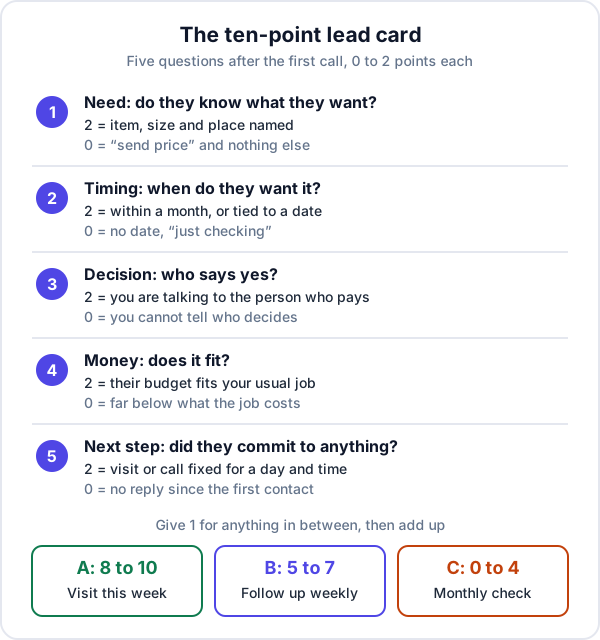
| Question | 2 points | 1 point | 0 points |
|---|---|---|---|
| Need. Do they know what they want? | Named the item, the size and the place | Knows the problem, not the solution | “Send price” and nothing else |
| Timing. When do they want it? | Within a month, or tied to a date | Within three months | No date, “just checking” |
| Decision. Who says yes? | You are talking to the person who pays | They will take it to the person who pays | You cannot tell who decides |
| Money. Does it fit? | Their budget fits your usual job | Budget not discussed yet | Far below what the job costs |
| Next step. Did they commit to anything? | Visit or call fixed for a day and time | Replied, sent a photo or a bill, no date | No reply since the first contact |
Why these five
The first four are the old salesman’s checklist of need, time, authority and budget, which large companies call BANT. The fifth is the one that separates talk from intent. A customer who gives you a time on Saturday for a site visit has spent something. A customer who says “send details on WhatsApp” has spent nothing.
Knock-outs come before the score
Some enquiries should not be scored at all. Close them and note why:
- Outside the area you serve
- Wants something you do not sell
- A student, a job seeker, or a supplier trying to sell to you
- A wrong or switched-off number after three attempts on different days
Record the reason each time. Three months of reasons tell you which source sends junk, which is worth more than the score itself.
What each grade gets
| Grade | Score | What you do |
|---|---|---|
| A | 8 to 10 | Visit or demo this week. Quotation within a day of the visit. Follow up in two days. |
| B | 5 to 7 | Find the missing answer on the next call. Standard price over WhatsApp before any visit. Follow up weekly. |
| C | 0 to 4 | One clear message with your price range. A check once a month. No visit unless the score rises. |
A grade nobody acts on is decoration. If A and C leads get the same treatment in practice, stop scoring and save the minute. For the calls themselves, our post on building a sales follow-up process gives a cadence you can attach to each grade.
A worked example: a solar installer with 60 enquiries a month
This is a made-up example. Say a rooftop solar installer in Kolhapur gets 60 enquiries a month and has one salesperson, who can manage about 20 site visits. Here are three of the month’s leads after the first call.
| Lead | Need | Timing | Decision | Money | Next step | Total |
|---|---|---|---|---|---|---|
| Bungalow owner, 3 kW, wants it before summer, visit fixed for Saturday | 2 | 2 | 2 | 1 | 2 | 9, A |
| Housing society secretary, 20 kW for common areas, committee meets next month, sent the electricity bill | 2 | 1 | 1 | 2 | 1 | 7, B |
| Portal enquiry, “solar panel price”, a relative of the shop owner is collecting rates | 1 | 0 | 1 | 1 | 1 | 4, C |
The bungalow gets a visit this week. The portal enquiry gets a price range on WhatsApp and a reminder next month. The society is the interesting one, and we come back to it below.
Check the score against real wins
Two months later, count what happened to each grade. Continuing the made-up example:
| Grade | Leads | Won | Win rate |
|---|---|---|---|
| A | 12 | 6 | 50% |
| B | 22 | 4 | 18% |
| C | 20 | 1 | 5% |
| Knocked out | 6 | 0 | – |
Here the score is doing its job: an A wins far more often than a B, and a B more often than a C. With 20 visits available, all 12 A leads are visited and 8 remain for the best of the B leads. No C lead takes an afternoon.
If your own table comes out flat, with A and C winning at similar rates, the questions are not measuring what matters in your trade. Look at the leads you won and ask what they had in common that the card missed. For a coaching institute it might be whether the parent visited in person. For a CCTV dealer it might be whether there was a recent theft nearby. Replace one question, score for two more months, and count again. Fewer than about 30 closed leads is too few to conclude anything, so wait until you have them.
Score is not size: keep the rupee value beside it
The score says how likely an order is, not how big. In the example, the bungalow might be a job of ₹2 lakh and the society one of ₹10 lakh. A 7 on a ₹10 lakh job deserves more effort than a 9 on a small one, because a rough expected value is the job value multiplied by the win rate of its grade: ₹2 lakh at 50% is ₹1 lakh, and ₹10 lakh at 18% is ₹1.8 lakh.
So write two things next to every lead: the grade and the value. Sort by grade for the daily calls, and look down the value column once a week for a large B that needs the owner’s own attention.
Where a simple score goes wrong
- Scoring on how the person sounds. Polished English, a known locality or a company email address are not on the card, for a reason. Score only the five answers. Plenty of good orders come from people who are brief on the phone.
- Scoring once and never again. A C who calls back with a date is no longer a C. Rescore whenever one of the five answers changes.
- Using C as permission to ignore. A C still gets one proper reply and a monthly check. Some of next quarter’s orders are in this pile.
- Scoring referrals and repeat customers. Someone sent by an existing customer, or who has bought from you before, goes to the front without a card.
- Adding questions. Ten criteria with weights feel thorough and stop being filled in by the second week. Five questions are answered from memory in a minute.
- Letting each salesperson invent a scale. Print the table. An 8 must mean the same thing whoever wrote it.
Give the source a head start, with evidence
Many owners want to score the source: referral high, portal low. Do it only once you have the numbers. If your records show that referrals win three times as often as portal enquiries, a referral can start at A before the card is filled in. Without records it is a prejudice. Tracking lead sources for two or three months gives you the win rate by source to base it on.
Where to keep the score
In a register or a spreadsheet, add two columns after the phone number: grade and value. Sort by grade each morning. That is enough for one person. It strains when several people share the sheet and the grade changes, for the reasons in our post on moving from Excel to a CRM.
Where Enkay CRM fits, and where it does not
Enkay CRM has no lead score field and does not score leads automatically. We would rather say so than let you look for it. What lead management in Enkay CRM does hold is the material the grade acts on: each lead has a value in rupees, a stage, an owner, a next follow-up date and a note. A workable habit is to write the grade as the first word of the note, move an A to the Qualified stage, and set the follow-up date by grade: two days for an A, a week for a B, a month for a C. The Qualified column of the pipeline board then holds your A leads until they move on to a visit or a quotation, and the lead sources report on the Business plan gives the win rate by source.
The limits: you cannot filter or sort the lead list by grade, since the grade is only text in a note, and there is no report of win rate by grade, so the two-month check is still a count you do yourself.
The short version
Lead scoring for a small business is five questions and ten points, asked after the first call and never instead of it. Grade each lead A, B or C, keep the rupee value beside the grade, and let the grade decide who gets the visit. After two months, count wins by grade, alongside the other numbers worth tracking; if A does not beat C, change a question. Score this week’s open enquiries on paper first. It takes about a minute each, and by Friday you will know whether it changes whom you call.
Frequently asked questions
What is lead scoring in simple words?
Lead scoring is giving each enquiry a number that says how likely it is to become an order, so you know whom to call and visit first. For a small business the number can come from five questions answered after the first conversation, with no software involved.
How do I score leads without software?
Ask five questions after the first call: is the need specific, when do they want it, are you talking to the person who decides, does the money fit, and did they agree to a next step. Give each answer 0, 1 or 2. A total of 8 to 10 is an A lead, 5 to 7 is a B and 0 to 4 is a C. Write the letter next to the lead.
Does a small business need lead scoring at all?
Only if there are more enquiries than time. If you can call every enquiry the same day and visit everyone who asks, scoring adds work and no benefit. It starts paying when site visits, demos or quotations have to be rationed, because then someone is already choosing, and a score makes the choice consistent.
Should I score a lead before I call it?
No. Call every new enquiry quickly, then score it. Before the first conversation you know only the source and one line of requirement, which is not enough to judge. The score decides what happens after the first call: who gets a visit, a detailed quotation and the second and third follow-up.
What is the difference between lead scoring and lead qualification?
Qualification is a yes or no: is this a real buyer you can serve. Scoring ranks the ones that passed, so the likeliest get your time first. The knock-out checks in this method are the qualification; the ten points are the score.
How often should I change the scoring questions?
Check them after about two months, once enough scored leads have been won or lost. If A leads are not winning clearly more often than C leads, the questions are not measuring what matters in your trade. Change one question at a time and check again.
Does Enkay CRM have lead scoring?
No. Enkay CRM has no score field and no automatic scoring. What it does hold is the stage of each lead, its value in rupees, the next follow-up date and a note, and a report of win rate by source. You can write the A, B or C grade in the note and let it decide the stage and the follow-up date.
Keep reading
Try Enkay CRM free
Every enquiry in one list, a follow-up date on each one, and your whole team on the same page. Free for one user — not a trial, no credit card.