If you run a small travel agency, the phrase travel agency CRM covers two very different things. One is a full travel suite: itinerary builder, supplier rates, booking engine, vouchers, accounts. The other is a plain CRM that does one job: every enquiry in one list, with a name against it, a quotation and a date for the next call.
In an agency of two to fifteen people, bookings are usually lost in the second area, not the first. The trip gets booked fine once the customer pays. The trouble is between the first WhatsApp message and the advance: slow replies, quotes nobody chased, and a third revision that was never sent. Peak season makes each of those worse. This post helps you decide which kind of tool you need, shows what the leaks cost in rupees, and gives a routine you can start this week.
Do you need a travel-specific CRM or a simple one?
A simple CRM is enough if you sell customised packages by phone and WhatsApp and book through suppliers or B2B portals you already use. You need a travel-specific suite when customers must book and pay online at live prices, or when seat inventory, supplier rates and supplier payments are too much for spreadsheets.
| Your situation | Simple CRM | Travel suite |
|---|---|---|
| Enquiries are forgotten, or nobody knows who is handling them | Enough | More than you need |
| Customised family, honeymoon and pilgrimage packages, quoted one by one | Enough | Optional |
| Two to eight people sharing enquiries from WhatsApp, calls and JustDial | Enough | Optional |
| You want a designed day-by-day itinerary with photos, made in minutes | Not built for it | Needed, or a separate itinerary tool |
| Customers book and pay on your website at live prices | Cannot do it | Needed (booking engine) |
| Several fixed-departure group tours with seats, rooming lists and instalments | Tracks the enquiries only | Needed |
| Contracted rates with many hotels and transporters, and supplier payments to reconcile | Cannot do it | Needed (supplier management) |
| Air ticketing in volume | Cannot do it | Needed, with a back office |
Two honest notes on that table. A suite does not fix follow-up by itself; an agency that does not call back enquiries today will not call them back from inside costlier software. And the two can be combined: some agencies keep enquiries in a simple CRM and build itineraries elsewhere. Start with the problem that is costing you bookings now.
What peak season does to enquiry handling
From October to January, the Diwali break, Christmas and New Year and the winter wedding season all send enquiries at once. April to June does it again with school holidays. Four things change:
- Volume jumps, staff does not. The same three agents take the calls, build the quotes and handle travellers who are already on a trip.
- Quotes go stale quickly. Hotel and flight prices move, so a quote left unconfirmed for a week often has to be redone.
- Customers compare. A family planning Kerala for Christmas has usually messaged more than one agency. The first sensible reply often sets the benchmark.
- Enquiries arrive after hours. People plan holidays at 10 pm, on their sofa, on WhatsApp.
None of this is a software problem. It is a queue problem, and the queue needs an order.
Where a travel agency loses enquiries: a worked example
This is an example with made-up numbers, not data from any agency. Put your own figures in its place.
Say a six-person agency in Indore gets 240 enquiries in November. The average package is ₹90,000 and the agency keeps about 10% of that, so ₹9,000 a booking.
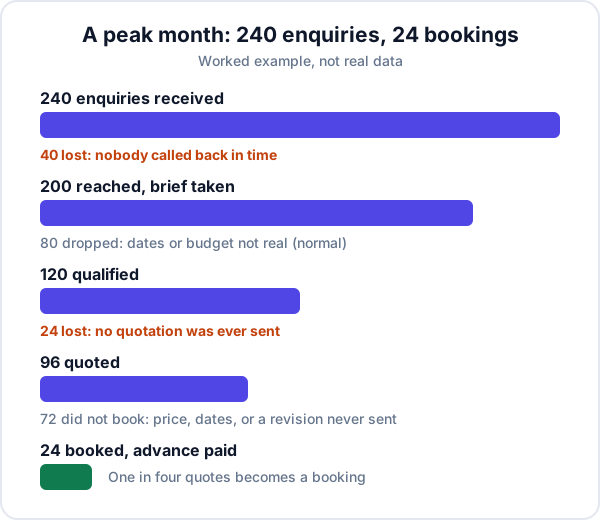
- 240 enquiries come in. 40 are never called back in time, because they sat in one agent’s WhatsApp.
- 200 are reached. 80 turn out to be people pricing a trip they will not take. That is normal.
- 120 are qualified. 24 of them never get a quotation, because the week was too busy.
- 96 are quoted. 24 book, which is one in four.
The month ends with 24 bookings, ₹21.6 lakh of package value and about ₹2.16 lakh kept.
Now the two avoidable leaks. The 24 qualified families who never got a quote, at the same one-in-four rate, were worth 6 bookings. The 40 who were never reached, at the same rates (60% qualify, a quarter of those book), were worth another 6. That is 12 bookings, or roughly ₹1,08,000 of margin in one month. Halve it, because late or cold enquiries do convert worse, and it is still ₹54,000. No advertisement was needed to earn it; those people had already asked.
There is a third leak the diagram cannot show well: among the 72 who were quoted and did not book, some asked for a change and never received the revised quote.
A peak-season enquiry routine for a small agency
This works on paper, in a sheet or in a CRM. The tool matters less than doing every step for every enquiry.
- One list. Every enquiry from WhatsApp, calls, your website form, JustDial, walk-ins and referrals goes into the same list on the day it arrives. Record the source too, so that in February you know which one produced bookings.
- The brief in five lines. Destination; dates and how flexible; adults and children with ages; hotel category and budget; departure city and whether flights are included. A quote built on half a brief is a revision waiting to happen.
- Acknowledge fast, call the same day. A short reply (“Got it. I will call you at 11 tomorrow to understand the trip”) holds a 10 pm enquiry overnight. Then keep the appointment.
- Sort by travel date, not arrival time. In peak season the oldest message is not the most urgent one. Use the table below.
- Every quote carries a validity date. “Valid till Friday, subject to availability” is honest, and it gives you a reason to call on Thursday.
- Every enquiry has a next date. No open enquiry without one. This single rule is what stops follow-ups being missed.
- Record why you lost it. Price, dates, booked direct, trip cancelled, went quiet. After one season the pattern is plain.
| Travel date | Priority | What to do |
|---|---|---|
| Within 3 weeks | Today | Call now, quote the same day, check availability before quoting |
| 3 to 8 weeks away | This week | Call within a day, quote within two, follow up before validity ends |
| More than 2 months away | Scheduled | Take the brief, send a rough range, set a follow-up date a few weeks out |
| “Just checking prices” | Low | Give a range, ask when they will decide, set that date |
Quotation revisions: where travel is different
In most trades a quotation is sent once, perhaps twice. In travel the quotation is the product, and three versions is ordinary: swap Munnar for Thekkady, add a houseboat night, drop to a cheaper hotel. Each change is a chance to lose track.
- Number the versions. V1, V2, V3 in the file name and in the message, so “the earlier one” means something.
- Revise, do not restart. One quotation with versions, not three unrelated documents with three totals.
- Write why it changed. “V3: customer wants 4-star in Munnar, budget up by ₹12,000.” The colleague covering your leave needs that line.
- A change requested is a task with a date. “Can you check Goa instead?” is a promise. If it is not written down with a date, it is the leak.
- Confirm the final version in writing before the advance. Disputes at check-in are usually about which version was agreed.
For the document itself, see how to write a quotation that gets accepted.
The booking advance: when an enquiry is really a booking
A customer who says “yes, confirm it” has not booked. Until the advance is received, treat the enquiry as open and keep its next date. In peak season, say plainly that the price holds only until the advance arrives, because that is true of the hotel rooms too.
When it is paid, record three things: the amount received, the balance and the date the balance is due. Then put that due date in your own diary. Balance collection a week before departure is the second place agencies lose money.
Tax on tour packages has its own rules. For overseas packages, tax collected at source (TCS) applies on top of the price; the Union Budget 2026–27 proposed reducing the TCS rate on overseas tour packages to 2 per cent, from 5 and 20 per cent. Confirm the rate in force and the GST treatment of your packages with your accountant, and show both clearly on the quote, so the customer is not surprised at payment.
What a travel agency CRM will not fix
- Slow suppliers. If the hotel takes a day to confirm a rate, your quote takes a day.
- Too few people. A list of 60 calls due today does not help if two agents can make 30. It does show you the gap, which is useful when deciding whether to hire for the season.
- Entry discipline. Every enquiry takes a minute or two to record. If the team will not do that at 9 pm in December, no tool works.
- Very low volume. One person with 30 enquiries a month can run on a notebook or a sheet. If you are moving off one, this is how to shift from Excel to a CRM without losing the old data.
Where Enkay CRM fits, and where it does not
Enkay CRM, made by Enkay Technologies, is the simple kind. For a travel agency it does these things:
- JustDial and website form enquiries arrive automatically once connected (JustDial’s team has to switch on its side). WhatsApp, phone and walk-in enquiries are added by hand; a phone number is the only required field.
- Each enquiry has an assigned agent, a requirement note for the brief, a value in rupees, and a next follow-up date. The Today screen lists overdue follow-ups first, and open enquiries that have no follow-up date at all.
- On the Business plan, quotations are itemised GST documents with a discount and revisions, shared by a link the customer can accept or decline on their phone. A follow-up task appears when the customer opens the quotation and when it is about to lapse.
- A GST invoice is raised from the quotation with a UPI payment link, and the advance and balance are recorded as payments.
- Marking an enquiry Lost asks for the reason. On the Business plan, reports show the win rate by source and why enquiries were lost.
And these it does not do:
- No booking engine. No flight or hotel inventory, no live fares, no tickets or vouchers.
- No supplier management. Supplier rates, confirmations and payments stay in your current system.
- No itinerary builder. A quotation is a list of line items, not a designed brochure.
- No automatic WhatsApp or SMS reminders, to customers or to staff. Reminders show inside the app; you send messages yourself with the one-tap WhatsApp button, from your own WhatsApp. WhatsApp messages are not captured automatically.
- Fixed pipeline stages. New, Contacted, Qualified, Site visit, Quotation, Negotiation, Won or Lost. You cannot rename them; a travel agency can simply skip Site visit.
The page on Enkay CRM for travel agencies shows the set-up stage by stage. The Free plan is for one user; Business is ₹499 a month for unlimited users. See pricing.
Before the season gets busy
Choosing a travel agency CRM is a smaller decision than it looks. If customers must book online, or supplier accounts are out of hand, buy a travel suite and accept the cost. If the problem is enquiries that nobody called and revisions that nobody sent, a simple list with a name and a next date on every row will recover more bookings than any feature. Work out your own version of the funnel above for last December, and see which leak is larger.
Frequently asked questions
What is a travel agency CRM?
It is software that keeps every trip enquiry in one list with the traveller’s brief, the agent responsible, the quotations sent and the next date to call. Some products stop there. Travel-specific suites add an itinerary builder, supplier rates, a booking engine and accounts on top of that.
Does a small travel agency need a travel-specific CRM?
Not always. If you sell customised packages over WhatsApp and phone and book through suppliers or B2B portals you already use, a simple CRM that tracks enquiries, follow-ups and quotations covers the part where bookings are lost. You need a travel suite when customers book online at live prices, or when you manage seat inventory and supplier payments in volume.
Can I manage peak season with Excel and WhatsApp?
Up to a point. One person handling 30 or 40 enquiries a month can run on a sheet and a good memory. It breaks when two or more agents share the enquiries, because a sheet does not show anyone whom to call today, and WhatsApp chats sit on individual phones.
How do I keep track of itinerary revisions?
Number every version, change one quotation instead of starting a new one, and write one line on why it changed. Before you take the advance, send the final version again and get a written “confirmed” on that version, so the hotel category and inclusions are not disputed later.
Can Enkay CRM book flights or hotels, or build an itinerary brochure?
No. Enkay CRM has no booking engine, no supplier management and no itinerary builder. It tracks the enquiry, the follow-ups, the itemised GST quotation and its revisions, and the advance payment. You keep booking through the systems you already use.
Keep reading
Try Enkay CRM free
Every enquiry in one list, a follow-up date on each one, and your whole team on the same page. Free for one user — not a trial, no credit card.