A proforma invoice is a price and terms you send before the sale, so the customer can pay an advance or get the purchase approved. A tax invoice is the GST document that records the sale itself. The difference that matters most: a proforma invoice creates no GST liability and gives the buyer no input tax credit, while a tax invoice does both.
So the short rule for proforma invoice vs tax invoice is: proforma before the deal is done, tax invoice when the goods go out or the service is supplied. The part most guides skip is the middle, when the customer pays against your proforma and nothing has been supplied yet. That is where small businesses get the GST wrong, and it is covered below with a worked example.
Proforma invoice vs tax invoice at a glance
| Proforma invoice | Tax invoice | |
|---|---|---|
| What it is | A commercial offer laid out like an invoice | The legal record of a taxable sale |
| Required by GST law? | No. The law does not mention it | Yes, for every taxable supply by a registered business |
| When | Before supply, once the customer is ready to buy | Goods: at or before delivery. Services: within 30 days of supply |
| Creates GST to pay? | No | Yes |
| Buyer can claim input tax credit? | No | Yes, if the details are right |
| Goes into GST returns? | No | Yes |
| Numbering | Its own series, e.g. PI/2026-27/014 | One unbroken series per financial year |
| Can be changed? | Yes, send a new one | No. Correct it with a credit or debit note |
The timing rules for tax invoices come from section 31 of the CGST Act and the invoice rules published by CBIC. What a tax invoice must contain is covered in our post on GST invoice rules for small businesses.
What is a proforma invoice for?
A proforma invoice is for getting paid, or approved, before you supply. It looks like the final invoice, with the same items, rates and GST, so the person paying knows exactly what the tax invoice will say. Nothing has been sold yet, so nothing is owed in law.
Typical uses in a small business:
- Collecting an advance. A CCTV dealer will not order twelve cameras for a warehouse on a phone promise. The proforma says what to pay and to whom.
- The customer’s approval process. A school or a company accounts team often cannot release money against a WhatsApp message. They need a document with your GSTIN, bank details and their purchase reference.
- Loans and subsidies. A bank financing a rooftop solar system or a machine may ask for the supplier’s proforma before it disburses.
- Imports and exports. Customs, letters of credit and foreign buyers commonly work from a proforma.
If none of these applies, you may not need one. A customer who has accepted your quotation and pays on delivery can go straight to the tax invoice.
When must you issue the tax invoice?
For goods, the tax invoice is issued before or at the time the goods are removed or delivered. For services, it is issued within 30 days of supplying the service (45 days for banks, insurers and similar financial institutions). Receiving an advance does not by itself require a tax invoice; it requires a receipt voucher, explained next.
The customer paid against your proforma. Now what?
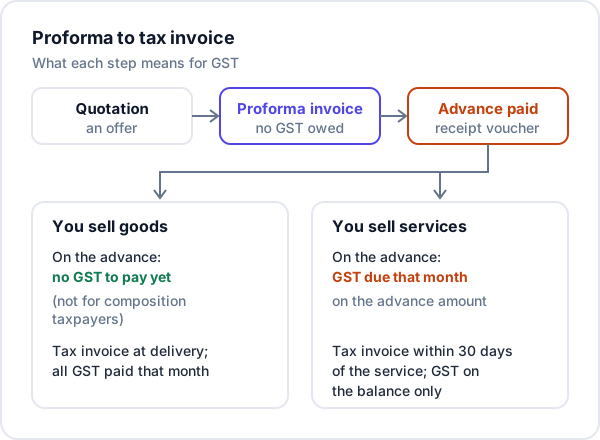
This is the step that trips people up. Money has arrived, but nothing has been supplied, so you cannot issue a tax invoice yet. GST law expects a receipt voucher for every advance (section 31(3)(d) of the CGST Act). It carries your name, address and GSTIN, its own serial number, the customer’s details, what the advance is for, the amount, and the tax rate and amount.
Whether you actually pay GST at this point depends on what you sell:
- Goods: a registered supplier of goods, other than a composition taxpayer, does not pay GST on the advance. The whole tax is paid when the tax invoice is issued. This comes from Notification 66/2017-Central Tax, explained in the GST Council’s flyer on time of supply.
- Services: GST is due on the advance in the month you receive it, because the time of supply for services is the earlier of the invoice and the payment.
A worked example
Two made-up businesses in Nashik each send a proforma for ₹1,18,000 including 18% GST and ask for a 50% advance. Each receives ₹59,000 on 10 November.
| CCTV dealer (goods) | Interior designer (design fee, a service) | |
|---|---|---|
| Advance received | ₹59,000 | ₹59,000 |
| Document on 10 Nov | Receipt voucher | Receipt voucher |
| GST payable for November | Nil on the advance | ₹9,000 (59,000 × 18 ÷ 118) |
| When the job is done | Tax invoice for ₹1,18,000; GST of ₹18,000 paid for that month | Tax invoice for ₹1,18,000; only the remaining ₹9,000 GST is due, as ₹9,000 was already paid |
Treat this as an illustration, not tax advice. Mixed supplies (a solar system with installation, cameras with an installation charge) and composition taxpayers have their own answers, so confirm yours with your accountant once and then follow it every time.
If the order is cancelled
If you took an advance, issued a receipt voucher and the deal falls through, the law provides a refund voucher (section 31(3)(e)) when you return the money. It only works if a receipt voucher was issued in the first place, which is one more reason not to skip it.
Six mistakes we see with proforma invoices
- Numbering the proforma in the tax invoice series. If the deal dies, your tax invoice series has a hole in it. Keep a separate PI series.
- Calling it “Invoice”. Write “Proforma invoice” at the top, clearly. A document that looks like a tax invoice causes confusion in the customer’s books and in yours.
- Never issuing the tax invoice. The customer paid in full against the proforma, the goods went out, and nobody raised the real invoice. The customer cannot claim credit, and your GST for the month is understated.
- No valid-until date. Steel, panels and cameras change price. Put a date on it, the way you would on a quotation.
- Recording the advance as a sale. Until supply, it is an advance held for that customer. Book it as a sale and your monthly figures, and possibly your tax, are wrong.
- Different numbers on the two documents without explanation. If the final quantity or rate changed, say so to the customer before the tax invoice goes out, and set the advance against it so the balance due is obvious.
When you do not need a proforma at all
Many small businesses use proformas out of habit. You can skip one when the customer pays on delivery, when your accepted quotation already shows the amount and GST and the customer is happy to pay against it, or for walk-in counter sales. Fewer documents means fewer chances for two of them to disagree. Where an advance is your main way of protecting cash, though, the proforma earns its place: it is the cleanest way to get paid before you spend on materials.
How Enkay CRM handles proformas and advances
In Enkay CRM, a proforma invoice is a draft invoice given a number from its own proforma series. It is not a tax document: nothing is owed and no stock moves. You send it to the customer, and when you issue it, it becomes the real tax invoice in your normal series, so the two always match. An advance can be recorded against the customer before any invoice exists and set against the invoice later, with a printable receipt.
What it does not do: it does not work out GST on an advance or produce a receipt voucher with a tax breakup, does not file returns, and does not generate e-invoices. If you supply services and owe GST on advances, your accountant still handles that part. Proformas, invoices and payments are part of quotations and invoices on the Basic and Standard plans; see pricing.
The short version
Proforma invoice vs tax invoice comes down to one question: has the supply happened? Before it, send a proforma in its own series with a valid-until date. When an advance arrives, issue a receipt voucher, and pay GST on it now only if you supply services. At delivery, or within 30 days for a service, issue the tax invoice, set the advance against it, and send the customer the balance.
Frequently asked questions
Is a proforma invoice valid under GST?
A proforma invoice is not a GST document at all. The GST law does not define it, it creates no tax liability, and it does not go into your GST returns. It is a commercial document: a firm price and terms sent before the sale, usually so the customer can pay an advance or get approval. The tax invoice is the GST document.
Can a buyer claim input tax credit on a proforma invoice?
No. Input tax credit needs a tax invoice (or another document the law allows, such as a debit note). A proforma invoice is not one of them. If a business customer asks for something to claim credit on, they need your tax invoice, issued in your normal series.
Do I have to charge GST on an advance paid against a proforma invoice?
It depends on what you sell. A registered supplier of goods, other than a composition taxpayer, does not pay GST when the advance arrives; the tax is due when the tax invoice is issued. A supplier of services pays GST on the advance when it is received. In both cases you issue a receipt voucher for the advance. Check your own case with your accountant.
Is a proforma invoice the same as a quotation?
They are close but not the same. A quotation is an offer the customer can negotiate. A proforma invoice usually comes after the customer has agreed, and is laid out like the final invoice so they can pay against it or get it approved by their accounts team or bank. Many small businesses send only one of the two, and that is fine.
Should a proforma invoice have its own number series?
Yes. Give proforma invoices their own series, for example PI/2026-27/014, and never take numbers from your tax invoice series. Tax invoice numbers must run in one unbroken sequence for the financial year, and a proforma that never turns into a sale would leave a gap.
How long is a proforma invoice valid?
As long as you say it is. There is no legal validity period because it is not a tax document. Write a valid-until date on it, for example 15 days, so a customer cannot pay months later at an old price.
Keep reading
Try Enkay CRM for 15 days
Every enquiry in one list, a follow-up date on each one, and your whole team on the same page. ₹49 for 15 days of the full Standard plan, unlimited users.