To collect payments faster, settle the payment terms before the work starts, take an advance where you can, send the invoice the same day the work is done with a UPI link on it, and remind on a fixed schedule that starts before the due date. Then have one person check what is owed every week. None of this needs new software. It needs the steps to happen every time, not only when cash is short.
Most late payments are not customers refusing to pay. They are invoices that went out a week late, did not say when payment was due, or arrived as a PDF with no easy way to pay. Fix those and the stubborn cases become a short list you can actually chase.
First, work out what slow payment costs you
One number tells you how slow your customers are: days of sales outstanding. Take what customers owe you today, divide by your average monthly sales, and multiply by 30.
An example. Say a CCTV and access-control dealer in Indore bills ₹6,00,000 a month and is owed ₹9,00,000 today. That is 9 ÷ 6 × 30 = 45 days. On average, the dealer waits a month and a half for every rupee.
If the dealer brought that down to 30 days, customers would owe about ₹6,00,000 instead of ₹9,00,000. That is ₹3,00,000 back in the bank, once, without selling anything extra. It is often the difference between paying the camera distributor on time and asking for another week. Work out your own figure before reading on; it makes the steps below feel less optional.
Nine ways to collect payments faster
1. Put the payment terms on the quotation
The cheapest time to agree on payment is before the customer has said yes. Write it on the quotation in plain words: “50% advance with order, balance on installation”, or “Payment within 15 days of invoice”. A customer who accepted those terms is far easier to remind than one who never saw them.
2. Take an advance
An advance does two jobs: it covers your material cost and it proves the customer is serious. Ask for it whenever you buy materials for a specific job. A proforma invoice is the clean way to ask for one, and it matters for GST if you supply services.
| Type of work | Common terms | Why |
|---|---|---|
| Installation with bought-in material (solar, CCTV, AC, interiors) | 40–60% advance, balance on completion | You pay suppliers before the customer pays you |
| Small repair or service visit | Full payment on the spot | The amount is too small to chase later |
| Annual maintenance contract | Full amount, or half-yearly, in advance | The service is a promise for the year ahead |
| Regular supply to a business | 7–30 days credit, in writing | Business buyers expect credit; agree the limit |
| Project over several weeks | Stage payments tied to milestones | Never let unpaid work pile up past one stage |
These are typical arrangements, not rules. Your trade and your customers decide what is normal, but write yours down and use them every time.
3. Invoice the same day
Every day between finishing the job and sending the invoice is a day added to the payment. Customers also pay most willingly when the work is fresh and they are happy with it. Make sending the invoice part of finishing the job, not part of a weekly admin session.
4. Make paying take ten seconds
Put a UPI link or QR code on the invoice and send it on WhatsApp, where the customer already is. Bank details at the bottom of a PDF still work for business customers, but a household customer who has to type an account number will do it “later”.
5. Write the due date, not “payable immediately”
“Due on 18 November” is a date the customer can put in their head. “Net 15” or “immediately” is easy to drift past. A real date also gives your reminders something to point to.
6. Remind on a fixed schedule
The schedule below works for most small businesses. The key step is the first one: a reminder before the due date is a courtesy, not a chase.
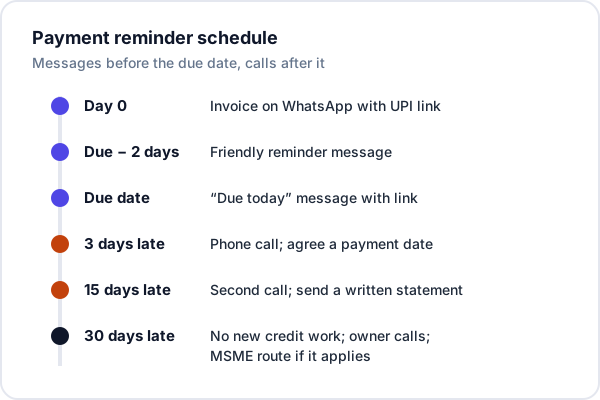
Messages you can adapt:
- Two days before: “Hello Mr Joshi, a reminder that invoice INV/2026-27/112 for ₹42,500 is due on Thursday. You can pay here: [link]. Thank you.”
- On the due date: “Hello Mr Joshi, invoice INV/2026-27/112 for ₹42,500 is due today. Payment link: [link]. Please tell me if anything on the invoice needs checking.”
- After a call, 15 days late: “As discussed, attached is your statement showing ₹42,500 outstanding since 18 November. You mentioned payment by Friday; I have noted that date.”
The line “tell me if anything needs checking” is deliberate. A customer who is unhappy with the work often goes quiet instead of complaining. Inviting the problem out early gets it fixed and gets you paid. More templates for other stages are in follow-up message templates.
7. Call after the due date
Messages are good for reminders and bad for collections. On a call you learn the real reason: the cheque is waiting for a signature, the accounts person is on leave, the customer is disputing one item. Each of those has a different fix, and you agree a date before you hang up. Then write that date down where you will see it.
8. Give one person the job
In many small businesses everyone assumes someone else is chasing. Name one person, give them half an hour every Monday, and have them go through what is owed, oldest first. The list to work from is an ageing report: amounts owed grouped by how late they are (not yet due, 1–30 days, 31–60, over 60). The over-60 column is where money stops coming back, so it gets the first calls. Our post on sales reports for a small business covers what else is worth checking weekly.
9. Stop new credit work for customers who are well overdue
It is uncomfortable, and it is the step that works. A customer 30 days overdue who orders again gets the new job on advance or cash, explained politely: “Happy to do this; we will need the earlier invoice cleared first.” Customers who value the work pay. Customers who do not were costing you money.
Why early-payment discounts are usually a bad deal
The common advice is to offer 2% off for paying early. Do the sum first. If a customer pays a ₹1,00,000 invoice 20 days early to save ₹2,000, you have paid ₹2,000 to have ₹98,000 three weeks sooner. Over a year that works out to roughly 2 ÷ 98 × 365 ÷ 20 = 37%. Few business loans cost that much.
Worse, the customers who take the discount are often the ones who would have paid on time anyway. A discount is worth it only if you need cash urgently and have no cheaper way to get it. An advance is almost always the better tool.
The MSME 45-day rule: what it allows you to do
If your business is a micro or small enterprise registered on Udyam, and you sell to another business, the MSMED Act gives you real leverage:
- The buyer must pay within the period agreed in writing, and that period cannot be longer than 45 days from accepting the goods or service. With no written agreement, the limit is 15 days.
- Late payments carry compound interest with monthly rests at three times the RBI bank rate, whatever your agreement says.
- You can file a delayed-payment case online with the Micro and Small Enterprises Facilitation Council. The MSME Samadhaan page explains the process; new applications now go through the MSME online dispute resolution portal.
Two honest limits. The rule does not help with households, only business buyers. And filing a case usually ends the relationship, so most businesses use the rule as a calm sentence in a reminder (“as a registered MSME, payments are due within 45 days”) long before they use the portal. Put your Udyam number on your invoices so business buyers know it applies.
What not to do
- Do not stop chasing because the customer is a friend or a big name. Large companies pay the suppliers who ask on time.
- Do not hold back the invoice until the customer “is ready”. The invoice starts the clock.
- Do not send the same reminder message five times. After the due date, change channel: call.
- Do not let payments sit unrecorded. A UPI payment that nobody marks against the invoice leads to an embarrassing reminder to a customer who has already paid.
Where Enkay CRM helps, and where it does not
Enkay CRM covers the steps that usually slip. When a quotation is accepted, it books a high-priority task for the next day to collect the advance and schedule the job. Invoices carry a UPI payment link and go out on WhatsApp with the message already written. You record payments against invoices, spread one payment across several invoices, and keep an advance on the customer’s account to set against a later bill. The Billing overview shows what is owed and overdue, who owes most and what falls due next week; a report groups money owed by age, and a customer statement shows everything billed and received with a running balance.
What it does not do: it does not send reminders on its own (the WhatsApp button on an overdue invoice writes the reminder and counts how many were sent, but a person sends each one), it is not connected to your bank to mark payments automatically, and there is no online payment gateway. These features are part of quotations and invoices on the Basic and Standard plans; see pricing.
The short version
To collect payments faster, agree terms on the quotation, take an advance for any job with material, invoice the same day with a UPI link and a real due date, remind two days before the due date, call after it, and have one person check what is owed every Monday. Work out your days of sales outstanding today and again in three months; the difference is money you did not have to borrow.
Frequently asked questions
What is the fastest way to get a customer to pay?
Make paying the easiest thing for them to do today. Send the invoice the day the work is done, with the amount, the due date and a UPI link or QR code on it, so the customer can pay from the same WhatsApp message. Most late payments are invoices that arrived late, were unclear, or needed effort to pay.
How many days should I give a customer to pay?
As few as your trade accepts. For homes and one-off jobs, ask for payment on completion. For businesses, 7, 15 or 30 days is common. If you are a registered micro or small enterprise, a business buyer must pay within the agreed period, which cannot be more than 45 days, or within 15 days if nothing was agreed in writing.
Should I offer a discount for early payment?
Rarely. A 2% discount for paying 20 days early costs you the same as borrowing at well over 30% a year. Ask for an advance instead, or charge a fair price and enforce the due date. A discount makes sense only if you badly need cash this week and have no cheaper way to get it.
How do I remind a customer about payment without sounding rude?
Send the reminder before the due date, not after, and keep it short and factual: invoice number, amount, due date and the payment link. After the due date, call rather than message. A polite reminder sent on schedule reads as organised, not rude.
What can a small business do if a business customer simply will not pay?
First, stop new work on credit for that customer and send a written statement of what is owed. If you are a micro or small enterprise with Udyam registration, you can file a delayed-payment case online with the MSME Facilitation Council, and the buyer owes compound interest at three times the RBI bank rate on late amounts. For large sums, speak to a lawyer.
Does Enkay CRM send payment reminders automatically?
No. On an overdue invoice, the WhatsApp button writes the reminder message for you and the invoice records how many reminders were sent and when, but a person sends each one from their own phone. There are no automatic WhatsApp, SMS or email reminders.
Keep reading
Try Enkay CRM for 15 days
Every enquiry in one list, a follow-up date on each one, and your whole team on the same page. ₹49 for 15 days of the full Standard plan, unlimited users.