To track sales team activity in a small business, ask each salesperson for five numbers at the end of every day: new enquiries called, customers actually spoken to, visits done, quotations sent, and follow-ups done out of those due. Take them in one short WhatsApp message at a fixed time, and spend ten minutes on them the next morning. That is enough for a team of two to ten. You do not need GPS, call recording or a screen-watching tool.
The rest of this post gives the message format to copy, works one salesperson’s week through in numbers, and covers what most pages on the subject skip: how tracking goes wrong, and when it does more harm than good.
Activity is not outcome, and tracking is not surveillance
Two distinctions do most of the work here.
Activity and outcome. An order is an outcome. It arrives days or weeks after the work that earned it, and it depends partly on things the salesperson does not control: the customer’s budget, a competitor’s price, the season. Activity is what the salesperson did today. If you look only at orders, you find out about a bad month when it is over. Activity is the part you can still correct on Wednesday.
Tracking and surveillance. Tracking records the work: this customer was called, this site was visited, this quotation went out. Surveillance watches the person: where their phone is, what is on their screen, what they said on a call.
| Tracking the work | Watching the person | |
|---|---|---|
| What is recorded | Calls, visits, quotations and follow-ups, against a customer | Location, screen, call audio, hours |
| Who records it | The salesperson | A device, without being asked |
| What it tells you | Whether selling is happening and where it stalls | Where a phone was |
| What the team learns | That the work is noticed | That they are not trusted |
A dot on a map outside a customer’s gate does not say whether anyone was met, what was asked for or what happens next. A two-line note does.
Five numbers that track sales team activity
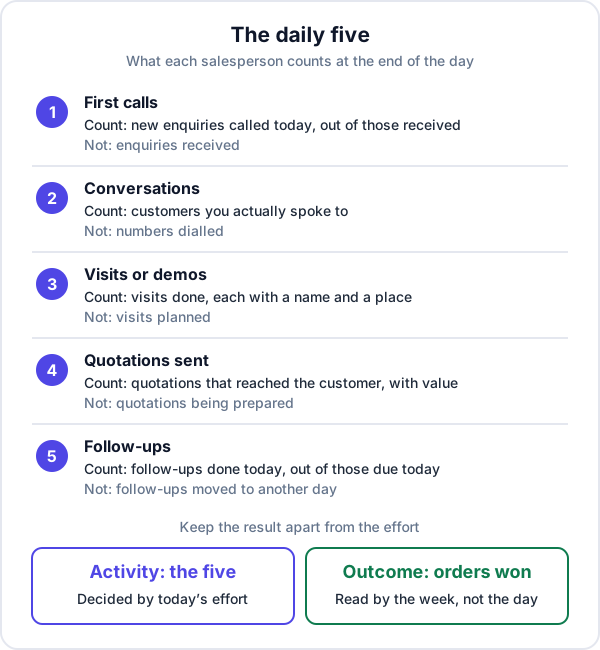
- First calls. New enquiries called today, out of those received. An enquiry from IndiaMART or JustDial that waits till tomorrow has often spoken to another seller by then.
- Conversations. Customers actually spoken to. Not dials, not “switched off”, not a message with one grey tick.
- Visits or demos. Done, not planned, each with a customer name and a place.
- Quotations sent. Ones that reached the customer, with the value.
- Follow-ups. Done today, out of those due today. Moving a follow-up to next week is not doing it.
Orders won and their value go on the same message, on a separate line. Five is deliberate. Fifteen numbers get filled in for a week and guessed at after that.
An end-of-day update you can copy
This is a made-up example. Change the names and figures.
Amit - Tue 6 Oct
New enquiries: 4 received, 4 called
Spoke to: 11 customers
Visits: 1 (Sharma Clinic, Dharampeth)
Quotations sent: 1 (Q-0231, Rs 48,000)
Follow-ups: 5 done of 6 due
Orders: 0
Stuck: Sharma Clinic wants 3-year battery warranty. Need your call.
Tomorrow: 2 visits, Hingna Road side
A few rules make it work:
- Same time every day. Say 6.30 pm, sent to the owner or a small sales group.
- Same lines in the same order, so you can read six of them in two minutes.
- Names on visits and quotations. A count with a name can be checked. A bare count cannot.
- The “Stuck” line matters most. It is the one place the report asks for help, and it is why a salesperson has a reason to send it.
- Acknowledge it. A thumbs-up or one line back. A report nobody reads stops coming within a fortnight.
The message is a summary. The detail belongs on each lead: a note of what was said and a next date, written straight after the call or visit. Our post on CRM habits for field sales teams covers that one-minute update.
How to read one salesperson’s week
A made-up example. An inverter and battery dealer in Nagpur has two salespeople on similar enquiries. Their six daily messages add up like this.
| Mon to Sat | Amit | Sneha |
|---|---|---|
| New enquiries called / received | 17 / 18 | 15 / 16 |
| Conversations | 62 | 31 |
| Visits done | 3 | 7 |
| Quotations sent | 2 | 6 |
| Follow-ups done / due | 21 / 24 | 19 / 20 |
| Orders won | 0 | 2 (₹1.1 lakh) |
On calls alone, Amit is the harder worker: twice the conversations. Read across instead of down. Amit gets one visit from about every 21 conversations (62 ÷ 3). Sneha gets one from about every 4 (31 ÷ 7). His first calls and follow-ups are fine. The work stalls between talking and visiting.
Many calls with few quotations usually means one of three things:
- He is not asking for the visit. The calls end with “I will send details”.
- He is ringing the same friendly customers who are not going to buy.
- His enquiries are weaker than hers. Check where each one’s leads came from before blaming the person.
None of these is fixed by “make more calls”. Sit beside him for three calls, read his notes on ten leads, and the cause shows itself. The opposite pattern is as readable: many quotations and few follow-ups done means prices are going out and nobody is chasing them, which our post on a sales follow-up process deals with.
One week is thin evidence. Look for the same shape two weeks running before you say anything. The weekly and monthly view, across the whole team, is a separate subject covered in the sales reports an owner should check.
The ten-minute morning review
- Before it, alone (2 minutes). Read last night’s messages. Mark one thing per person: a stuck line, a missed follow-up, a good visit.
- Overdue first (3 minutes). Each person names yesterday’s follow-ups that were not done and when today they will be. This is the core of not missing follow-ups.
- Today (3 minutes). Visits fixed, quotations to go out, who needs the vehicle or the demo unit.
- Stuck items (2 minutes). You decide on the spot: a price, a warranty term, a call you will make yourself.
Stand up, start on time, and take anything longer with one person afterwards. Do not read out a ranking. The review is for unblocking today, not for judging yesterday.
What goes wrong
- Fake entries. A daily target of “30 calls” produces 30 calls on paper. Ask for counts that leave a trace, and ring two customers a week yourself, as a courtesy call: did our person come, do you have what you need? It is good service and a quiet check.
- Counting calls, not conversations. Dials reward redialling dead numbers.
- Punishing honesty. If the person who writes “Visits: 0” is shouted at, next week everyone writes 2. Ask what got in the way. The day you react badly to a true number is the day the numbers stop being true.
- The number becomes the job. Visits rise, orders do not. Keep reading activity next to outcomes.
- Comparing unlike work. A salesperson covering an industrial estate 30 km out will show fewer visits than one working the city centre.
- Asking and not reading. The commonest failure, and it is the owner’s.
Location tracking is a different decision
Many pages that rank for this subject sell an app that shows staff on a live map. Before choosing one, treat it as a separate question. A person’s location through the day is information about that person, not about your leads, so recording it raises consent and privacy questions. The rules on employee data are not something to guess at; ask your accountant or a lawyer how they apply to your business. At the least, tell people plainly what is recorded and when, and do not track outside working hours. Then ask what the map would tell you that a named visit and a customer’s confirmation would not.
When tracking hurts more than it helps
- You sell alone, or with one trusted person. Your order book already tells you everything.
- Sales take months. For a machine sold after six meetings, most days have nothing to count. Track the next step on each deal instead.
- You want it to catch someone. If the purpose is evidence against one person, have that conversation directly. Do not put six people on a report to watch one.
- You will not look at it. An unread report costs each salesperson ten minutes a day and tells them their time is cheap.
- The team is hitting its numbers and tells you early when something slips. Keep the “Stuck” line and drop the rest.
Where Enkay CRM fits, and where it does not
Enkay CRM records work on leads, not people’s movements. Every lead carries notes, an activity timeline and a next follow-up date with a note, so the detail behind the evening message has a home. Each person’s Today screen lists overdue follow-ups above today’s, plus open leads with no follow-up at all, which is most of the morning review already laid out. Tasks cover the rest. The dashboard has a trend line of leads, won and follow-ups done, and the median response time. A salesperson can log a call on a lead with its outcome (interested, connected, call back later, no answer, busy, switched off or wrong number), and each attempt goes on the lead’s timeline. On the Business plan the team performance report then shows, for each person over the period you pick, leads received, how many were called, the usual time to the first call, quotations sent, deals won and their value. Roles decide who has the “see every lead” permission; team management in Enkay CRM explains both.
The limits, plainly: no GPS or location tracking, no call recording, no attendance, no screen monitoring, and no capture of WhatsApp messages. Nothing is picked up from the phone itself: a call exists in Enkay CRM only when the salesperson logs it, and a visit only as a note. The report counts leads called over a period, not each day’s conversations or visits. The evening message still does that. Reminders show inside the app only.
The short version
To track sales team activity without turning into a watchman, count five things a day per person: first calls, conversations, visits, quotations sent and follow-ups done. Take them in one fixed-format message, keep orders on a separate line, and read across the numbers to see where the work stalls. Spend ten minutes each morning on overdue items and stuck ones. React calmly to a bad number, or you will stop getting true ones. Start tomorrow evening with the format above, run it for two weeks, and then decide which lines your business really needs; the longer-run figures are in our post on CRM metrics for a small business.
Frequently asked questions
How do I track my sales team’s daily activity?
Ask each salesperson for five numbers at the end of the day: new enquiries called, customers actually spoken to, visits done, quotations sent, and follow-ups done out of those due. Take them in one short message at a fixed time, read them the same evening, and spend ten minutes on them the next morning.
What should a daily sales report include?
The salesperson’s name and the date, the five activity counts, orders won with their value, one line on anything stuck that needs the owner, and the plan for tomorrow. Visits and quotations should carry a customer name, so the report can be checked. It should fit on a phone screen without scrolling.
What is the difference between sales activity and sales results?
Activity is what a salesperson does today: calls, visits, quotations, follow-ups. Results are orders and money, which arrive days or weeks later and depend partly on things outside the salesperson’s control. Track activity daily because it can still be corrected; read results by the week or the month.
Do I need a GPS app to track field salespeople?
Not to know whether selling is happening. A location tells you where a phone was, not whether a customer was met or what was said. A visit recorded with a customer name, a place and a note, checked now and then with a courtesy call to the customer, tells you more. Location tracking also raises consent and privacy questions.
How do I know the numbers are not made up?
Ask for counts that leave a trace. A visit has a customer name and a place. A quotation has a number and a value. Then ring two customers a week to ask whether they got what they needed. Most invented entries come from daily targets that punish a low number, so check your own reaction first.
How many calls should a salesperson make in a day?
There is no honest single figure. It depends on the trade, the size of the order and whether the day includes site visits. Compare each person with their own earlier weeks, and count conversations, not dials. Twelve real conversations are worth more than forty calls nobody answered.
Does Enkay CRM track calls, location or attendance?
Not automatically. Enkay CRM has no GPS or location tracking, no call recording, no automatic call log from the phone, no attendance, no screen monitoring and no capture of WhatsApp messages. A salesperson can log a call on a lead by hand with its outcome, and it goes on that lead’s timeline. On the Business plan, the team performance report shows for each person the leads received, how many were called, the time to the first call, quotations sent and deals won.
Keep reading
Try Enkay CRM free
Every enquiry in one list, a follow-up date on each one, and your whole team on the same page. Free for one user — not a trial, no credit card.