The sales reports a small business owner needs each week come to five: follow-ups overdue, enquiries in by source, quotations sent and still open, orders won and lost with reasons, and money invoiced, collected and overdue. Read in that order they take 20 to 30 minutes. Each one should end in a decision, or in “nothing to change this week”.
Most lists of sales reports are written for a sales manager with a team, a quota and a dashboard, and run to a dozen report types or more. Others are billing formats: invoice-wise, item-wise, GST-wise. This post is the owner’s version. It covers which reports to open, in what order, the question each one answers and what you do about it. The numbers themselves and their formulas are in our post on CRM metrics for small businesses.
What is a weekly sales report for?
A weekly sales report exists to catch what can still be fixed this week: a call not made, a quotation nobody chased, an invoice sliding past its due date. It is not for judging the business; that needs a month or a quarter of figures. If a report cannot change what someone does by Friday, move it to the monthly review.
The five sales reports a small business should check weekly
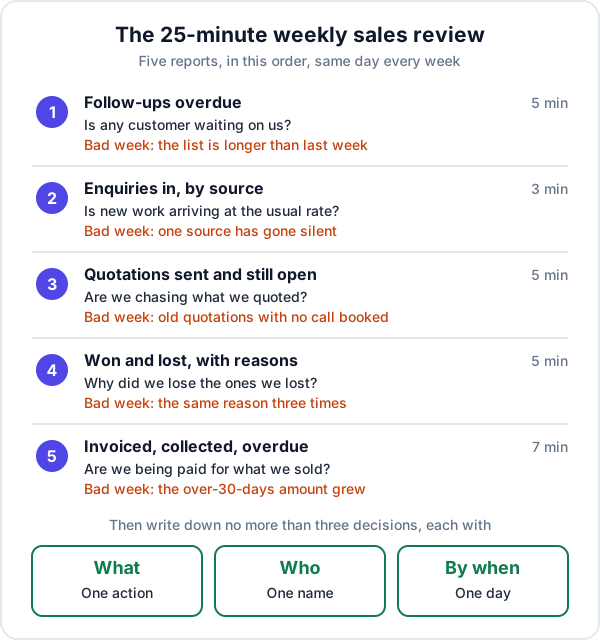
| Report | The question it answers | What a bad week looks like | The decision it leads to |
|---|---|---|---|
| 1. Follow-ups overdue, and open leads with no next date | Is any customer waiting on us? | More overdue than last week, or the same names still on the list | Who clears them and by which day; dead leads closed with a reason |
| 2. Enquiries in, by source | Is new work arriving at the usual rate? | Well under the four-week average, or one source suddenly silent | Check the listing or form that went quiet. No change in spend on one week’s count |
| 3. Quotations sent this week, and those still open | Are we quoting what we visited, and chasing what we quoted? | Visits done but not quoted; open quotations older than ten days with no call booked | Pending quotations out within a day; a follow-up date on every open one |
| 4. Won and lost, with reasons | What closed, and why did we lose the rest? | The same reason three times, or no losses recorded at all, which means dead leads are being left open | One thing to try next week, such as a price range in the first message |
| 5. Invoiced, collected and owed by age | Are we being paid for what we sold? | Collected far below invoiced; the amount overdue by more than 30 days growing | Who calls which customer, today |
Why this order
The order follows an enquiry through its life: it arrives, it is chased, quoted, closed and paid for. Overdue follow-ups come first because they are the only report where every day of delay costs something, and fixing them is free. Money comes last because it takes longest and ends in phone calls.
End with three decisions, not ten
Write down no more than three decisions, each with one action, one name and one day. Next week, start by reading last week’s three aloud.
A worked example: one week at a kitchen equipment supplier
This is a made-up example. Say a commercial kitchen equipment supplier in Indore sells to restaurants and caterers, with the owner, one salesperson and an accounts assistant. On Monday morning the owner’s sheet reads:
| Line | Last week | Usual week (average of the last four) |
|---|---|---|
| Follow-ups overdue | 14 | 5 |
| New enquiries | 22 (IndiaMART 12, JustDial 4, website 2, phone and referral 4) | 24 |
| Quotations sent | 9, worth ₹6,40,000 | 8 |
| Quotations still open | 17, six of them older than ten days | 12 |
| Orders won | 3, worth ₹1,85,000 | 3, worth ₹2,10,000 |
| Leads lost | 6: no response 4, price 1, bought elsewhere 1 | 5 |
| Invoiced | ₹2,30,000 | ₹2,00,000 |
| Collected | ₹1,20,000 | ₹1,90,000 |
| Overdue by more than 30 days | ₹3,10,000, up from ₹2,60,000 | – |
How the owner reads it
Enquiries, quotations and orders are all within a normal week. On those lines the decision is to leave things alone.
Two lines are not normal. Overdue follow-ups are nearly three times the usual, because the salesperson spent two days at an installation in Dewas. Four of the six lost leads were “no response”, and six quotations have sat for more than ten days. That is one problem seen from three sides: nobody chased.
The second is money. ₹1,20,000 came in against ₹2,30,000 billed, and the overdue pile grew by ₹50,000. The owed-by-age list shows ₹1,40,000 of it is past 60 days and sits with two restaurants.
The three decisions:
- The salesperson clears the 14 overdue follow-ups by Tuesday evening. The owner takes the six old quotations herself.
- The owner calls both restaurants on Monday about the ₹1,40,000.
- From this week, no further delivery to a customer with an invoice past 60 days without an advance.
Note what she did not do: question the IndiaMART subscription because enquiries were down by two.
How to build the weekly sales report in Excel
Without a CRM you need two sheets. Enquiries, one row each: date, name, phone, source, value, stage, next follow-up date, quotation date, quotation amount, closed date, result (Won or Lost) and lost reason. Invoices, one row each: invoice date, number, customer, amount, due date, amount received and balance.
Put the week’s start date in cell N1 and its end date in N2. With the columns in the order above, starting at A:
Enquiries in the week   =COUNTIFS(A:A,">="&N1,A:A,"<="&N2)
Follow-ups overdue      =COUNTIFS(G:G,"<"&TODAY(),K:K,"")
Quotations sent, value  =SUMIFS(I:I,H:H,">="&N1,H:H,"<="&N2)
Won in the week, value  =SUMIFS(E:E,K:K,"Won",J:J,">="&N1,J:J,"<="&N2)
Owed past 30 days       =SUMIFS(G:G,E:E,"<"&TODAY()-30)   (Invoices sheet)
For enquiries by source and for lost reasons, use a pivot table filtered to the week. For the amount collected, add up the week’s receipts from the bank statement and the cash book; with part payments that is quicker and more reliable than a formula.
The formulas are the easy part. The report is only as good as the columns, and the two that go unfilled are the next follow-up date and the lost reason. When several people share the file it strains further, for the reasons in our post on moving from Excel to a CRM.
Weekly or monthly: which report goes where
Weekly for what you can act on within days. Monthly for rates and comparisons, which need more results behind them.
| How often | Reports | Why |
|---|---|---|
| Weekly | The five above | Each can be acted on within days |
| Monthly | Win rate by source, quotation acceptance and days to accept, lost reasons grouped, team performance, best sellers, GST summary | A week holds too few wins and losses for a rate to be steady |
| Quarterly | Cost and revenue per source, before renewing a paid listing | Slow deals take weeks to close; see tracking lead sources |
Team performance sits in the monthly row on purpose. Who called whom today is a different job from the owner’s review, and we cover it in tracking sales team activity.
What goes wrong with weekly sales reports
- Reports nobody acts on. The figures are read out, everyone nods, and nothing is written down.
- Vanity totals. Total enquiries, total quotation value and total pipeline value all rise when nobody closes dead leads. Count what is new, what is decided and what is overdue.
- Comparing unlike weeks. A five-day week against Diwali week, or against a week with a bandh and a long weekend, tells you about the calendar. Compare with the average of the last four weeks, and in season with the same week last year.
- Tiny numbers treated as trends. Two orders after three is not a 33% fall. It is one order.
- Invoiced mistaken for money. A record billing week with nothing collected is a week you funded your customers.
- Definitions that drift. Decide once whether the week runs Monday to Sunday, and whether “won” means the customer said yes or the advance arrived. Then leave it.
The limits of weekly numbers when volume is low
Be honest about what a week can show. If you win two or three orders a week, the weekly count will bounce between one and five for no reason at all. A rule of thumb we use: when a count is in single digits, read the list behind it, not the number.
For anything expressed as a rate, wait until about 30 results have been decided before drawing a conclusion. For many small businesses that is a month or a quarter. A rolling four-week total, updated each Monday, is steadier than a single week and still current.
If you get five enquiries a week, skip the weekly numbers altogether. Walk the open leads one by one, as in our post on tracking your sales pipeline, check the overdue invoices, and do the counting once a month. And no report explains why a customer went quiet. It tells you where to look; the phone call tells you the rest.
Where Enkay CRM fits, and where it does not
In Enkay CRM, from Enkay Technologies, the Today screen is report one: overdue follow-ups, today’s, and open leads with no follow-up at all. The dashboard, on every plan, can be set to the last 7 days and shows new leads, deals won, follow-ups done, pipeline counts, leads by source, money figures and the median response time. Set it to 30 days and divide by four for a rough usual week. On the Business plan the reports add quotations (acceptance rate and days to accept), why deals were lost, invoiced and collected, and money owed by age, along with the monthly ones: win rate by source, team performance, best sellers and a GST summary.
The limits: nothing is scheduled or emailed, so the review happens only if you open the app. There is no custom report builder; for your own layout, export leads and customers to CSV. There are no targets or quotas to measure against. The three decisions are still yours to write down.
The short version
The sales reports a small business needs every week are five: follow-ups overdue, enquiries by source, quotations sent and open, won and lost with reasons, and money invoiced, collected and overdue. Read them in the same order on the same day, compare with the last four weeks, and stop at three decisions with a name and a day on each. Leave rates and source comparisons to the month. Try it this Monday with whatever records you have; the gaps you find in the sheet are the first useful result.
Frequently asked questions
What sales reports should a small business track?
Five are enough for a weekly review: follow-ups overdue, enquiries in by source, quotations sent and still open, orders won and lost with reasons, and money invoiced, collected and owed by age. Rates such as win rate by source, quotation acceptance and team performance are better read monthly, because a week holds too few results.
What should a weekly sales report include?
Counts and rupee amounts for the week beside the usual week: new enquiries by source, quotations sent, orders won, leads lost with the reason, amount invoiced, amount collected and the amount overdue by more than 30 days. Add the number of overdue follow-ups, and end with up to three decisions, each with a name and a day.
What is a simple sales report format for a small business?
One page with three columns: the line, this week, and the usual week taken as the average of the last four. Seven or eight lines cover enquiries, quotations, won, lost, invoiced, collected and overdue. Under the table, write the decisions taken. A format with more lines than that tends to be filled in and not read.
How long should a weekly sales review take?
About 20 to 30 minutes if the figures are ready before you sit down. Five reports at three to seven minutes each, then five minutes to write the decisions. If it regularly takes an hour, the time is going into discussing individual customers, which belongs in the daily follow-up routine.
Should sales reports be weekly or monthly?
Both, for different things. Weekly reports are for what can still be fixed this week: overdue follow-ups, unchased quotations and overdue invoices. Monthly reports are for rates and comparisons: win rate by source, acceptance rate, lost reasons grouped, team performance and best sellers. Decisions about renewing a paid listing need a quarter.
Can I make a weekly sales report in Excel?
Yes. Keep one sheet with a row per enquiry and one with a row per invoice, with the dates, source, value, result and lost reason filled in. COUNTIFS and SUMIFS between a week-start and a week-end date give every line of the report, and a pivot table gives enquiries by source.
Does Enkay CRM email a weekly sales report?
No. Enkay CRM has no scheduled or emailed reports; you open the dashboard and the reports in the app. The dashboard can be set to the last 7 days, and on the Business plan there are reports for quotations, why deals were lost, invoiced and collected, and money owed by age.
Keep reading
Try Enkay CRM free
Every enquiry in one list, a follow-up date on each one, and your whole team on the same page. Free for one user — not a trial, no credit card.