Fair lead assignment in a small sales team needs three things: a rule everyone knows before the lead arrives, a rule nobody can bend for a particular lead (the owner included), and a monthly look at what each person received in rupees, not only in numbers. For most teams of two to ten, that means rotating ordinary enquiries in turn, handing out the few big ones in a separate turn, and keeping repeat customers with whoever served them.
This post compares six ways to assign leads to a sales team, works one example through in rupees, and sets out the rules that most guides skip: what happens on leave, when a lead is taken back, and who gets a customer who returns.
What “fair” means: count, value or chance
Salespeople and owners use the word for three different things, and most arguments about lead distribution are really arguments about which one is meant.
- Equal count. Everyone gets the same number of leads. Easy to check, and the only thing a plain rotation promises.
- Equal value. Everyone gets roughly the same rupee potential. This is what salespeople on commission care about. It is harder to arrange, because you rarely know a lead’s size when it arrives.
- Equal chance. Nobody chooses who gets the good one. The rule decides, and the rule was fixed before anyone saw the lead.
A workable target for a small team: equal chance on every lead, equal count over a month, and a check on value once a month so that bad luck is corrected before it becomes a grievance.
Six lead assignment methods compared
| Method | Fair when | Unfair when | Suits |
|---|---|---|---|
| Round robin (in turn) | Leads are similar in size and anyone can handle any of them | A few leads are ten times the rest, or people work different days | Office-based teams with steady portal and website enquiries |
| By area | Areas produce similar business, and are reviewed now and then | One person holds the industrial estate and another the old town | Field teams, where travel time decides how many visits fit in a day |
| By product or skill | The skill difference is real and each line brings enough work | “Skill” is a polite name for giving one person the larger product line | Mixed catalogues: solar and inverters, CCTV and access control |
| By source | Sources convert at similar rates | One person gets referrals and another gets cold portal leads | Teams where one source needs a habit, such as replying within minutes |
| Owner picks | The owner follows reasons they would say aloud, and volume is low | The same person keeps getting the big enquiries | Two or three people, a handful of leads a week |
| First to claim | Everyone is at a desk for the same hours and leads are alike | Field staff are on site while the office claims everything | Rarely a good standing rule; useful for leads nobody has touched |
These can be combined, and usually should be. Split by area or product first, then rotate inside each group. Our post on CRM habits for field sales teams covers the area split in more detail. If you assign by source, do it from figures and not from a feeling: tracking lead sources for a few months shows how unequal they are.
A worked example: equal counts, unequal money
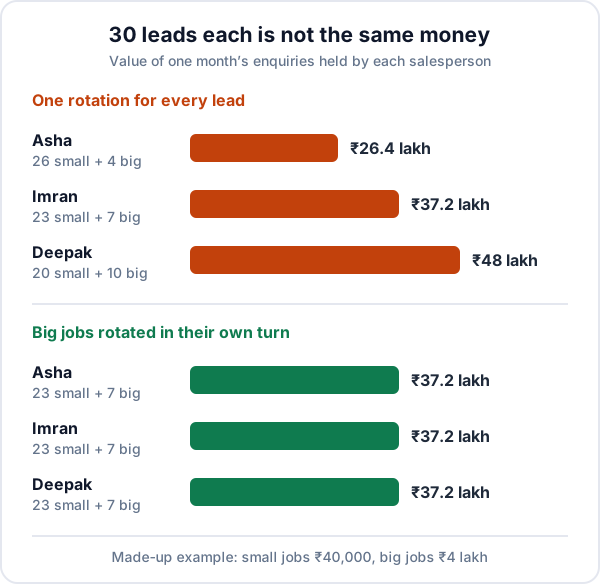
This is a made-up example. Say a solar and inverter dealer in Nashik gets 90 enquiries a month and rotates them strictly among three salespeople, 30 each. Of the 90, 69 are home jobs worth about ₹40,000 and 21 are commercial jobs worth about ₹4 lakh. The rotation does not know which is which, so the big ones land where they land.
| Salesperson | Leads | Home jobs | Commercial jobs | Value of enquiries |
|---|---|---|---|---|
| Asha | 30 | 26 | 4 | ₹26.4 lakh |
| Imran | 30 | 23 | 7 | ₹37.2 lakh |
| Deepak | 30 | 20 | 10 | ₹48 lakh |
Each of them got 30 leads, and Deepak holds nearly twice the business Asha does. If all three win at the same rate, he earns nearly twice the incentive for the same work, and the owner will conclude that he is the better salesperson. Nobody cheated. Twenty-one large leads is simply too few for luck to even out in a month.
The fix is two turns instead of one. Rotate the home jobs among the three, and rotate the commercial jobs separately. Each person then gets 23 home and 7 commercial enquiries, worth ₹37.2 lakh. You need one fact at the moment of assignment, big or small, and a threshold the team has agreed, say ₹1 lakh. Where the size is not known until the first call, let the lead go out in the ordinary turn and keep a tally of big ones per person, so that whoever is behind gets the next.
Three rules every method needs
Whatever the method, assign quickly. A lead that waits half a day for the owner to decide whose it is has been treated worse than one assigned unfairly within five minutes. Then write down these three rules, because they are where a method that sounded fair starts to fail.
Leave and absence
- Someone on leave comes out of the turn for new leads from their last working day until they are back. The same applies to a weekly off.
- No make-up leads after a short absence. Giving a returning person ten at once guarantees that most are called late.
- Their open leads stay theirs. One named colleague makes the follow-ups that fall due.
- Decide beforehand who gets the credit if a covered lead is won. A common answer: the original owner, if the quotation had already gone out.
Stale leads
Define “stale” before anyone’s leads are taken away. A starting point you can adjust: no contact attempt by the end of the next working day, no follow-up date at all, or a follow-up more than seven days overdue. A stale lead goes back to whoever assigns and on to the next person in turn. The first owner does not get a replacement, which is what makes the rule bite. Seeing who has gone quiet is a subject of its own, covered in our post on tracking what your sales team does each day.
Repeat customers and referrals
A customer who bought before goes back to the person who served them, outside the turn. So does a referral from that person’s customer. They earned it, and the customer expects the same face. This only works if someone checks the phone number before a new enquiry is handed out. If the earlier salesperson has left, the lead goes into the ordinary turn.
What goes wrong in practice
- Cherry-picking. Whoever sees the leads first keeps the good ones and passes on the rest. It happens most where one salesperson also holds the IndiaMART login. The person who assigns should not be competing for the same leads.
- Hoarding. A salesperson sits on forty open leads, working eight, and refuses to give any up “because they may come back”. The stale rule above is the remedy, along with a limit on open leads with no next date.
- The owner’s favourite. The owner trusts one person and routes the large enquiries there without quite deciding to. The others notice within weeks. A count of big leads per person, visible to all, usually ends it.
- Swapping and gifting. Leads change hands privately. Allow it only through whoever assigns, so the record stays true.
- Judging before calling. Deciding a lead is poor from one line of text and assigning it accordingly. Call first; a simple lead score comes after the conversation, not before.
When not to rotate leads
Round robin lead assignment is a good default, not a law. Leave it alone when:
- The skills really differ. If one person can size a 50 kW plant and the others cannot, rotating that enquiry is unfair to the customer.
- Distance decides. Sending someone 25 km across the city for a turn’s sake costs a visit elsewhere.
- Volume is tiny. At five leads a week, the owner choosing with stated reasons is quicker and no less fair.
- Someone is new. A half share for the first month, with the reason given, is fairer to the leads and to the newcomer.
- The order is very large. Giving it to your strongest closer is a legitimate choice. Make it openly, above a stated value, and not as a habit.
Running the rule day to day
A two-person team can run all of this from a register with a tally column. Past three people, or once leads arrive from portals at all hours, the tally is the first thing to fall behind.
Where Enkay CRM fits, and where it does not
In Enkay CRM every lead has one assigned owner, and anyone whose role has the “assign leads and tasks” permission can assign or reassign it. On the Business plan, the Team page can share new leads in turn: each lead arriving from a connected source (IndiaMART, JustDial or the website form) goes to the next person who has “Gets new leads” switched on. Switch it off for someone on leave. Leads added by hand stay with whoever adds them, and with sharing off, leads arrive unassigned. Each lead carries a value in rupees, and the team performance report shows how each person is doing. Team management in Enkay CRM covers roles and permissions.
The limits are worth knowing before you plan around it. The turn is one plain rotation. Enkay CRM does not assign by area, product, source or value, has no weighted shares or caps, and cannot run a separate turn for big jobs. It does not take stale leads back or skip an absent person on its own; you reassign and flip the switch yourself. It does not route a returning customer to their earlier salesperson, though the lead page shows other leads with the same number so you can do it by hand. And it sends no WhatsApp, SMS or email alert when a lead is assigned; the lead appears in the person’s list inside the app.
The short version
Fair lead assignment is a published rule, applied to every lead, checked against rupees once a month. Rotate the ordinary enquiries, give the large ones their own turn, keep repeat customers with the person who won them, and write down what happens on leave and when a lead goes stale. Then count last month: leads per person, and the value of those leads per person. If the two columns tell different stories, your team has already noticed.
Frequently asked questions
What is lead assignment?
Lead assignment is deciding which person in the team is responsible for each new enquiry. A good rule gives every lead exactly one named owner within minutes of its arrival, and is known to the whole team before the lead comes in.
What is round robin lead assignment?
Round robin means leads are handed out in a fixed turn: the first lead to the first person, the second to the second, and back to the start after the last. Everyone gets the same number of leads. It does not make the leads equal in value, so a team that rotates still needs to check the rupee total each person received.
What is the fairest way to assign leads to a sales team?
For most teams of two to ten, rotate ordinary enquiries in turn, hand the few large ones out in a separate turn, and keep repeat customers and referrals with the person who earned them. The rule matters less than two conditions: everyone knows it in advance, and nobody, the owner included, can bend it for a particular lead.
Should the best salesperson get the best leads?
It may bring in more money this month, and it is a legitimate choice for a very large order. As a standing rule it has a cost: the others never get the practice, you cannot tell whether they are weak or only badly fed, and they leave. If you do it, say so openly and limit it to leads above a stated value.
What should happen to a salesperson’s leads when they are on leave?
Take them out of the turn for new leads from their last working day until they return. Their open leads stay theirs, with one named colleague making the follow-ups that fall due. Agree beforehand who gets the credit if a covered lead is won.
When should a lead be reassigned to someone else?
When it has gone stale by a definition the team agreed in advance, for example no contact attempt by the end of the next working day, or a follow-up more than seven days overdue. A stale lead goes back to whoever assigns and then to the next person in turn. The first owner does not get a replacement.
Does Enkay CRM assign leads automatically?
On the Business plan it can share new leads in turn. Each lead arriving from a connected source goes to the next person who has “Gets new leads” switched on. It does not assign by area, product, source or value, has no weighted turns, and does not move stale leads on its own. Those are done by hand by someone with permission to assign.
Keep reading
Try Enkay CRM free
Every enquiry in one list, a follow-up date on each one, and your whole team on the same page. Free for one user — not a trial, no credit card.