A CRM for agencies has two jobs. It makes sure every prospective client who asks for a proposal gets one, and then gets a follow-up instead of silence. And it makes sure every existing client has a renewal conversation booked before the contract runs out, not after. It does not run your projects, track your hours or manage approvals. That is what a project management tool is for.
Most agency CRM advice is written by vendors and lists every feature they sell. This post is narrower: where a small digital marketing, design or development agency actually loses money between the first call and the second year, what a CRM should record, what to keep out of it, and when you do not need one at all.
Why an agency sale is not like a shop sale
An agency does not sell a product off a shelf. It sells a promise about results, to people who have usually been let down by an agency before. That changes the sale in four ways:
- Every proposal is made to measure. Scope, channels, budget and timelines change for each client, so a proposal takes hours to write and is easy to leave unchased once it is sent.
- The proposal gets revised. “Can you do it without the video?” “What if we start with SEO only?” Two or three versions are normal, and the team needs to know which one is current.
- More than one person decides. The marketing manager likes you, the founder signs, and accounts asks about payment terms.
- The real money is in month seven, not month one. A retainer that renews for two years is worth many times the setup fee. Losing it quietly is the most expensive thing an agency does.
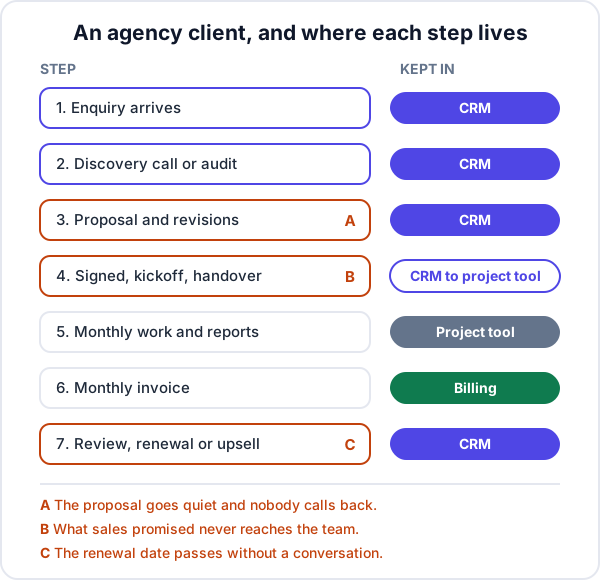
Where agencies lose clients
The proposal that goes quiet
You had a good discovery call, spent an evening on the proposal, sent it, and heard nothing. A week later someone else is busy, and the proposal is never mentioned again. Silence after a proposal rarely means no. It usually means the client is busy, comparing, or waiting for someone internally. The agency that calls on day two, asks what is unclear and offers a smaller first phase often wins against a cheaper one that never called.
The fix is a rule, not a feature: every proposal sent gets a follow-up date, and a second one before its validity runs out. Our post on writing a quotation that gets accepted covers what to put in the proposal itself.
The promise lost at handover
Sales says “we will have the first report ready by the 5th” and “you will get a weekly call”. The delivery team starts from the signed scope and never hears either promise. Two months in, the client feels let down by things nobody on the team knew about. Write the promises in the proposal, or in a handover note on the client record, and make the handover a meeting with the account lead in the room.
The renewal nobody booked
A six or twelve month retainer has an end date. If nobody books a review a month before it, the first conversation about renewal happens when the client says they are moving on. By then the decision is made. A renewal date on every client record, with a follow-up a month earlier, turns that into a planned conversation where you can show results and propose the next quarter.
The lost reason nobody wrote down
When an agency loses a pitch, it usually guesses why: price. Write down the real reason each time, from the client if they will say. After a quarter, the pattern is often something else: response time, no case study in their industry, a proposal that was too long, or scope the client did not understand. That is information you can act on. A guess is not.
A worked example: what one quiet retainer costs
This is a made-up example, not data from a real agency. Say an agency has 14 retainer clients paying an average of ₹45,000 a month, and two of them leave each year because nobody spoke to them before the renewal.
| Item | Figure |
|---|---|
| One average retainer, per year | ₹45,000 × 12 = ₹5,40,000 |
| Clients lost to a missed renewal, per year | 2 of 14 |
| Revenue that leaves with them | 2 × ₹5,40,000 = ₹10,80,000 a year |
| Proposals needed to replace them, if one in four is won | 8 new proposals, each several hours of work |
Compare that with the cost of keeping them: a review call a month before each renewal date, booked in advance. Even if the review only saves one of the two, it is worth more than most months of new business. Put your own numbers in: your client count, your average monthly fee, how many left last year without a real conversation first.
What a CRM for agencies should record
Keep it short. Every field you add is a field someone has to fill in on a busy Friday.
- Who and how to reach them: name, phone, email, company, and who actually signs.
- Where they came from: referral, your website, a LinkedIn post, an ad, an event. Agencies that track this often find most of their good clients come from referrals and their own site, not from the channel they spend most on. See tracking lead sources.
- What they asked for, in their words: “more leads from Google”, “a new website before the launch in March”.
- Budget range and timing, if they gave them.
- Stage, next step and next date. No open lead without a date.
- The current proposal, its value and validity, with earlier versions kept.
- For clients: start date, renewal date, monthly value, and promises made at signing.
- If lost: the reason.
What to keep out of the CRM
| Job | Better kept in |
|---|---|
| Enquiries, proposals, follow-ups, renewals, lost reasons | CRM |
| Tasks, deadlines, content calendars, approvals | Project management tool |
| Hours logged against a retainer | Time tracking tool |
| Campaign results and client reports | Ad platforms, analytics, your reporting tool |
| Invoices and payments | Your invoicing or accounts software, or a CRM that does invoices |
The temptation is to find one product that does all five. For a small agency, that often means a tool that does each job half well and takes months to set up. Two or three simple tools with a clean handover usually work better.
When an agency does not need a CRM
Be honest about this before paying for one. A freelancer or two-person studio with a handful of long-term clients, a few new enquiries a month and one person doing all the selling can run on a calendar and a short spreadsheet: name, source, next step, date, renewal date. The habit matters more than the software.
The signs you have outgrown that: proposals you forgot to chase, two people talking to the same prospect, a renewal that slipped past, or no answer to “where did our last five clients come from?”. If you are choosing between a free plan and a paid one, our comparison of free and paid CRMs sets out what you give up.
Where Enkay CRM fits, and where it does not
Enkay CRM, made by Enkay Technologies, is a general CRM for businesses that win work through enquiries. For an agency it covers the selling side:
- Enquiries from your website form arrive as leads automatically. Referrals, calls and messages are added by hand; a phone number is the only required field. Each lead holds the email, company, source, requirement and value.
- Every open lead has an owner and a next follow-up date, and the Today screen puts overdue ones first.
- On the Business plan, quotations have line items, revisions with history, and a share link the client can accept or decline online. Sending one books a follow-up two days later, and the client first opening the link brings it forward to today.
- Marking a lead Lost asks for the reason, and a report shows why you lose.
- Invoices can repeat monthly, quarterly, half-yearly or yearly; each run is raised as a draft for you to check and issue, which suits a fixed monthly retainer.
What it does not do for an agency:
- No project management. Tasks with a priority and due date exist, but there are no boards for deliverables, content calendars or client approvals.
- No time tracking, so no hours-used-versus-hours-sold on a retainer.
- No contract or renewal field with automatic reminders. Keep the renewal as a follow-up date on a lead linked to the client.
- Fixed pipeline stages: New, Contacted, Qualified, Site visit, Quotation, Negotiation, Won, Lost. Use Site visit for the discovery call or audit meeting.
- Reminders are inside the app only, not by email or WhatsApp, and there is no email inbox sync.
The Free plan is a real plan for one user. Business is ₹499 a month for the whole team. See pricing, or how it fits other trades on the industries page.
And your own website
Agencies are often the last to fix their own site: a portfolio that loads slowly on a phone, no clear way to enquire, a form whose emails go to one person’s inbox. If yours needs rebuilding, or you would rather hand off a client’s site than build it in-house, Enkay Technologies also does business website development, with the enquiry form connected to a CRM so no lead is lost on the way in.
Start with three things this week
Whatever CRM for agencies you choose, or none, these three habits keep the most revenue:
- List every proposal sent in the last 60 days with no reply, and call each one this week.
- Put a renewal date on every retainer client, and book a review a month before it.
- For the next ten lost pitches, write down the real reason. Read them together at the end of the quarter.
Frequently asked questions
What is a CRM for agencies?
It is software that keeps every prospective client, discovery call, proposal and renewal in one shared list, with a person and a next date against each. For a digital marketing, design or development agency it covers the selling side: winning the first contract and keeping existing clients renewing. Tasks, deliverables and hours belong in a project management tool.
Do small agencies need a CRM?
A solo freelancer with five steady clients usually does not; a calendar and a spreadsheet will do. Once you send more than a handful of proposals a month, have two people selling, or have lost a client because a renewal slipped past, a CRM pays for itself by making sure every open proposal and every renewal date has an owner.
What is the difference between a CRM and a project management tool for an agency?
A CRM tracks people and deals before and around the contract: enquiries, proposals, follow-ups, renewals and why you lost. A project management tool tracks the work after the contract: tasks, deadlines, approvals and hours. Some products try to do both. A small agency is usually better served by one good tool for each and a clean handover between them.
Can a CRM track retainers and renewals?
Most can hold the renewal date and a follow-up before it, and many can raise a repeating invoice each month. Fewer can compare hours used against hours sold, which needs time tracking. Decide which of those you actually need before choosing; the renewal conversation matters more than the hour count for most small agencies.
What should an agency record about every lead?
Who they are and how to reach them, where they came from, what they asked for in their own words, the budget range if they gave one, who decides, the next step and its date, and, if you lose, why. Those last two fields do more for an agency's win rate than anything else in the record.
Keep reading
Try Enkay CRM free
Every enquiry in one list, a follow-up date on each one, and your whole team on the same page. Free for one user — not a trial, no credit card.