A CRM for clinics does one job that the clinic software usually does not: it keeps track of people who have not become patients yet. Every enquiry, from a phone call, a WhatsApp message, a website form or a directory listing, goes into one list with a person responsible and a date for the next call. It stays there until the patient books, starts treatment, or says no and tells you why.
That matters most where a patient has to decide something: an implant, aligners, a hair or skin treatment, a fertility cycle, a physiotherapy package, a full-body check-up. Most of those enquiries are not lost to a better clinic. They are lost because nobody called back, nobody reminded the patient the day before, or nobody rang the person who said “let me think about it”. This post shows where the leaks are, what to record and what to keep out, and when a clinic does not need a CRM at all.
CRM, EMR or clinic software: which does what?
The three get mixed up on vendor pages, so it is worth being clear. Clinic management software and EMRs run the visit. A CRM runs the conversation before the first visit and between the consultation and the start of treatment.
| Job | Clinic or lab software / EMR | CRM |
|---|---|---|
| Appointment calendar | Yes | Usually not |
| Clinical notes, prescriptions, reports | Yes | No, and should not |
| Billing and receipts | Yes | Sometimes |
| Enquiries that have not booked | Rarely | Yes |
| Who calls back, and when | Rarely | Yes |
| Treatment plans not yet accepted | Sometimes, as a record | Yes, with a follow-up date |
| Which source brings patients who start | No | Yes |
If your clinic software already has a solid enquiry list with follow-up dates, use it before buying anything. Most do not, and the enquiries end up in the reception register, a WhatsApp chat list and the doctor’s memory.
Does your clinic need a CRM?
A simple test: is there a gap between the first enquiry and the patient’s decision, and does somebody need to call during that gap? If yes, a CRM earns its place. If patients walk in unwell and are seen the same day, it does not.
| Type of practice | Decision gap | Worth a CRM? |
|---|---|---|
| Walk-in general practice | None | No |
| Dental: implants, aligners, root canal plans | Days to months | Yes |
| Dermatology, hair and cosmetic clinics | Days to weeks; packages | Yes |
| Fertility and IVF | Weeks to months; two people decide | Yes |
| Physiotherapy and rehab packages | Days; sessions lapse | Yes |
| Eye surgery, such as cataract or LASIK | Weeks; family involved | Yes |
| Diagnostic centre: single test on prescription | Hours | Only for speed of reply |
| Diagnostic centre: check-up packages, corporate camps | Days to weeks | Yes |
Where patient enquiries leak
The diagram below is a made-up month at one clinic, but the shape will be familiar to anyone who has sat at a clinic reception. There are three leaks, and only one of them is about marketing.
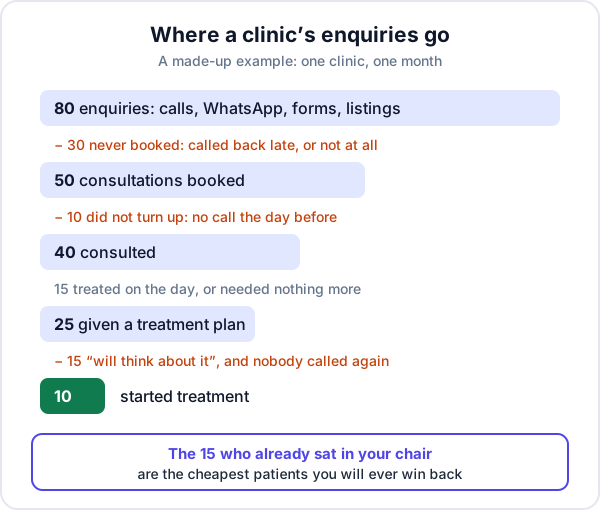
Leak 1: the call-back that comes too late
Someone searching for a dentist or a skin clinic usually messages two or three at once. The clinic that replies first with a sensible question (“which tooth, and is it painful now?”) usually gets the booking. Enquiries that arrive during a busy OPD hour, after closing or on Sunday are the ones that wait. Give one person at reception the job of clearing new enquiries every hour, and see how fast to reply to a new lead for targets by type of enquiry.
Leak 2: the booking that does not turn up
A short call or message the day before (“Dr Mehta at 5:30 tomorrow, please bring your old X-rays”) catches the patient who forgot or quietly changed their mind. If they cancel, you get the slot back and a reason. If they do not answer, rebook them while you have them on the phone the next time.
Leak 3: the treatment plan nobody followed up
This is the expensive one. A patient who has been examined, been told what they need and been given an estimate has done most of the deciding. When they say “I will discuss at home”, most clinics wait for them to call. Few do.
Give every plan a follow-up date before the patient leaves the building: two or three days for most treatments, a week for large ones. On that call, ask what is holding them back. The answer is usually one of four things: the cost, the fear, the time off work, or someone else at home who has to agree. Each has a different reply, and a set of follow-up message templates saves staff from inventing one every time.
A worked example in rupees
Take the made-up clinic above. Fifteen patients a month leave with a treatment plan they have not accepted. Say the average plan is ₹30,000. If a structured follow-up call on day three and again on day ten brings back three of those fifteen, that is ₹90,000 of treatment a month, from patients you had already spent the time and the consultation on.
Work out your own number: plans given last month, minus plans started, times your average plan value. Even a small share of that figure is usually more than a month’s advertising.
What to record, and what to keep out
A CRM for a clinic should hold what a receptionist needs to make the next call, and nothing more.
- Record: name, phone number, the treatment or package asked about, where the enquiry came from, who is responsible, the next follow-up date, and a short note such as “worried about cost, wants EMI option” or “husband to join next visit”.
- Record when it ends: started, or lost with a reason (cost, distance, timing, chose another clinic, not suitable for treatment).
- Keep out: diagnoses, test results, images, prescriptions and clinical notes. They belong in your clinical software, which is built and controlled for them.
Health information carries extra legal protection in many places. Under UK GDPR, for example, data concerning health is special category data. Rules differ by country and by profession, so check the ones where you practise. Keeping the CRM to contact and follow-up details keeps the risk small whatever the rules say.
Diagnostic centres: two kinds of customer
A diagnostic centre sells to patients and to organisations, and the two need different handling.
- Patients enquire about a single test, a check-up package or home sample collection. For prescribed tests the only thing that matters is answering fast with the price, timing and fasting instructions. Packages behave like clinic treatments: people compare, hesitate and need a follow-up.
- Organisations, such as companies booking an annual staff check-up or a housing society booking a health camp, behave like any business sale: a contact person, a quotation, a negotiation and a date. They are worth a pipeline of their own because one yes is worth hundreds of single tests.
Referring doctors are the third relationship, and a customer record per doctor with notes on each visit is often enough. Track which sources bring patients who actually come in, not just enquiries: a listing that brings many price-only calls may be worth less than one doctor who refers five patients a month.
Mistakes clinics make with a CRM
- Buying a system before choosing who owns follow-up. Software does not call anyone. One named person per shift has to clear the list.
- Logging only the enquiries that booked. The ones that did not book are the reason for having a CRM.
- Treating every enquiry the same. A price-only question about a blood test does not need three follow-ups. An implant plan does.
- No lost reasons. After a quarter, “cost” or “chose another clinic” tells you whether to offer instalments or look at your reviews.
- Copying clinical notes in. It feels thorough and creates a second place to protect.
Where Enkay CRM fits, and where it does not
Enkay CRM, from Enkay Technologies, is an enquiry and follow-up CRM, not clinic software. Website form and JustDial enquiries can arrive in the lead list automatically, and calls, walk-ins and WhatsApp enquiries are added by hand with a phone number as the only required field. Each lead carries a responsible person, a next follow-up date and notes, and the Today screen puts overdue calls first. The pipeline’s Site visit stage works as the consultation and Quotation as the treatment plan given. Marking a lead Lost asks for the reason, and on the Business plan the reports show conversion by source and by staff member. A WhatsApp chat or a call opens in one tap from the lead.
It does not book appointments, keep medical records, store reports or send reminders to patients by SMS, WhatsApp or email. The stages are fixed and cannot be renamed. Enkay Technologies holds no ISO or SOC 2 certification, so if your rules require a certified vendor for patient contact data, it is not the right choice. The follow-up screen shows how the daily call list works, the industries page shows how other trades set it up, and pricing starts with a free plan for one user.
Whichever tool you use, the habit is what counts: every enquiry in one list, a date on every open one, and a call to every patient who left with a plan. A CRM for clinics only makes that habit hard to forget.
Frequently asked questions
What is a CRM for a clinic?
A CRM for a clinic is a list of every patient enquiry with its source, the person responsible for it and the next date to contact them, followed through to a booked consultation and a started treatment. It handles the part before and between visits. Medical records, prescriptions, reports and billing belong in your clinic or lab software.
What is the difference between a clinic CRM and an EMR or clinic management software?
Clinic management software and EMRs run the visit: appointments, the patient’s clinical record, prescriptions, billing and, for a lab, the reports. A CRM runs the conversation before the visit and after the consultation: enquiries, call-backs, treatment plans the patient has not yet accepted, and why people said no. Many clinics need both, and some clinic software includes a basic version of the second.
Does every clinic need a CRM?
No. A walk-in general practice or a pharmacy-attached clinic, where patients come when they are unwell and are seen the same day, has nothing to follow up. A CRM pays off where there is a gap between enquiry and decision: dental, dermatology and hair, fertility, physiotherapy packages, eye surgery, cosmetic treatments, and health check-up packages at a diagnostic centre.
Is it safe to keep patient enquiries in a CRM?
Keep the CRM to what you need for follow-up: name, number, the treatment asked about, source and next date. Leave diagnoses, reports, images and prescriptions in your clinical software. Health information has extra legal protection in many places, so check the data protection rules where you practise and your professional body’s guidance before choosing any tool.
Can Enkay CRM book appointments or send reminders to patients?
No. Enkay CRM has no appointment calendar and sends no SMS, WhatsApp or email reminders on its own. It keeps every enquiry in one list with a next follow-up date, shows staff who to call today, and opens a WhatsApp chat or a call in one tap from the lead so the message is sent from your own phone.
Keep reading
Try Enkay CRM free
Every enquiry in one list, a follow-up date on each one, and your whole team on the same page. Free for one user — not a trial, no credit card.