A good lead response time for a small business is a real conversation within one working hour of the enquiry. For leads that went to several sellers at once, such as an IndiaMART buy-lead or a JustDial enquiry, aim for five to fifteen minutes. Enquiries that arrive after closing get a short acknowledgement that evening and a call first thing next morning.
Most pages on this topic stop at “five minutes” and a statistic. That number comes from US call-centre studies of web leads that are now 15 to 19 years old, and it is often misquoted. This post sets a target by type of lead, explains what the research actually measured, and shows how to measure your own speed from a register or spreadsheet, which is the only number that matters for your business.
What is lead response time?
Lead response time is the gap between an enquiry arriving and your first real contact with the person who sent it. Measure it per lead, then summarise it as the median for the week or month, the share of leads reached within one hour, and the number of leads nobody contacted at all.
Lead response time = time of first real contact − time the enquiry arrivedThe word that needs defining is “real”. More on that below, because it changes the number more than anything else.
How fast should you reply? It depends on the lead
One target for every enquiry is too strict for some and too slow for others. The question is how many other sellers the customer is talking to, and how soon they will decide.
| Type of lead | Target for a real conversation | Why |
|---|---|---|
| Marketplace buy-lead sent to several sellers (IndiaMART, JustDial) | 5 to 15 minutes | The buyer usually talks seriously to whoever calls first, and that seller sets the reference price |
| Your own website form or ad enquiry | Within 1 working hour | They may have filled in two or three forms; you are still in the first group to call |
| Inbound call you missed | Call back within 15 minutes | They wanted to talk now; the next number on their list is one tap away |
| Referral or repeat customer | Same day | They chose you already; speed matters less than turning up prepared |
| Large considered job (a tender, a full interior, a factory rooftop) | Same day, with a useful reply | The decision takes weeks; a thoughtful first call beats a rushed one |
| Anything arriving after closing or on a holiday | Acknowledge the same evening, call by 10 am next working day | Few people expect a call at 10 pm; most expect not to be forgotten |
If you sell through marketplaces, the first row is where most of the money is lost. We cover why in how to stop losing IndiaMART leads.
What the research actually found
Two studies sit behind nearly every statistic on this topic. Both are worth knowing properly, including their limits.
The HBR study (2011)
In “The Short Life of Online Sales Leads” (Harvard Business Review, March 2011), Oldroyd, McElheran and Elkington sent a test web enquiry to 2,241 US companies. 37% responded within an hour, 24% took more than a day and 23% never responded. Among those that replied within 30 days, the average was 42 hours. You will often see “47 hours” quoted; the article says 42.
A second part looked at 1.25 million leads at 42 US companies. Firms that tried to contact a lead within an hour were nearly seven times as likely to qualify it, meaning a meaningful conversation with a decision maker, as firms that tried an hour later, and more than 60 times as likely as firms that waited a day or more.
The “5 minute” study (2007)
The five-minute figure comes from the Lead Response Management study by InsideSales.com and Dr James Oldroyd (a printed copy of the original survives). It covered six companies, about 15,000 web leads and over 100,000 call attempts. Its headline: the odds of reaching a lead called within 5 minutes, rather than 30, were 100 times higher, and the odds of qualifying it 21 times higher.
What that means for a small business
- They are US web-form leads, handled by call centres, much of it mortgage and insurance. Not WhatsApp, not marketplaces, not a two-person business.
- They measured conversations, not sales. The 2007 study says plainly that it did not look at close rates.
- The direction is solid; the multipliers are not portable. Your own figures will not show “100 times”. They will show that leads reached on the first day close more often than leads reached on the third.
- The 2007 study also found that after about 20 hours, extra call attempts stopped helping. Past the first day, a message and a planned date work better than ringing again.
What counts as a response
There are three different things people call a response, and they give three very different numbers.
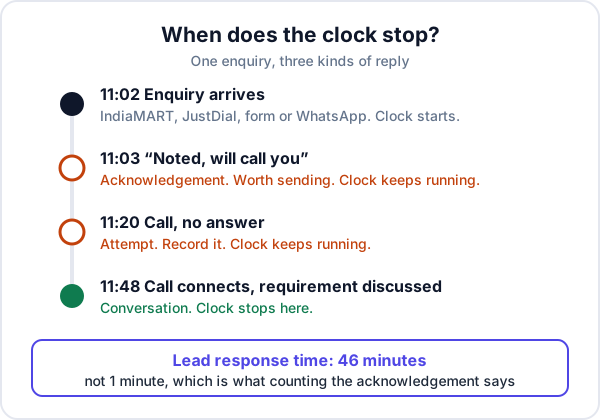
- Acknowledgement: “Thanks, noted, we will call you shortly.” Worth sending within minutes, especially out of hours. It is not a response.
- Attempt: a call that rang out, or a WhatsApp the customer has not answered. Record it, because it explains slow figures. It is not a response either.
- Conversation: you spoke, or exchanged messages about the actual requirement. This stops the clock.
Businesses that count the acknowledgement report two-minute response times and still lose leads. Count conversations. For acknowledgement wording you can copy, see our follow-up message templates.
How to measure your lead response time without software
You need two columns in the enquiry register or sheet: arrived (date and time) and first conversation (date and time). Take the arrival time from the IndiaMART or JustDial notification, the form email or the WhatsApp message, not from when someone noticed it.
Minutes to respond        =(B2-A2)*24*60
Median for the period     =MEDIAN(C2:C200)
Share within one hour     =COUNTIF(C2:C200,"<=60")/COUNT(C2:C200)
Never contacted           =COUNTBLANK(B2:B200)   (count only rows with an arrival time)
A worked example: why the average misleads
This is a made-up example. Say a CCTV dealer in Nashik logs ten enquiries in a week. The minutes to first conversation are 4, 7, 12, 15, 25, 40, 55, 90, 180 and 4,320 (one lead that arrived on Friday evening and was called on Monday).
| Summary | Result | What it tells the owner |
|---|---|---|
| Average | 475 minutes, about 8 hours | Nothing useful: one lead drags it up |
| Median | 32.5 minutes | A typical lead is reached in about half an hour |
| Within one hour | 7 of 10 | Three leads waited longer; look at those three |
| Slowest | 3 days, Friday evening | The real problem is weekends, not weekdays |
Use the median and the share within an hour together, and read the slowest few by name. The decision here is a Saturday-morning check of the weekend’s enquiries, not a lecture about speed.
How a team of one to three gets faster
Small businesses are slow for one reason: the person who answers leads is also the person on site, at the counter or doing the accounts. These fixes cost nothing:
- Name a lead-taker for each part of the day. “Before 2 pm Ritu, after 2 pm Amit.” When everyone is responsible, a lead waits for whoever looks first.
- Turn on the marketplace app notifications on the lead-taker’s phone, and get website enquiries to that phone, not to an email folder checked at night. Our post on sending website enquiries into a CRM covers the form side.
- Acknowledge in one minute, call within the hour. A saved WhatsApp message buys time honestly when you are on a ladder.
- Check at fixed times if you cannot watch all day: opening, 11, 2, 5 and closing. That alone caps most waits at three hours.
- Share leads in turn when there is more than one salesperson, so nobody waits for a busy person. See how to assign leads fairly.
When speed matters less
Being first wins the first conversation. It does not win a ₹6 lakh interior project by itself. For large, considered purchases, a same-day call from someone who has read the enquiry and asks good questions beats a two-minute call that reads from a script. What loses those jobs is the silence after the first call, which is a follow-up process problem, not a response-time one.
Speed also matters less for referrals and repeat customers, and not at all for leads that were never real: wrong numbers, job seekers, suppliers selling to you. Exclude those from the figure, or they hide the leads that were.
Mistakes that make the number lie
- Starting the clock when someone saw the lead, not when it arrived. The customer’s clock started at arrival.
- Leaving out leads never contacted. They are the worst response time of all; count them separately every week.
- Counting the acknowledgement as the response.
- Chasing speed and skipping preparation. A fast call that cannot answer “what will it cost roughly?” wastes the advantage.
- Measuring for a week and stopping. Response time drifts back as soon as nobody looks. Put it in the monthly metrics.
Where Enkay CRM fits, and where it does not
In Enkay CRM, from Enkay Technologies, IndiaMART, JustDial and website enquiries arrive in one lead list with the time they came in. The dashboard shows the median response time, and on the Business plan the team performance report shows each person’s median time to first call. The response is the first recorded contact: a logged call that reached the customer, a lead moved on a stage, or a follow-up marked done. New leads from connected sources can be shared in turn across the team.
The limits matter for this topic. Enkay CRM does not send alerts for new leads by email, push or WhatsApp, so keep marketplace notifications on and keep the lead list open. It does not read your phone, so a call made from the dialler counts only once someone logs it. And the clock runs through nights and Sundays, so read the median alongside when your slow leads arrived.
The short version
Aim for a real conversation within an hour, within five to fifteen minutes for leads shared with other sellers, and first thing next morning for after-hours enquiries. Acknowledge fast, but do not count the acknowledgement. Measure your own lead response time as a median and a share within one hour, list the leads nobody called, and look hardest at when the slow ones arrived. Start with this week’s enquiries and two columns.
Frequently asked questions
What is a good lead response time?
For a small business, a real conversation within one working hour of the enquiry is a good target for most leads. For enquiries sent to several sellers at once, such as IndiaMART buy-leads and JustDial enquiries, aim for a call within five to fifteen minutes. Enquiries that arrive after closing should be answered first thing the next working morning.
What is the 5-minute rule for leads?
It comes from a 2007 study by InsideSales.com and Dr James Oldroyd of six US companies handling web leads. It found the odds of reaching a lead fell sharply between a call at five minutes and a call at thirty. It measured relative speed, not a cut-off, and it did not look at sales closed. Treat five minutes as a target for shared leads, not a law.
How do you calculate lead response time?
For each lead, subtract the time the enquiry arrived from the time of the first real conversation. In Excel, with arrival in column A and first contact in column B, =(B2-A2)*24*60 gives minutes. Then take the median of the column, the share answered within one hour, and a separate count of leads never contacted.
Does a WhatsApp auto-reply count as responding to a lead?
It counts as an acknowledgement, not a response. An automatic or one-line “noted, will call you” message tells the customer the enquiry arrived, which is worth doing. Stop the clock only when you have actually spoken to the customer or had a two-way exchange about their requirement.
Should response time count nights and Sundays?
Measure clock time, so the figure reflects what the customer experienced, but read after-hours enquiries separately. If most of your slow responses arrived after 7 pm, the fix is a morning routine or a message that sets expectations, not a faster salesperson.
Does Enkay CRM show my lead response time?
Yes. The dashboard shows the median response time, and the team performance report on the Business plan shows each person’s median time to first call. Enkay CRM counts the first recorded contact: a logged call that reached the customer, a stage moved on, or a follow-up marked done. It cannot see calls made outside the app unless someone logs them.
Keep reading
Try Enkay CRM free
Every enquiry in one list, a follow-up date on each one, and your whole team on the same page. Free for one user — not a trial, no credit card.