Fixed price vs time and material comes down to one question: who pays when the estimate is wrong. In a fixed price project you agree one price for a written scope, and the developer pays for their own underestimates. In time and material you pay for the hours actually worked, so you pay for them. A third option, a dedicated developer by the month, gives you a fixed monthly bill and full control of priorities, but no promise about how much gets done in a month.
None of the three is cheaper in general. Each one is cheaper in a particular situation. Below is what each model really means, the same project priced all three ways in rupees, and a table of which suits which situation. We sell two of these ourselves, so we have tried to be plain about where each one goes wrong.
The three software pricing models side by side
| Fixed price | Time and material | Dedicated monthly | |
|---|---|---|---|
| You pay for | An agreed result | Hours worked, at a rate | A developer’s month |
| If the estimate was wrong | Developer pays | You pay | You pay, in extra months |
| If you add new work | You pay, by change request | You pay, in hours | You pay, or drop something else |
| Changing direction | Slow: needs a new quote | Easy | Easiest: you set each sprint |
| What you must provide | A clear scope, up front | Time to review hours and progress | Someone who decides priorities every week |
| Best for | A first version with a clear purpose | Small, uncertain jobs | Ongoing work after launch |
What is a fixed price software project?
A fixed price software project has a written scope, a single agreed price and a dated plan, all settled before any code is written. If the developer underestimated work that was in the scope, the extra cost is theirs. If you ask for something that was not in the scope, it is quoted separately and you decide whether to go ahead.
It works only as well as the scope does. A one-paragraph description cannot carry a fixed price; a list of every screen, rule, report and integration can. That is why a fixed price quote takes a few days to produce and a time and material quote can be given on the phone.
The costs people miss:
- The buffer. A developer carrying the risk prices it in. When everything goes to plan, you pay a little more than the hours would have cost.
- Arguments about scope. “Was the dealer login included?” can only be settled by the written scope. If it is vague, the fixed price is a number on paper.
- Corners cut late. A developer losing money in the last weeks of a fixed price job has a reason to rush testing. Acceptance tests in the contract are the defence, and our software development agreement checklist covers how to write them.
What is a time and materials contract?
A time and materials contract bills you for the hours actually spent, at an agreed rate, plus any direct costs such as paid services or licences. You usually get an estimate, but the estimate is not a promise. You can change what is being built at any point without a new quote, and you pay for every hour of that change.
It is honest pricing for genuinely uncertain work: reading an old system someone else built, connecting to an API with poor documentation, or a small fix whose cause is not yet known. For a whole project, it needs controls, or the bill drifts:
- A written estimate for each feature, not only a total.
- A not-to-exceed cap that needs your written approval to raise.
- Weekly timesheets showing which feature each hour went to.
- A rule that the developer stops and asks before going past, say, 80% of a feature’s estimate.
What is a dedicated developer, monthly?
A dedicated monthly team means you book one or more developers by the month and they work on your priorities. You decide at the start of each sprint what matters most; they build it and show you. There is no total project price, only a monthly one, and you can usually stop with a notice period.
It suits a business whose software is never finished: a system that is live and in daily use, with a steady list of changes from staff. It suits badly a business that wants a first version by a date, for a known amount, without having to manage anyone. Someone in your business has to decide every week what gets built next. If nobody does, you are paying for a developer to wait.
The same project priced three ways: a worked example
These figures are made up to show how the models behave. They are not quotes from us or anyone else, and real rates vary widely.
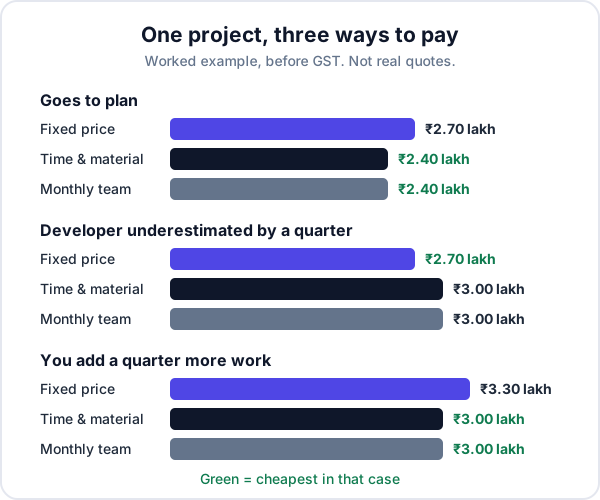
Say a solar installer in Nashik wants a first version of a custom CRM: enquiries, site surveys, quotations and installation jobs. The developer estimates about 240 hours of work. We have set the three prices so they start roughly level, so that you see the risk and not the rate:
- Fixed price: ₹2,70,000 for the written scope. That includes the developer’s buffer.
- Time and material: ₹1,000 an hour, estimated at 240 hours, so ₹2,40,000.
- Dedicated monthly: one developer at ₹60,000 a month, planned for 4 months, so ₹2,40,000.
Now three things that can happen:
| What happens | Fixed price | Time and material | Dedicated monthly |
|---|---|---|---|
| Goes to plan | ₹2,70,000 | ₹2,40,000 | ₹2,40,000 |
| Developer underestimated by a quarter | ₹2,70,000 | ₹3,00,000 | ₹3,00,000 (5 months) |
| You add a quarter more work | ₹3,30,000 | ₹3,00,000 | ₹3,00,000 (5 months) |
| Both of the above | ₹3,30,000 | ₹3,60,000 | ₹3,60,000 (6 months) |
In the fixed price column, the quarter more work is 60 extra hours billed as change requests at the same ₹1,000 an hour, so ₹60,000 on top. All figures are before GST.
What the example shows
There are two kinds of overrun, and they are not the same. An estimate error is work that was always in the scope but took longer. A scope change is work you asked for later. Fixed price moves the first onto the developer. Nothing moves the second off you, under any model.
So the question is not which model is cheapest. It is which risk you expect. If you know what you want and fear the developer’s estimate, fix the price. If you expect to learn a lot once your staff see the first screens, fixed price will cost you its buffer plus every change, and a capped time and material or monthly arrangement may cost less.
One more thing the table hides: under the monthly model, the fifth and sixth months only happen if you allow them. You can hold the bill at ₹2,40,000 and accept less software instead. That choice is the real advantage of the model, and it only helps if somebody makes it.
Which pricing model suits which situation
| Your situation | Usually fits |
|---|---|
| First version, clear purpose, fixed budget | Fixed price against a written scope |
| Business website with known pages | Fixed price |
| Taking over a system someone else built | A small paid audit first, then fixed price or monthly |
| Live system, steady stream of changes | Dedicated monthly, or a care plan for small ones |
| You cannot say yet what you need | A short paid scoping phase, then fixed price |
| Nobody in your business can review work every week | Fixed price. Avoid monthly and uncapped hourly |
| A one-off fix of unknown cause | Time and material with a cap |
Most projects end up using two models in sequence: a fixed price for the first version, then a monthly arrangement once the system is live and the changes start. That is a sensible pattern, not a failure of either.
Mistakes that make any model expensive
- Choosing by the headline number. A time and material estimate of ₹2,00,000 and a fixed price of ₹2,70,000 are not comparable figures. One is a guess, the other is a commitment.
- A fixed price without a written scope. You get the risk of time and material with the inflexibility of fixed price.
- Uncapped hours. Nobody intends the bill to drift; it drifts because nobody reads timesheets.
- A monthly team with no owner on your side. The developer builds what they think is useful, which is not always what you would have chosen.
- Forgetting what comes after launch. Hosting, backups and small fixes cost money under every model. What custom software actually costs covers the upkeep, and our custom software guide works through a three-year comparison.
How Enkay Technologies prices custom work
Our custom software page offers two of these models plus upkeep. A fixed-price project is the most common: a written scope with a dated plan, websites from about ₹25,000 and custom systems and apps from about ₹1,50,000, paid in stages tied to delivery. The price does not move unless you change the scope; if we underestimate something that was in it, that is our cost. A dedicated monthly team starts at about ₹60,000 per developer per month, with you setting priorities each sprint, a working build every two weeks, and one month’s notice. After launch, a care plan starts at about ₹5,000 a month. All before GST, and every project is quoted in writing after a free scoping call.
Typical timelines from us are 2 to 4 weeks for a website, 6 to 10 weeks for a first version of a custom CRM, and 10 to 16 weeks for an app on both stores. And if your need is ordinary leads, follow-ups and quotations, a ready-made tool such as Enkay CRM costs far less than any of these models; buy or build explains how to tell.
Choosing between fixed price and time and material
Fixed price vs time and material is a choice about risk, not about rate. Fix the price when you know what you want and need a ceiling. Pay by the hour, with a cap, when nobody can know the work until it starts. Book a monthly developer when the software is live and the list of changes never ends. Whichever you pick, get the scope and the change process in writing, because no pricing model protects you from a scope agreed on a phone call.
Frequently asked questions
What is the difference between fixed price and time and material?
In a fixed price contract you agree one price for a written scope, and the developer absorbs the cost if their estimate was wrong. In time and material you pay for the hours actually worked at an agreed rate, so you carry the risk of the estimate being wrong, but you can change direction without renegotiating.
Is fixed price more expensive than time and material?
Usually by a margin when everything goes to plan, because the developer adds a buffer for the risk they carry. When the developer has underestimated, fixed price often ends up cheaper for you. When you add a lot of new work, fixed price tends to cost the most, because the buffer stays and the changes are billed on top.
When should I hire a dedicated developer by the month?
When the work keeps coming after launch, the priorities change every few weeks, and someone in your business can decide what gets built next. It is a poor fit for a first build with a deadline and a budget limit, because a monthly bill is fixed but what gets delivered in a month is not.
Can a time and materials contract have a budget limit?
Yes. Ask for a not-to-exceed cap, a written estimate per feature, weekly timesheets, and a rule that the developer must stop and ask before passing a stated share of the estimate. That keeps most of the flexibility while stopping the bill from running on unnoticed.
Which pricing model is best for a small business?
For a first version with a clear purpose, a fixed price against a written scope, because it caps your spend. After launch, a monthly care plan or a monthly developer if changes keep coming. Hourly time and material suits small, uncertain jobs such as investigating an old system before deciding what to do with it.
Keep reading
Get a fixed price you can hold someone to
Tell us what keeps going wrong. The scoping call and the written scope with a fixed quote are free, and you decide afterwards.