To revive old leads, pick the enquiries that went quiet for a reason that may have changed, such as timing, budget or comparing quotes. Give each a genuine new reason to talk, contact it once by call or WhatsApp with a short message that says who you are and which enquiry it was, and close the lead if there is no reply. Leave alone anyone who said no for a reason that still holds.
Most advice on reviving cold leads is written for software companies with email lists of thousands. It says “segment your list” and “add value” without saying how. This post is for a business with a register or CRM full of last year’s enquiries and an hour a week to spare: which ones to pick, what to say, what it can earn and what can go wrong.
Cold, dead or never real: sort before you start
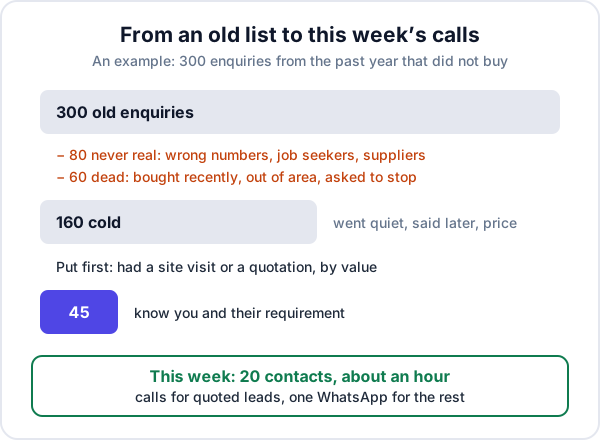
An old lead is any enquiry that did not become an order and has had no contact for a month or more. They fall into three groups, and only one is worth your time.
- Cold: they went quiet, said “later”, or chose not to buy for a reason that may have changed. These are the revival list.
- Dead: they bought elsewhere recently, asked you to stop, or need something you do not do. Leave them.
- Never real: wrong numbers, job seekers, suppliers selling to you, students collecting rates. Remove them so they stop inflating the list.
Which old leads are worth reviving
The lost reason decides most of it. If you recorded one, this table does the sorting for you.
| Why it went cold | Reopen? | What to lead with |
|---|---|---|
| “Later”, after a festival, next season, next financial year | Yes, on that date | The date they gave you |
| No response after the quotation | Yes, once | One easy question about whether the plan is still on |
| Price, or a cheaper quote | Yes, after 2 to 3 months, if you have a different option | A smaller scope, another brand, or a price that has moved |
| Still comparing, or waiting for family to decide | Yes | Something concrete: a site visit, a sample, a start date |
| Bought from someone else | Sometimes, months later | Service, maintenance or the next job, never criticism of the other seller |
| Unhappy with something you did | Only by the owner, by phone | An apology and a question, not an offer |
| Outside your area, or not a job you do | No | – |
| Asked you not to contact them | Never | – |
If you never recorded lost reasons, use how far the lead got. A lead that had a site visit or a quotation is worth far more than one that only asked a rate on IndiaMART, because you already know their requirement and they already know you.
Size the list to the time you have
Do not try to revive a year of enquiries in one go. Sort the cold leads by how far they got, then by value, and take the top 15 to 25 each week. That is roughly an hour of calls and messages, it can be repeated every week without displacing new enquiries, and the replies arrive in numbers you can actually handle.
Give them a new reason to talk
“Just checking in” asks the customer to do the work of remembering you and deciding again. A revival message works when something has changed. Look for one of these:
- A date they gave you. “You said after Diwali” is the easiest revival there is.
- A season. AC servicing before summer, waterproofing before the monsoon, school and coaching admissions before a new batch.
- A new option. A cheaper range, a smaller package, a payment in parts, a model that was out of stock when they asked.
- A price that moved. Only if it really did. Invented urgency is remembered.
- A job nearby. “We are installing in your society next week; I can look at your site the same day.”
Call or WhatsApp: who gets which
Call the leads that had a site visit or a quotation and are worth more than your average job. They know you, and a conversation recovers far more than a message. Send a WhatsApp to the rest, and to anyone who did not answer the call. Messages you can copy, adjusted to your trade:
They said “later”
“Namaste, Priya from Shree Kitchens, Nagpur. In March you mentioned doing the kitchen after the new flat’s possession. Has the possession date come through? I can measure the site whenever suits you.”
No response after a quotation
“Hello, Amit from Sai Solar. We sent a quotation for a 3 kW rooftop system in June. Is the plan still on for this year, or has it moved? Either answer helps me keep my diary right.”
Lost on price
“Hello, this is Rahul from Secure Vision. You asked about 8 cameras for your shop in May and our quote was more than you wanted to spend. We now have a 4-camera package that covers the counter and entrance for less. Shall I send the details?”
Each one names the business and the enquiry, says what changed, and ends with a question that can be answered in a word. For more wording at other moments in the sale, see our follow-up message templates.
A worked example: what one month of revival can return
This is a made-up example. Say a modular kitchen maker in Nagpur has 300 enquiries from the past year that did not become orders. After sorting, 160 are cold, and 45 of those had a site visit or quotation. The owner works through 20 a week for four weeks: 80 contacts, about four hours in all.
| Step | Example result |
|---|---|
| Contacted (calls first, then WhatsApp) | 80 |
| Replied at all | 14 |
| Still planning, agreed a visit or a revised quote | 5 |
| Orders | 2, at ₹1,80,000 each |
| Margin at, say, 25% | ₹90,000 |
| Cost | About four hours and nothing else |
Your numbers will differ, and a month with no orders is entirely possible. The sum to do is simpler: how many revived orders a year pay for an hour a week? For most businesses with jobs worth tens of thousands of rupees, the answer is one. Just as useful are the replies: every “we bought from X” or “your price was too high” is a lost reason you did not have before.
Staying on the right side of customers and the rules
Reviving old leads goes wrong when it turns into bulk messaging. WhatsApp’s Business Messaging Policy says people should expect the messages they receive, that businesses must respect requests to stop, and that users can block or report a business; it may limit accounts that draw a lot of negative feedback. One message about the person’s own enquiry, with your name, is expected. The same text sent to 300 numbers at once is how a business number gets reported.
For phone calls and SMS in India, TRAI’s commercial communication regulations (TCCCPR 2018) treat promotional calls and messages without the recipient’s consent as unsolicited, and allow consent to be inferred from an existing relationship. A call about someone’s own enquiry is a different thing from a promotional blast to an old number list, but where the line falls is a judgement, not a settled rule. Keep revivals personal, one at a time, and stop the moment anyone asks.
When not to revive old leads
- When you are busy. In peak season, every revived lead competes with new enquiries you already cannot call fast enough. Revive in the slack weeks.
- When the list was never real. If most of last year’s enquiries were rate-shoppers from one source, reviving them repeats the waste. Fix the source instead.
- When new leads are waiting. A revival hour while today’s follow-ups are overdue is the wrong hour. Clear those first.
- When the decision is long past. A tender awarded, a flat already furnished, a batch already started.
Make next year’s revival easy
The hard part of reviving leads is not the message. It is not knowing why each lead went cold. Two habits fix that: record a lost reason every time you close a lead, and when a customer says “later”, set a follow-up for that date instead of marking the lead lost. A lead with a date in the future is not lost; it is waiting. Our post on stopping missed follow-ups covers the daily side of this.
Where Enkay CRM fits, and where it does not
In Enkay CRM, from Enkay Technologies, marking a lead Lost asks for the reason, and a report shows why deals were lost. The lead list filters by status, so lost leads can be listed and worked through, and a lost lead is reopened by picking a stage on its page. From the lead you call or open WhatsApp in one tap, then set the next follow-up date so a reply is not forgotten. For your own sorting, export leads to CSV on any plan.
What it does not do: there is no bulk messaging, campaign or broadcast, and nothing is sent to customers automatically. Each revival is a call or message you make yourself, which for this job is arguably the point. A shared team WhatsApp inbox is in development.
The short version
To revive old leads, throw out the ones that were never real or are truly dead, and sort the rest by how far they got and what they were worth. Take 15 to 25 a week. Give each a real reason to talk, contact it once by call or WhatsApp with your name and their enquiry, and close it if there is no reply. Record lost reasons from today, and next year’s list will sort itself.
Frequently asked questions
How do you revive a dead lead?
Pick leads that went quiet for a reason that may have changed, such as timing, budget or comparing quotes. Give each one a new reason to talk: a new season, a new option, a price change, a date they mentioned. Contact them once by call or WhatsApp, say who you are and which enquiry it was, ask one easy question, and close the lead if there is no reply.
How old is too old to follow up a lead?
It depends on how fast your customers decide. For seasonal or quick purchases such as AC servicing, an enquiry older than a year is usually stale. For slow decisions such as interiors, solar or machinery, 6 to 18 months can still be worth one message, especially if they said “later” rather than “no”.
What should I say to a cold lead on WhatsApp?
Your name and business, the enquiry you are writing about, the one thing that has changed, and an easy question to answer. For example: “Namaste, Priya from Shree Kitchens. You asked about a modular kitchen in March. Our new range starts lower than the quote we sent. Is the kitchen still on your plans this year?” Avoid “just checking in”.
How many times should I follow up an old lead?
Once, maybe twice. A revival is a single honest attempt, not a new cadence. If the first message gets no reply, a second a week later is reasonable for a quoted, high-value lead. After that, mark it lost with the reason “no response to revival” and leave it.
Is it allowed to message old enquiries on WhatsApp?
WhatsApp’s Business Messaging Policy says people should expect the messages they receive, that businesses must respect requests to stop, and that people can block or report a business. A single message about the person’s own enquiry, with your name, is far safer than a bulk broadcast to an old list. Stop the moment anyone asks.
Can Enkay CRM send a revival campaign automatically?
No. Enkay CRM does not send bulk or automatic messages to customers. It keeps lost leads with their reason, filters the lead list by status, and lets you reopen a lost lead by picking a stage. You then call or open WhatsApp from the lead in one tap and set a follow-up date.
Keep reading
Try Enkay CRM free
Every enquiry in one list, a follow-up date on each one, and your whole team on the same page. Free for one user — not a trial, no credit card.