To choose a CRM development company, send the same written requirements to three developers, take a scoping call with each, and compare the written scopes they send back rather than the prices they mention on the phone. Pick the one that understood your process, put every screen and the ownership of the code in writing, and can show you a CRM it built that people use every day.
Our guide to custom software development covers whether to build at all and the basics of choosing a company. This post goes further for the case where you have decided to build a CRM: what kind of developer suits the job, twelve questions to ask, the red flags in quotes and contracts, and a scoring table so the cheapest quote does not win by default. We build custom CRMs ourselves, so read it with that in mind.
Freelancer, studio, agency or platform partner?
“CRM developer” covers four quite different businesses. Know which one you are talking to, because each fails in its own way.
| Who | Suits | Watch for |
|---|---|---|
| Freelancer | A small, defined build with one or two kinds of user | One person is the whole project. If they fall ill or take a bigger job, everything stops. |
| Small studio | A system with several roles, integrations and data to move | Capacity. Ask how many projects they are running now. |
| Large agency | Large, multi-team systems with formal process | You talk to an account manager while juniors build it. Higher price for the same screens. |
| Platform partner | Setting up and customising a ready-made CRM you rent | It is not a build. You keep paying the platform’s licence, and the work lives inside their product. |
There is a fifth kind: the “ready CRM in seven days” offer. That is usually a template with your logo on it. It can be fine value, as long as you know you are buying a licence to someone else’s product, not code of your own.
Before you talk to anyone, write down what you need
Every comparison below depends on all three developers quoting for the same thing. Two to four pages is enough: the problem, who sees what, the path one enquiry takes, the documents, connections and old data. Our CRM requirements document template is a fill-in version. Without it, you are comparing three guesses.
12 questions to ask a CRM developer before hiring
Ask these on the scoping call. The answers matter less than how specific they are: a developer who has built CRMs answers with examples, a developer who has not answers with adjectives.
- Can you show me a CRM you built that people use every day? Logged in, with real-looking data, not screenshots or a design file. Ask what the users complained about after launch.
- What do you need from me before you can quote? A good developer wants your process, your users and a sample of your data. A price in the first ten minutes is a guess.
- Which of my requirements is the expensive one? Someone who has priced CRMs before can name it, usually permissions, an integration or data migration.
- What would you leave out of version one? If the answer is “nothing, we can do it all”, the first version will be late.
- How will you move my old data, and who cleans it? Listen for a test import your staff check before go-live.
- How do you handle who sees what? Ask them to show a role or permission setting in something they built.
- Have you connected IndiaMART, WhatsApp or Tally before, and what broke? Everyone who has done it has a story. Nobody who has not does.
- Who will I talk to each week? The person building it is best. Ask how often you get a working link to try.
- What happens when I ask for something not in the scope? The right answer is a written change with a price, which you approve before anyone starts.
- Where does the code live during the build? In a repository you can see from the first weeks, not a zip file at the end.
- What does the contract say about ownership and accounts? Code, copyright, domain, server, WhatsApp number and store listings, all to you. More on this below.
- What do the first 90 days after launch cost? A free-fixes period, then a stated monthly or per-change price. Not “we will see”.
Questions for their past client
If they give you a reference, call it, and ask things a happy client would not volunteer: Did it finish on the date in the plan? What turned out to cost extra? Do your staff still use it every day? Would you hire them again for the next part?
Red flags in a CRM development quote
Read the quote as carefully as the price. These are the lines, or missing lines, that most often lead to disputes later.
| In the quote | What it usually means | Ask |
|---|---|---|
| One lump sum, no list of screens | Scope not worked out yet | For a written scope before any payment |
| Delivery in days | A template renamed | Whether you get code or a licence |
| No mention of old data | Migration will be extra | Who imports it, and who checks it |
| “Unlimited revisions” | No agreed definition of finished | How each stage is accepted |
| Half or more upfront | Little reason to finish on time | For stages paid against working parts |
| Hosting and domain “included” | Often in the developer’s account | Whose name every account is in |
| Yearly licence fee on a custom build | You are renting, not owning | What happens if you stop paying |
| No exclusions listed | Every grey area becomes an argument | What is not included, in writing |
| Far below the other two | Something the others included is missing | To go through the scopes side by side |
Contract clauses to read before you sign
This is general information, not legal advice. For a large project, pay a lawyer to read the contract; it costs less than one disagreement.
- Assignment of the code. All rights in the code, designs and documentation assigned to you on final payment, for the full term of copyright, worldwide. Where the developer is in India, the Copyright Act, 1957 makes the author the first owner, and section 19 says an assignment must be in writing and signed; if the period is not stated it is deemed to be five years, and if the territory is not stated, India only. “Of course it is yours” on a call is not an assignment.
- The developer’s existing code. Most developers reuse their own libraries and keep them. That is normal, but the contract should give you a permanent licence to use and modify them that you can pass to another developer. Otherwise the part they kept can stop anyone else maintaining your system.
- Accounts. Domain, server, email sending, WhatsApp number, payment gateway and app store accounts registered in your business’s name.
- Acceptance. How long you get to test each stage, and what counts as accepted. Without it, “finished” means whatever the developer says.
- Defects after launch. How long fixes are free, and what counts as a defect rather than a change.
- Changes. Written, priced and approved by you before work starts.
- Ending early. If either side stops, you receive the code and data for every stage you have paid for.
- Your data. It stays confidential, is not reused, and is returned or deleted at the end.
A scoring table for comparing CRM development companies
After the calls, score each developer from 0 to 5 on each line, multiply by the weight, and divide by 5. The weights are ours; change them if your situation differs, but decide them before you see the prices.
| What you score | Weight | 5 looks like |
|---|---|---|
| Understood your process | 20 | Asked about your users, steps and data before any price |
| Quality of the written scope | 20 | Every screen, rule and report, with exclusions and dates |
| A CRM they built in daily use | 15 | Shown live, with what changed after launch |
| Ownership and accounts in writing | 15 | Assignment clause and accounts in your name |
| Payment tied to delivery | 10 | Each stage paid when it is working |
| After-launch terms priced | 10 | Free-fixes period, then a stated price |
| You talk to the builder | 5 | Direct line to the person writing the code |
| Common, hireable tools | 5 | Another developer could take it over |
Here is how it plays out in a made-up example: three quotes for the same requirements from a small distributor in Indore.
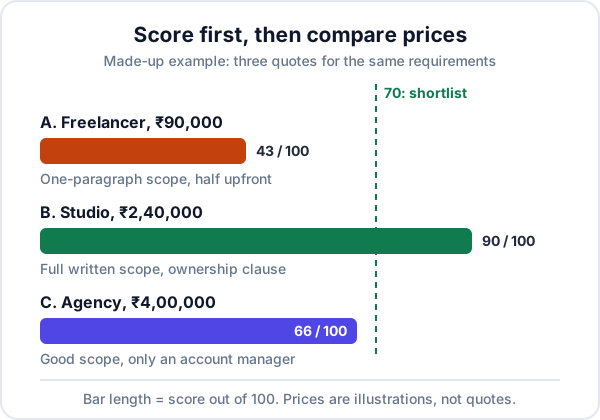
The rule we would use: drop anyone under 50 whatever their price, shortlist anyone over 70, and only then compare prices. If nobody clears 70, the problem may be your requirements document rather than the developers; tighten it and ask again.
What a scoring table cannot tell you
It cannot tell you whether you will get on. You will be talking to this developer every week for two or three months, so the call itself is evidence: did they explain things in your words, and did they push back on anything? A developer who agrees with every request will agree with the scope creep too.
It also cannot rescue a build that should not happen. If your must-have list is leads, follow-ups, a pipeline and quotations, a ready-made CRM is usually cheaper than any developer on your shortlist. Buy or build sets out three questions that settle it, and what custom software costs shows which requirements push the price up.
How Enkay Technologies answers these questions
Enkay Technologies builds custom CRMs, so score us like anyone else. Our answers, in short: a free 30 to 45 minute scoping call; a written scope with a fixed price and dated plan within two to three days; a working link every two weeks; payment in stages tied to delivery; you talk to the developer doing the work, on WhatsApp; Laravel, MySQL or PostgreSQL, and React or Flutter, all widely used; on final payment the code, the repository and every account are transferred to you, with copyright assigned in writing; 30 days of free fixes, then a care plan from ₹5,000 a month that you are not obliged to take. A working first version usually takes 6 to 10 weeks, and quotes start at about ₹1,50,000 before GST.
What we cannot give you on question 1 is a client’s system: we do not publish customer names or testimonials. The CRM we can show you live is our own product, Enkay CRM, which we built and run in production. If it already covers your list, we will tell you to use it instead of hiring us, or anyone.
The short version
The right CRM development company is the one whose written scope matches your requirements line by line, whose contract hands you the code and the accounts, and who can show you a CRM people actually use. Write your requirements, send them to three, ask the twelve questions, score the answers before you look at the prices, and read the contract before you pay the first stage.
Frequently asked questions
How do I choose a CRM development company?
Send the same written requirements to three developers, take a scoping call with each, and compare the written scopes that come back, not the phone prices. Score each on how well they understood your process, the quality of the scope, a CRM they built that is in daily use, ownership terms, payment terms and after-launch costs. Compare prices only among the ones that score well.
What questions should I ask a software developer before hiring?
Ask to see a CRM they built that people use every day, what they need from you before quoting, which of your requirements is the expensive one, what they would leave out of version one, how they move old data, what happens when you ask for something outside the scope, where the code lives during the build, and what the first 90 days after launch cost.
Should I hire a freelancer or a company to build a CRM?
A freelancer suits a small, well-defined build with one or two kinds of user, as long as the code is in a repository you can access from the first week and someone else could take it over. A company suits a system with several roles, integrations and data migration, where one person falling ill should not stop the project.
What are the red flags in a software development quote?
One lump sum with no list of screens, a delivery time in days, no mention of moving your old data, unlimited revisions instead of a defined scope, most of the money upfront, hosting and domain in the developer's account, a yearly licence fee on software you paid to have built, and a price far below everyone else's.
Who owns the code when I hire a CRM developer?
Whatever the contract says, so read it. Where the developer is in India, the Copyright Act, 1957 makes the author the first owner, and an assignment is valid only in writing and signed; an unstated period defaults to five years and an unstated territory to India. Ask for a written assignment of all rights, for the full term, worldwide, on final payment.
How many developers should I get quotes from?
Three is enough. Fewer gives you nothing to compare; more and you will not have time to read each written scope properly, which is the only comparison that means anything. Send all of them the same requirements document so the quotes describe the same system.
Keep reading
Put us on your shortlist
Send us your requirements. You get a free scoping call and a written scope with a fixed price, and you can score it against everyone else's.