Your business has outgrown Excel and WhatsApp when the sheet and the chats stop telling you what to do next. Leads arrive faster than anyone types them in, follow-ups depend on someone remembering, two people work from different copies, and a simple question about last month takes an hour of scrolling. One of these is a nuisance. Three or more, and the tools are now costing you sales.
Below are ten signs, each with a test you can run this week rather than a feeling you have to trust. Score yourself at the end. The score tells you whether to tidy what you have, which costs nothing, or to move to a CRM.
Why Excel and WhatsApp worked, until they did not
Nearly every small business starts here, and for good reason. WhatsApp is where customers already are. Excel or Google Sheets is free, flexible and needs no training. For one owner answering a few enquiries a day, the pair is hard to beat.
The trouble starts with the second person and the third lead source. A sheet does not remind anyone of anything. A chat belongs to the phone it is on. Neither knows that the IndiaMART enquiry from Tuesday and the WhatsApp message from Thursday are the same customer. The owner’s memory filled those gaps. Growth is the point at which memory stops being enough.
10 signs you have outgrown Excel and WhatsApp
1. Follow-ups happen when someone remembers
The sheet has a “next call” column, but nobody sorts it every morning, so on busy days nobody calls.
Test: count the open enquiries with no next follow-up date, or with a date already in the past. If it is more than a fifth of your open enquiries, follow-up is running on luck. Our post on how to stop missing customer follow-ups covers the habit that fixes it.
2. Portal leads are typed in late, or not at all
IndiaMART and JustDial send enquiries by email, SMS and app alerts. Someone has to copy each one into the sheet. On a busy day that is the first job dropped.
Test: compare last week’s enquiry count in the IndiaMART or JustDial seller panel with the rows added to your sheet for that source. Any gap is customers who never got a call.
3. You cannot answer simple questions in five minutes
How many enquiries came in last month? From where? How many became orders?
Test: time yourself answering those three. If it takes more than five minutes, or the answer starts with “roughly”, you are making spending decisions (which portal to renew, which ads to run) without the numbers.
4. The same customer lives in three places, and they disagree
A name in the phone contacts, a different spelling in the sheet, the real requirement buried in a WhatsApp chat.
Test: pick ten recent customers. For how many can you find, in one place, what they asked for, what you quoted and when you last spoke? Below seven out of ten, your records are in people’s heads.
5. There is a “final_v3” file
Two people edit at once and one overwrites the other, or a salesperson keeps a private copy because the shared one is a mess. Google Sheets fixes the overwriting, not the private copies.
Test: ask each person where they keep their leads. If you get more than one answer, you have more than one list.
6. Nobody can find which quotation was sent
The customer calls back and says yes “to the one with the discount”. There were three PDFs, made in Word, sent from two phones.
Test: pick the last five quotations. Can you find the final version and the date it was sent within a minute each?
7. When a salesperson leaves, their customers leave with their phone
If enquiries are handled on staff members’ personal WhatsApp, the chat history goes wherever that phone goes.
Test: if your best salesperson resigned today, list what you would lose. If the honest answer is “I am not sure”, this sign applies.
8. The business WhatsApp phone gets passed around
One number, several people, one phone on the counter. Linked devices help; WhatsApp’s help centre says one phone can link up to four other devices. But everyone sees every chat, nobody knows who replied to whom, and two people answer the same customer differently.
Test: scroll back through yesterday’s chats. Can you tell which enquiries are still waiting on a reply, and whose job it is?
9. You cannot see who did what
The owner asks “did anyone call the Kothrud enquiry?” and three people say they thought someone else had.
Test: for last week’s new enquiries, can you say who made the first call and when? If not, you cannot coach anyone or assign leads fairly.
10. Won deals and unpaid invoices are not connected
The sale is marked “done” in the sheet, the invoice is made in another program, the payment arrives by UPI on the owner’s phone and is marked nowhere.
Test: from your sheet alone, list which customers still owe money. If you need to open three other places, money is slipping through the same gaps as leads.
Score yourself
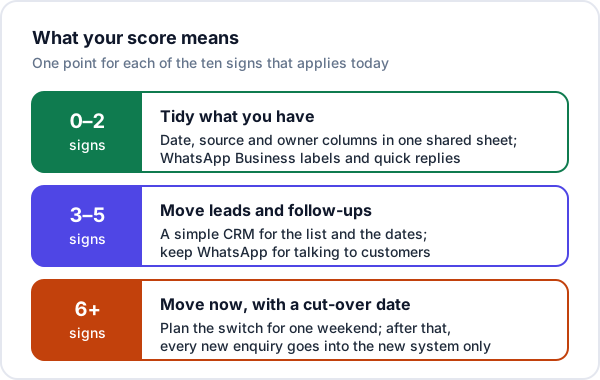
Give yourself one point for each sign that applies today, not one that applied last Diwali. Then read across.
Fix it first, or move?
Not every sign needs software. Several have a free fix inside the tools you already use. Try it for a month. If the fix holds, you have saved the cost of a CRM. If it needs someone to police it every day and nobody does, that is your answer.
| Sign | Free fix to try first | When the fix stops working |
|---|---|---|
| Missed follow-ups | A “next date” column, sorted by date every morning | Nobody sorts it on busy days |
| Portal leads typed late | One person copies them in twice a day | More than a few a day, or that person is away |
| Slow answers | A source column with a dropdown and a monthly pivot table | Sources are filled in inconsistently |
| Several lists | One shared Google Sheet; delete every private copy | People start keeping copies again |
| Chats on personal phones | All enquiries on one WhatsApp Business number | More than one person needs to reply |
| Nobody knows whose lead | An “owner” column and a rule that every row has one | Leads arrive faster than anyone assigns them |
| Lost quotations | One folder, file name = customer + date | Revisions are sent from phones |
WhatsApp Business is worth setting up properly before anything else: labels such as New, Quoted and Payment due, quick replies for your common messages, and a greeting message for first-time chats. Our post on managing WhatsApp chats as a team goes further.
What staying costs: a worked example
The sums are rough, but worth doing with your own numbers. Say a solar installer in Nagpur gets 60 enquiries a month, wins 1 in 6, and the average job is ₹1,20,000. That is 10 jobs a month.
Now say the first two signs apply, and 8 enquiries a month get no follow-up at all. If those 8 would have converted at the same 1 in 6, that is about 1.3 jobs, or roughly ₹1,60,000 of sales a month that never happened. Even at a 15% margin, it is about ₹24,000 of profit.
Against that, a small-business CRM costs a few hundred to a few thousand rupees a month, plus the effort of moving. The point is not that software pays for itself automatically. It is that the cost of staying put is usually invisible, because nobody records the enquiry they forgot to call. Our post on free vs paid CRM works through the cost side.
When you have not outgrown them
Moving is the wrong answer more often than CRM vendors admit. Stay where you are if:
- You are one person with a handful of enquiries a week from one source. A notebook and WhatsApp labels will do.
- Your work is mostly repeat customers who call you, not new enquiries you have to chase.
- The real problem is that nobody follows up at all. Software reminds people; it does not make them call. Fix the habit first, or the CRM becomes one more list nobody opens.
- Nobody will own the change. A CRM that one person keeps up and everyone else ignores is worse than a shared sheet.
If you decide to move
Three things make the move stick. Pick a cut-over date after which every new enquiry goes into the new system only, and keep the old sheet read-only as an archive. Connect the lead sources that can connect, so nobody types IndiaMART leads again; see connecting IndiaMART to a CRM. And keep WhatsApp for talking to customers, while the list, the dates and the history live in one place. The step-by-step for the data is in moving from Excel or Google Sheets to a CRM.
Where Enkay CRM fits, and where it does not
Enkay CRM, from Enkay Technologies, is built for exactly this move. IndiaMART, JustDial and website enquiries arrive as leads on their own. Every lead carries a next follow-up date, and the Today screen shows what is overdue, what is due today and which leads have no date at all. Each lead has an owner, quotations and invoices are made from the same record, and you open a WhatsApp chat or call in one tap. Existing leads come in from a CSV file on the Basic and Standard plans.
What it does not do: it does not read your WhatsApp chats or phone calls on its own (those enquiries are added by hand in a few seconds), there is no separate phone app or offline mode (it runs in the phone’s browser), and a shared team WhatsApp inbox is still in development. It is not accounting software. See what Enkay CRM does and pricing: a ₹49 trial for 15 days, then ₹499 a month for up to 2 users or ₹999 for the whole team.
The short version
You have outgrown Excel and WhatsApp when follow-ups rely on memory, portal leads are retyped late, simple questions take an hour, and customers live in several places at once. Run the ten tests this week and count. Up to two signs: tidy what you have. Three or more: move your leads and follow-ups to one system, and keep WhatsApp for the conversations.
Frequently asked questions
How do I know if I have outgrown Excel?
You have outgrown Excel when the sheet stops telling you what to do next. The usual signs are follow-ups that depend on someone remembering, leads from IndiaMART or JustDial typed in late or not at all, two people overwriting each other, and simple questions such as “how many enquiries came from JustDial last month” taking more than five minutes to answer.
Is WhatsApp Business enough to manage customers?
For one person with a few enquiries a day, often yes: labels, quick replies and a greeting message go a long way. It stops being enough when several people need the same chats, when you need a follow-up date on every enquiry, or when a salesperson leaving means their chats leave with their phone. WhatsApp is a good place to talk to customers and a poor place to keep the list of who needs what.
How many leads a month before a small business needs a CRM?
There is no fixed number. The volume matters less than the number of people and sources. One owner handling 20 enquiries a month from one source can manage in a notebook. Two salespeople sharing 30 enquiries a month from IndiaMART, JustDial, the website and WhatsApp usually cannot, because nobody owns the follow-up.
Should I fix my spreadsheet or move to a CRM?
Fix the spreadsheet first if only one or two signs apply: add a next follow-up date column, a source column with a dropdown, and one owner per lead. Move when the fixes need someone to keep them up every day and nobody does, or when three or more of the ten signs apply.
Can I keep WhatsApp if I start using a CRM?
Yes, and you should. Customers will keep writing on WhatsApp. The CRM holds the list, the follow-up dates and the history; WhatsApp stays the place you talk. Most small-business CRMs, Enkay CRM included, open a WhatsApp chat with the customer in one tap from their record.
Keep reading
Try Enkay CRM for 15 days
Every enquiry in one list, a follow-up date on each one, and your whole team on the same page. ₹49 for 15 days of the full Standard plan, unlimited users.