A good payment reminder message names the invoice, the amount and the due date, makes paying take one tap, and arrives before the due date rather than after it. The tone gets firmer in steps, from a friendly note to a final notice, and somewhere after the due date the message gives way to a phone call. Below are templates for each step, and for the awkward cases most template lists skip: part payment, a promise missed, a disputed item and a bounced cheque.
The examples use a made-up electrical contractor in Surat and a customer called Mr Desai. Change the names, numbers and trade. If you want the routine behind the messages, terms, advances and the weekly check on what is owed, that is in how to collect payments faster.
What every payment reminder needs
Five things, in this order. Leave one out and the customer has a reason to put the message aside.
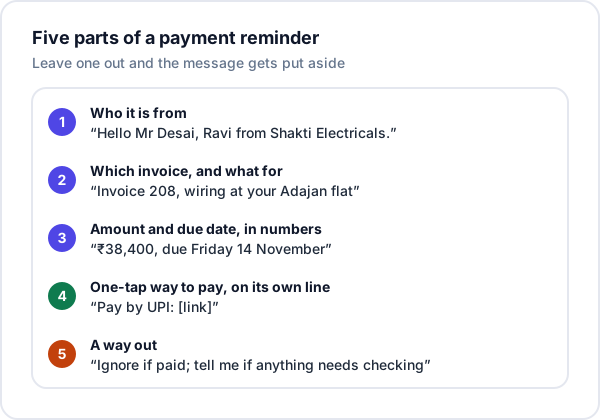
- Who it is from, in the first line. The customer may have your number saved as “Electrician”.
- The invoice number and what it was for. “INV/2026-27/208 for the wiring at your Adajan flat” is easy to match; “your pending bill” is not.
- The amount and the date, in numbers. ₹38,400, due 14 November.
- How to pay, as a UPI link on its own line. Every extra step is a reason to pay “later”.
- A way out: “please ignore this if already paid” and “tell me if anything needs checking”. The first saves embarrassment when a payment crossed your message. The second brings out the customer who is quietly unhappy with the work, which is often the real reason for the delay.
Payment reminder templates by stage
Three days before the due date: friendly
WhatsApp: “Hello Mr Desai, this is Ravi from Shakti Electricals. A reminder that invoice INV/2026-27/208 for ₹38,400 (wiring at your Adajan flat) is due on Friday, 14 November.
Pay by UPI: [link]
Please ignore this if already paid, and tell me if anything on the invoice needs checking. Thank you.”
SMS: “Shakti Electricals: invoice 208 for Rs 38,400 is due on 14 Nov. Pay by UPI: [link]. Ignore if already paid. Thank you.”
On the due date: clear
WhatsApp: “Good morning Mr Desai. Invoice INV/2026-27/208 for ₹38,400 is due today.
Pay by UPI: [link]
If you have already paid, please send the UPI reference so I can mark it. Thank you.”
Asking for the reference is useful: UPI payments often land on the owner’s phone and nobody marks them, and the next reminder goes to a customer who has paid.
Three to five days late: call, then confirm in writing
Do not send a third message. Call. On the call, find out why: the payment is waiting for a signature, the accounts person is away, one item is in dispute. Agree a date before you hang up. Then confirm it:
WhatsApp: “Thank you for your time on the phone, Mr Desai. As discussed, ₹38,400 for invoice 208 will be paid by Wednesday, 19 November. Payment link again: [link].”
That message is not a reminder. It is a written record of a promise, and it is far harder to ignore than a reminder.
Fifteen days late: firm, with a statement
WhatsApp or email: “Mr Desai, invoice INV/2026-27/208 for ₹38,400 was due on 14 November and is now 15 days overdue. I have attached your statement of account. Please let me know today when we can expect payment. If there is a problem with the work, I would rather hear it now and fix it.”
A statement listing every invoice and payment ends arguments about the amount, and shows the customer you keep proper records.
Thirty days late: final notice
Email, copied on WhatsApp: “Dear Mr Desai, invoice INV/2026-27/208 for ₹38,400, due on 14 November, remains unpaid after 30 days and two reminders and a call. From 15 December we are unable to take further work on credit until this is cleared. Statement attached. Payment link: [link]. Please call me on 98XXX XXXXX if you would like to discuss it.”
State only consequences you will carry out. A final notice followed by another polite reminder teaches the customer that your final notices are not final.
Email subject lines that get opened, for the business customers who live in their inbox: “Invoice 208 from Shakti Electricals, due 14 Nov”, then “Invoice 208 overdue: ₹38,400”, then “Final notice: invoice 208, 30 days overdue”. The invoice number in the subject lets their accounts team find it.
Templates for the awkward cases
Part payment received
“Thank you, Mr Desai, ₹20,000 received today against invoice 208. The balance is ₹18,400. Could you confirm when the rest will come? Link for the balance: [link].”
Thank first, state the balance in the same message, and ask for a date. Never let a part payment close the conversation.
The promised date passed
“Mr Desai, we had agreed ₹38,400 for invoice 208 by Wednesday, 19 November, and I have not seen it yet. Could you check and let me know today? Link: [link].”
Quote the promise back, with its date. No accusation is needed; the facts do the work.
The customer disputes one item
“Thank you for telling me about the extra MCB, Mr Desai. I will check it with the site supervisor and come back by tomorrow. Meanwhile, could you release ₹35,200 for the rest of the invoice? I will send a revised bill or a credit note for the difference if we got it wrong.”
Separate the disputed part from the rest. A ₹3,200 question should not hold up ₹35,200.
A cheque bounced
“Mr Desai, the cheque for ₹38,400 (no. 004512) has come back from the bank unpaid. Could you transfer the amount by UPI today instead? Link: [link].”
Most bounced cheques are a mistake, so start politely. But do not let it drift: under section 138 of the Negotiable Instruments Act, the legal notice has to go within 30 days of the bank telling you the cheque was returned, and the customer then has 15 days to pay. If you might need that route, speak to a lawyer the same week.
An advance before the work starts
“Hello Mr Desai, to book the materials and the start date of 24 November, the 50% advance of ₹19,200 is due by Thursday. Proforma invoice attached. Pay by UPI: [link].”
Tie the advance to something the customer wants, the start date. A proforma invoice is the clean document to send with it.
Payment received: always say so
“Received ₹38,400 for invoice 208, thank you Mr Desai. Receipt attached. It was a pleasure working on your flat.”
The step most businesses skip. A receipt closes the invoice for the customer’s records, and the last line is a better moment to ask for a review than any other.
In Hindi or Gujarati
Write in the language you speak to the customer. Keep numbers as numbers:
“Namaste Desai ji, Shakti Electricals se Ravi. Invoice 208 ka ₹38,400 ka payment Friday, 14 November ko due hai.
UPI link: [link]
Agar payment ho gaya ho to please ignore karein. Dhanyavaad.”
How the tone should change
| When | Tone | Channel | What is new in the message |
|---|---|---|---|
| 3 days before | Friendly | Due date and link | |
| Due date | Clear | “Due today”, ask for UPI reference | |
| 3–5 days late | Direct | Phone call, then WhatsApp | The date they promised |
| 15 days late | Firm | WhatsApp or email | Days overdue, statement attached |
| 30 days late | Formal | Email, copied on WhatsApp | What you will do, and from when |
For households, you can usually stop at the call and the firm message. For business buyers, if you are a micro or small enterprise registered on Udyam, a calm line in the 15-day message helps: “As a registered MSME, our payment terms are covered by the 45-day limit under the MSMED Act.” What that rule allows is explained in our post on collecting payments.
Phrases that delay payment
- “Kindly clear the pending dues at the earliest.” No invoice, no amount, no date, no link. It can be ignored without guilt.
- “As per our records you have failed to pay.” An accusation, in the first message. The customer defends instead of paying.
- Capital letters and “URGENT”. Reads as panic, and suggests you are short of cash.
- Threats you will not carry out. Legal action over ₹6,000 is not believable, and once called, every later message is weaker.
- Reminders in a group chat with the customer’s staff or family. It embarrasses them and delays payment.
- Messages at 10 pm or on a Sunday morning. Send between 10 am and 7 pm on working days.
Before you press send
Check that the payment has not already come in, especially by UPI to a phone nobody looks at. Check the invoice number and amount against the invoice itself, not a note. And check you are sending to the person who pays, which in a business is often the accounts team, not the person who ordered the work. A reminder with the wrong amount costs more goodwill than no reminder.
Save the templates as quick replies in WhatsApp Business so they take a second to send, and edit the name, number and date every time. More on that in our follow-up message templates.
Where Enkay CRM helps, and where it does not
In Enkay CRM, from Enkay Technologies, every invoice carries a UPI payment link and goes out on WhatsApp with the message already written. On an overdue invoice, the WhatsApp button writes the reminder for you, and the invoice records how many reminders were sent and when, so two people do not chase the same customer on the same day. Payments are recorded against invoices, part payments show the balance, and a customer statement lists everything billed and received with a running balance. The Billing overview shows who owes most and what falls due next week.
What it does not do: it does not send reminders on its own, and it does not send SMS or email reminders. A person sends each WhatsApp reminder from their own phone. It is not connected to your bank, so a UPI payment still has to be recorded by someone. See quotations and invoices and pricing.
The short version
A payment reminder message should carry the invoice number, the amount, the due date and a payment link, and offer a way out if the customer has paid or has a problem. Send one three days before the due date and one on it, then call, then confirm the promised date in writing. Get firmer at 15 days with a statement, and at 30 days say what you will do and do it. Write the templates once, save them as quick replies, and check the payment has not already arrived before every send.
Frequently asked questions
How do I write a polite payment reminder message?
Keep it short and factual: the invoice number, the amount, the due date and a way to pay, such as a UPI link. Send the first one before the due date, add “please ignore this if already paid”, and invite the customer to raise any problem with the invoice. A reminder that arrives on time with the facts in it reads as organised, not rude.
When should I send the first payment reminder?
Two or three days before the due date. A reminder before the due date is a courtesy and gives the customer time to arrange payment; the first message after the due date is already a chase. For payment on completion, send the invoice the same day and the first reminder the next morning.
How many payment reminders should I send?
Usually two messages: one before the due date and one on it. After that, call rather than send more messages, and use writing to confirm what was agreed on the call. Five copies of the same message teach the customer that your reminders can be ignored.
What should a final payment reminder say?
That the amount is overdue, how long it has been, what you will do and from which date: for example, no further work on credit until it is cleared. Only state consequences you will actually carry out. Attach a statement of account so there is no argument about the amount.
Can I send payment reminders in Hindi or another language?
Yes, and for many customers you should. Write in the language you normally speak to that customer. Keep the invoice number, amount and date in numbers so they cannot be misread, and keep the payment link on its own line.
Does Enkay CRM send payment reminders automatically?
No. On an overdue invoice, the WhatsApp button writes the reminder for you and the invoice records how many reminders were sent and when. A person sends each one from their own WhatsApp. There are no automatic WhatsApp, SMS or email reminders.
Keep reading
Try Enkay CRM for 15 days
Every enquiry in one list, a follow-up date on each one, and your whole team on the same page. ₹49 for 15 days of the full Standard plan, unlimited users.