Software maintenance cost is what you pay every year to keep software you own hosted, safe, working and slowly improving after it has been built. It is made of a small fixed part (server, domain, backups) and a much larger part that is people’s time: patching, upgrades, bug fixes and changes. How much you ask to change decides most of the bill.
This post breaks maintenance into the work it actually involves, shows how developers price it, adds up a worked yearly budget in rupees, and lists what a software AMC (annual maintenance contract) should say before you sign it. We sell maintenance ourselves, so read it with that in mind; the checklist works whoever you hire.
What does software maintenance include?
Software maintenance covers five kinds of work: running the server, domain, certificate and backups; applying security patches; upgrading the language and framework before support ends; fixing bugs; and adjusting to changes in outside services. Small changes and improvements are a sixth, often bundled in, and should always be priced separately so you can see them.
| Work | What it means in practice | How often |
|---|---|---|
| Hosting and domain | Paying for and watching the server, renewing the domain, keeping disk space and memory from running out | Monthly, yearly |
| SSL certificate | The padlock in the browser. Free certificates renew automatically, but someone has to notice when renewal fails | Every few weeks, automatically |
| Backups | A copy of the database and uploaded files every day, kept somewhere other than the server, and a restore actually tested | Daily, tested quarterly |
| Security patches | Small updates to the operating system, PHP, the framework and libraries when a hole is found | Monthly, or the day a serious one appears |
| Version upgrades | Moving to a newer PHP or framework version before the old one stops getting security fixes. Sometimes a few hours, sometimes a few days | About once a year |
| Bug fixes | The software not doing what the agreed scope said it would | As they turn up |
| Outside service changes | WhatsApp, a payment gateway, an SMS provider or a lead portal changes how its connection works | A few times a year |
| Small changes | A new field, a changed report, a different PDF layout, a new user role | Whenever the business changes |
The first five keep the software alive. The sixth makes it better. Most arguments about maintenance happen because nobody wrote down which was which.
Why software needs maintenance when nothing is broken
Owners often ask why they should pay every month for software that already works. The honest answer is that the software does not change, but everything around it does, on dates set by other people.
- The language gets old. Each PHP version gets two years of active support and then two years of security fixes only. After that, it is end of life. The PHP project’s own table shows PHP 8.2 reaching end of life on 31 December 2026. A system built on it in 2023 needs an upgrade now, whether or not anything looks wrong.
- The framework gets old faster. Laravel, a common choice for business systems, gives each major release 18 months of bug fixes and two years of security fixes. Laravel 12, released in February 2025, gets security fixes until February 2027.
- Certificates get shorter. Let’s Encrypt, the free certificate authority, is cutting its default certificate lifetime from 90 days to 64 days in February 2027 and to 45 days in February 2028. Renewing by hand stops being realistic; automatic renewal that nobody watches is how sites end up showing a security warning to customers.
- Outside services move. Meta, which runs the WhatsApp Business Platform, guarantees each Graph API version for at least two years. After that, calls to the old version are moved to the next oldest one still running, which may behave differently. According to Meta’s changelog, version 20.0 stopped being available on 24 September 2026. Payment gateways and lead portals change their connections too, usually with less notice.
None of these is a bug in your software. All of them can break it.
How software maintenance cost is priced
Developers price maintenance in four ways. None is wrong; each suits a different kind of system and owner.
| Model | How it works | Suits | Watch out for |
|---|---|---|---|
| Fixed monthly care plan or AMC | A set fee covering hosting, patches, backups, bug fixes and a stated amount of small changes | Systems staff use every day | Vague words like “minor changes” with no hours attached |
| Yearly percentage of the build | The AMC is quoted as a share of what the build cost | Packaged software sold with a licence | The fee says nothing about what work is included |
| Pay per change | No monthly fee; each fix or change is quoted when you ask | Websites and tools that rarely change | Nobody is patching anything between your requests |
| Hours bank or retainer | You buy a number of hours a month and use them as you like | Systems still growing every month | Unused hours that expire, and patching eating your change hours |
The percentage model is the most common way an AMC gets quoted and the least useful for you, because it ties the price to what the build cost rather than to the work the year will need. A simple system that changes every week can need more upkeep than a large one nobody touches.
A worked yearly budget in rupees
These are made-up round numbers for one example, not a quote from anyone. Say a distributor in Nagpur had a custom order and dispatch system built for ₹3,00,000. It runs on one small cloud server and connects to WhatsApp and a payment gateway. A developer charges ₹800 an hour for upkeep.
| Item | Assumption | Yearly (₹) |
|---|---|---|
| Keeping it alive | ||
| Cloud server | ₹1,500 a month | 18,000 |
| Domain renewal | Once a year | 1,000 |
| Off-site backup storage | ₹200 a month | 2,400 |
| SSL certificate | Free, renews automatically | 0 |
| Patches, monitoring, backup checks | 2 hours a month | 19,200 |
| One PHP or framework upgrade | 16 hours, once | 12,800 |
| One outside service change | 8 hours, once | 6,400 |
| Subtotal | 59,800 | |
| Fixing it | ||
| Bug fixes | 3 hours a month | 28,800 |
| Improving it | ||
| Small changes | 3 hours a month | 28,800 |
| Total, before GST | 1,17,400 | |
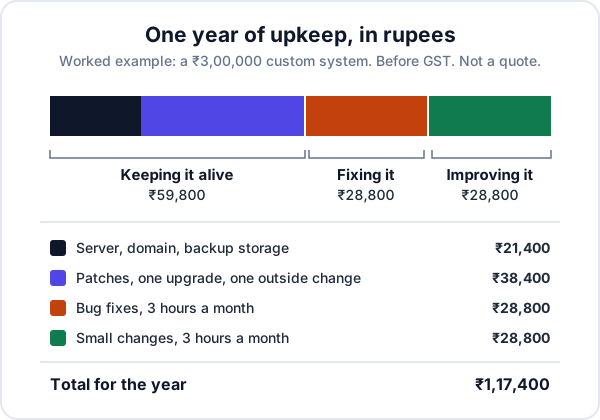
Three things to take from it.
- The server is the cheap part. Hosting, domain and backup storage come to ₹21,400. A quote that is mostly “hosting” is either hiding the labour or leaving it out.
- “Keeping it alive” is the floor. About ₹60,000 a year in this example. Below that, something on the list is not being done, and it is usually the upgrade.
- Changes are the dial you control. Double the small changes and the bill rises by ₹28,800. Stop asking for them and it falls by the same. That is a business decision, not a technical one.
Leave out of this budget, and ask to see separately, anything charged by usage: WhatsApp message charges, SMS, email sending and payment gateway fees. Those are paid to the provider and grow with your business, not with the software.
What a software AMC should list
A good software AMC is short, specific and boring. Before you sign one, check that it answers each of these in writing.
- What is covered. Which applications, websites and servers, by name.
- Whose accounts. The server, domain, email sending and WhatsApp accounts in your business’s name, with the developer given access, not the other way round.
- Backups. How often, how long they are kept, where they are stored, and how often a restore is tested.
- Patching. How soon security updates are applied after release, and the window when the system may be briefly down.
- Version upgrades. Whether moving to a new PHP or framework version is included, or quoted each time.
- Bug or change. A definition of each, and who decides when you disagree.
- Included hours. How many hours of small changes a month, and whether unused hours carry over.
- Response times. How quickly they answer when the system is down, and when it is a minor problem, and during which hours.
- Outside services. Whether adapting to a WhatsApp, gateway or portal change is covered.
- Exclusions. New features, problems caused by someone else changing the code, moving to a new server.
- Price and renewal. The fee, GST, and how much it can rise at renewal.
- Exit. Notice period, and the handover of code, passwords and a full data export when the contract ends.
The last item matters most. An AMC you cannot leave is not a service; it is a hostage arrangement. If you are still choosing who builds the software, our guide to custom software development covers getting the code and accounts in your name from day one.
What happens if you skip maintenance
Nothing, for a while. That is the trap. Software left alone tends to fail in one of these ways, and rarely at a convenient moment:
- The certificate lapses and every customer opening your website or share link sees a full-page security warning.
- The host forces an upgrade. When a hosting company retires an old PHP version, a system that was never upgraded can stop loading that day.
- An integration goes quiet. Leads stop arriving or payments stop being marked as paid, and nobody notices for a week because there is no error on screen.
- The backup was never tested. The server fails and the last good copy turns out to be months old, or missing the uploaded files.
- The one person who knew it leaves. Nobody else has the server password, and getting it back takes longer than the outage.
When the bill finally comes, it is usually bigger than the maintenance would have been: two or three years of skipped upgrades done at once, under pressure. The buy-or-build question “who will own it in three years?” is the same point from the other side.
When paying for software maintenance is not worth it
Do not pay a monthly fee for a five-page website that changes twice a year. Hosting with automatic certificates, plus pay-per-change, is enough; just make sure the hosting login is yours. Do not pay for an AMC on software nobody uses; switch it off and export the data instead. And if you are about to build something ordinary, such as a lead list with follow-ups, compare the upkeep with renting a product. A ready-made CRM moves the whole maintenance list to the vendor.
That last point applies to us as well. Enkay CRM is our ready-made product: on the Business plan you pay ₹499 a month for leads, follow-ups, quotations and invoices, and keeping the software hosted and up to date is our job, not yours. There is no AMC. What it does not do is bend to an unusual process; if yours needs that, it is a build, and the build needs upkeep.
How Enkay Technologies handles upkeep
When Enkay Technologies builds a custom CRM or a business website, the first 30 days of fixes after launch are free. After that, the care plan starts at ₹5,000 a month before GST and covers hosting, SSL, daily backups, security patches, version updates, bug fixes and small changes. You are never obliged to take it, and the code and accounts are yours either way. We also take over systems other developers built, starting with a paid review of the code so you know what you are taking on.
Whoever you choose, ask for the software maintenance cost split the way the worked example is: keeping it alive, fixing it, improving it. If a quote cannot be split like that, you do not yet know what you are paying for. For what moves the build price itself, see what custom software actually costs.
Frequently asked questions
What does software maintenance include?
Five kinds of work: keeping the server, domain, SSL certificate and backups running; applying security patches; upgrading the programming language and framework before their support ends; fixing bugs; and adapting to changes in the outside services the software talks to, such as WhatsApp or a payment gateway. Small changes and new features are often included up to a limit, and should be listed separately.
How much does software maintenance cost per year?
It depends far more on how many changes you ask for than on the size of the build. In our worked example, a custom system that cost ₹3,00,000 to build needs about ₹60,000 a year just to stay safe and running, and about ₹1,17,000 once bug fixes and a few small changes a month are added. Ask any developer to split their quote the same way.
What is a software AMC?
An annual maintenance contract for software: a yearly or monthly agreement in which a developer keeps an application hosted, patched, backed up and working for a fixed fee. A good one lists what is covered, how fast problems are answered, how many hours of changes are included, what is excluded, and how you get your code and data back if you leave.
Is a bug fix the same as a change?
No. A bug is the software not doing what the agreed scope said it would; fixing it should not cost extra while you are under an AMC. A change is anything that makes it do something new or different, even a small one, and is usually counted against included hours or quoted separately. Agree the definition in writing.
Can I skip maintenance if the software is working fine?
For a few months, often yes. Over a year or two, no. Security support for each PHP version ends four years after release, SSL certificates are moving to shorter lifetimes, and outside services such as Meta retire their API versions on a fixed timetable. Software nobody looks after keeps working until one of those dates arrives.
Can another developer take over maintenance of my software?
Usually, if you own the code and the accounts. Expect them to start with a paid review of the code and the server before they agree a monthly fee. Systems with no documentation, no version control or a server only the old developer can log into take longer and cost more to take over.
Keep reading
Have software that needs looking after?
Whether we built it or someone else did, tell us what it runs on and what keeps going wrong. The first call is free, and you get the care plan in writing.