A statement of account lists everything you billed a customer and everything they paid over a period, in date order, with a running balance after each line. The format is simple: your details and the customer’s at the top, the period, an opening balance, one row per invoice, payment or credit note, and a closing balance at the bottom. Add which part of that balance is overdue and how to pay, and the statement does its real job: it gets you paid on several invoices at once, without an argument about the figure.
Below is the format with a worked example you can check line by line, the mistakes that make customers dispute a statement, and when to send one.
What a statement of account is for
An invoice says “you owe me for this sale”. A statement says “here is everything between us, and here is where it leaves us”. That makes it useful in three situations:
- Customers who buy often on credit. A contractor who takes material from you every week will not pay twelve invoices one by one. They pay from the statement.
- Overdue accounts. A statement removes the “which invoice?” and “we already paid that” conversations, because every payment is listed with its date and reference. Our payment reminder templates attach one at the 15-day stage for this reason.
- Year end. Before 31 March, business customers and their accountants often ask suppliers to confirm the balance. Sending your statement first means your figure is the starting point.
A statement is not a tax document. It does not replace a GST invoice, and nothing should appear on it that has not already been invoiced, paid or credited.
Statement of account format: the parts
| Part | What it shows | Why it matters |
|---|---|---|
| Header | Your business name, address, GSTIN and phone; the customer’s name, address and GSTIN | The customer’s accounts team files it against the right supplier |
| Period | From and to dates, and the date the statement was made | A balance means nothing without a date |
| Opening balance | What was owed at the start of the period | Both sides must agree this before anything else |
| Entries | Date, particulars (invoice number, payment reference, credit note), debit, credit, running balance | Each line can be ticked off against the customer’s books |
| Closing balance | What is owed at the end of the period, with totals of debits and credits | The one number the customer is asked to pay or confirm |
| Overdue summary | How much of the balance is not yet due, and how much is late, by age | Separates “owed” from “late”, which is what you chase |
| How to pay | UPI ID or link, bank details | Removes the last excuse for waiting |
| A confirm line | “Please tell us of any difference within 15 days” | Brings disputes out now, not in month four |
Debit means the customer owes you more (an invoice). Credit means they owe you less (a payment, a credit note for returned goods, an advance). The running balance goes up with each debit and down with each credit.
A worked example
Say Om Hardware & Paints in Rajkot supplies Patel Constructions on 30 days’ credit. Here is the statement for July to September 2026. Every figure below is made up, and every line adds up.
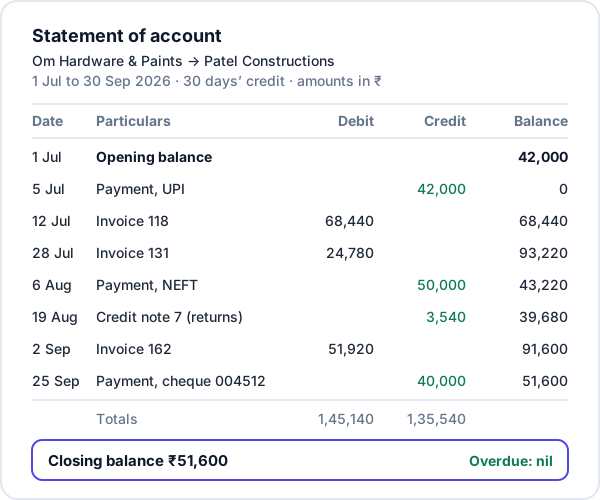
Check it the way the customer’s accountant will: opening balance ₹42,000, plus invoices of ₹1,45,140, minus payments and credits of ₹1,35,540, gives a closing balance of ₹51,600.
Owed is not the same as overdue
Now apply each payment to the oldest invoice first, which is the usual rule unless the customer says which invoice a payment is for. The July payment clears the opening balance. The August payment and the credit note go against invoice 118. The September cheque clears the rest of 118, all of 131, and ₹320 of invoice 162. What is left, ₹51,600, is all from invoice 162, dated 2 September.
On 30 September that invoice is 28 days old, inside the 30-day terms. So the statement shows ₹51,600 owed and nothing overdue. Sending this customer a reminder would be wrong. Sending the statement with “Overdue: nil, ₹51,600 due on 2 October” is exactly right, and the customer can see you keep careful books.
The opposite case matters more. A customer with a modest closing balance can still have an old invoice inside it that is 70 days late, hidden under recent purchases. The overdue summary at the bottom is what surfaces it.
Why customers dispute statements, and how to prevent it
Most disputes are not about honesty. They are two sets of books that recorded the same events differently.
- Tax deducted at source. A business customer may deduct TDS from a payment and treat the full invoice as settled. If you record only the cash, your balance is higher than theirs by the deduction. Ask for the TDS certificate and record the deduction as a credit, or the difference sits on the statement for ever.
- Timing. A cheque the customer sent on 29 September that reached your bank on 3 October is in their September books and your October ones. Say on the statement which date you use.
- Credit notes they have not booked. Send the credit note itself when you raise it, not only as a line on the next statement.
- Payments without references. “₹40,000 received” can be matched to anything. Record the cheque number or UPI reference on every payment.
- No agreed opening balance. If last year’s closing figure was never confirmed, every later statement inherits the argument. Fix the opening balance first, then the rest.
- Proforma invoices listed as debits. A proforma invoice is a request, not a bill. It does not belong on a statement; the advance it brought in does, as a credit.
When to send one
| Customer | Send a statement |
|---|---|
| Business buying regularly on credit | Monthly, in the first week |
| Any customer 15+ days overdue | With the reminder, then with each later chase |
| Every customer with a balance | At the end of the financial year |
| Customer who asks | The same day |
| Walk-in or pay-on-completion customer | Not needed; a receipt is enough |
Send it as a PDF on WhatsApp or by email to the person who pays, usually the accounts team, not the site engineer who ordered the material. A short covering line is enough: “Your statement for July to September is attached. Balance ₹51,600, due 2 October. Please let us know of any difference within 15 days.”
Making one in Excel, and where that breaks
In a spreadsheet, a statement is five columns: date, particulars, debit, credit and balance, where each balance cell is the previous balance plus that row’s debit minus its credit. Put the opening balance in the first row and filter one customer’s entries for the period.
That works for a handful of customers. It breaks when the entries have to be copied in from your invoice book and a payments list, because one mistyped amount changes every balance below it, and nobody notices until the customer does. If you make more than a few statements a month, have them come from the same records the invoices and payments are made in. Our post on collecting payments faster covers the weekly check that goes with them.
Where Enkay CRM helps, and where it does not
In Enkay CRM, from Enkay Technologies, a customer statement is built from the invoices, payments, credit notes and advances already recorded against that customer. Pick two dates (it defaults to the current financial year) and it shows everything billed and received, with the opening balance and a running balance, on screen, ready to print, or as a CSV download. Payments can be spread over several invoices, an unused amount stays on the customer’s account as an advance, and a report groups what is owed by age. It is part of quotations and invoices on the Basic and Standard plans, and opening one needs the “see every lead” permission.
What it does not do: it is not accounting software and does not replace your books in Tally or elsewhere; it does not record TDS deductions as a separate entry; it has no bank connection to match payments; and it does not email statements on a schedule. See customer management and pricing.
The short version
A statement of account format needs your and the customer’s details, the period, an opening balance, one row per invoice, payment and credit note with a running balance, a closing balance, and a line saying how much is overdue. Agree the opening balance first, record a reference on every payment, and send one monthly to credit customers, with every overdue reminder, and at year end to everyone who owes you money.
Frequently asked questions
What is a statement of account?
A statement of account is a summary of everything you billed a customer and everything they paid over a period, with an opening balance, a running balance after each entry and a closing balance. It is not a demand for a new payment. It lets the customer check your figures against their own books and see what they owe.
What is the difference between an invoice and a statement of account?
An invoice bills one sale and creates an amount owed. A statement lists many invoices, payments and credit notes together and shows the balance that results. Customers pay from the statement when they want to settle several invoices at once, but each amount on it must already exist as an invoice.
How often should I send a statement of account?
Monthly to business customers who buy on credit, and whenever a payment is 15 or more days overdue. Send one at the end of the financial year to every customer with a balance, so both sides agree the figure before the books close. Customers who pay on the spot do not need one.
Why does my customer's ledger not match my statement?
Usually because of timing or deductions: a payment you received after the period ended, a credit note they have not recorded, an invoice they have not booked yet, or tax deducted at source that they treat as paid and you have not recorded. Compare the two entry by entry, starting from an opening balance you both agree on.
Should a statement of account show GST separately?
No. The statement shows invoice totals including GST, because that is what the customer owes. The GST split belongs on each tax invoice. A statement is not a tax document and does not replace the invoices.
Can Enkay CRM make a customer statement?
Yes. On the Basic and Standard plans, a customer statement shows everything billed and received between two dates, with the opening balance and a running balance, on screen, to print, or as a CSV download. It needs the “see every lead” permission. Enkay CRM is not accounting software, so if your accountant keeps the books in Tally, their ledger is the one to reconcile with.
Keep reading
Try Enkay CRM for 15 days
Every enquiry in one list, a follow-up date on each one, and your whole team on the same page. ₹49 for 15 days of the full Standard plan, unlimited users.