Website development cost has two parts, and most quotes show only the first. There is the build, paid once, which depends on what the site has to do. Then there are the running costs: domain renewal, hosting, the security certificate, upkeep and new content, which come back every year for as long as the site is live.
For a small business website that brings in enquiries, the build usually matters less than people think. In the three-year example further down, the build is under half of the total. This post covers what the money pays for, how cost changes with the type of website, the yearly costs people forget, and the red flags in a quote that looks too cheap. We build websites ourselves at Enkay Technologies, so read it with that in mind.
What the money in a website quote actually buys
A quote that says “6-page website, ₹X” tells you almost nothing. A website project is several jobs, and the cheap quotes are cheap because some of them are missing.
- Scope: deciding which pages and features you need, written down. Without it, you and the developer will remember different conversations.
- Design: your logo and colours on real screens, checked on a phone as well as a laptop.
- Content: the words and photos. The most common reason a website is late, and the item most often left to the client without saying so.
- Build: turning the design into pages that load fast on mobile data.
- Search setup: page titles and descriptions, a sitemap, Google Search Console and your Google Business Profile linked.
- Enquiries: tap-to-call and WhatsApp buttons, a short form, and proof that the form actually reaches someone.
- Handover: the domain, hosting and source files in your name, and someone showing you how to change a phone number.
When you compare two quotes, compare them line by line against this list. A quote that is ₹15,000 cheaper and leaves out content and search setup is not cheaper.
How much does a business website cost, by type of website?
The type of website moves the price more than the number of pages. A brochure site for a service business is the starting point. A product catalogue, online payments or customer logins each add a part that has to be built, tested and maintained, and each one also adds running costs.
| Type | What it is, and who it suits | What pushes the build cost up | Running costs on top |
|---|---|---|---|
| Brochure | A page per service, about, contact. Installers, clinics, contractors, consultants: anyone who sells by phone call or site visit. | Number of services and areas, writing the copy, a photo shoot, a second language | Domain, hosting, small edits, new service pages |
| Catalogue | Products by category with specifications and an enquiry button on each. Dealers, distributors, manufacturers who quote rather than sell online. | Number of products, who enters them, filters, downloadable brochures, a way for staff to add products | As brochure, plus someone keeping products and prices current |
| E-commerce | Cart, checkout and online payment. Only for goods with a fixed price that ship without a conversation. | Payment gateway, shipping and tax rules, stock, order emails, return policies, the legal pages a gateway asks for | Gateway fee on every sale, plugin or platform fees, order handling, more upkeep |
| Portal | Customer or dealer logins, bookings, order tracking. Usually the front of a custom CRM or internal system. | Kinds of users, what each can see, integrations, data from the old system | Better hosting, backups that are tested, security updates, support |
For a reference point, our own quotes for a business website start at about ₹25,000 before GST, and rise with the number of pages, a product catalogue, more than one language, online payments, bookings or customer logins. Other firms price differently, and a freelancer with a template may quote far less. If what you need is really a system with a website in front of it, the build is a different order of cost; what custom software costs explains what moves that number.
Why “price per page” is a poor way to compare
Per-page pricing treats a contact page and a service page with photos, prices and questions as the same work. They are not. The expensive parts of a website, such as a catalogue, a checkout or a login, are not pages at all. Use a per-page figure only to price extra pages once the scope is agreed, and make sure it says whether writing the content is included.
The yearly running costs people forget
These come every year, whoever built the site. The third-party prices below are what the providers’ own pages listed in October 2026; check them again before you buy, because introductory offers change often.
| Running cost | What it is | What to watch |
|---|---|---|
| Domain renewal | Your address, renewed every year | First-year offers. Hostinger’s rupee price page listed a .in domain at ₹1 for the first year and ₹899 a year at renewal. |
| Hosting | The server the site runs on | Long-term intro prices. Hostinger’s Premium shared plan was listed at ₹149 a month on a 48-month term, renewing at ₹449 a month. |
| Security certificate (SSL) | The padlock and https | Often free. Let’s Encrypt issues certificates at no charge, and many hosts include one. Do not pay a large yearly fee for a plain business site without asking why. |
| Upkeep | Software updates, backups, fixes when something breaks | A WordPress site with plugins needs updating regularly. A plain hand-built site needs far less. |
| Small changes | New phone number, prices, photos, a new offer | Agree a price per change, or a monthly plan, before you need the first one. |
| New content | A page for each new service or area, articles | The cost that actually brings search traffic, and the one most often skipped. |
| Payment fees (online sales only) | The gateway’s cut of each sale | Razorpay’s pricing page listed a 2% platform fee per domestic transaction, plus 18% GST on that fee, with no setup or annual fee. |
The pattern to notice: the first-year price and the renewal price are different numbers, and the quote you get from a developer usually shows only the first. Ask for the year-two cost in writing.
Three years of website development cost: a worked example
These are made-up round numbers, not quotes, all before GST. Put your own in their place.
Say an electrical contractor in Nashik has a six-page brochure site built for ₹30,000. The domain renews at about ₹900 a year and shared hosting costs about ₹4,000 a year. The certificate is free. Small changes cost ₹3,000 in the first year and ₹6,000 a year after that, and from year two they add two new service pages a year at ₹2,500 each.
| Item | Year 1 | Year 2 | Year 3 | Three years |
|---|---|---|---|---|
| Build | ₹30,000 | – | – | ₹30,000 |
| Domain | ₹900 | ₹900 | ₹900 | ₹2,700 |
| Hosting | ₹4,000 | ₹4,000 | ₹4,000 | ₹12,000 |
| SSL certificate | ₹0 | ₹0 | ₹0 | ₹0 |
| Small changes and updates | ₹3,000 | ₹6,000 | ₹6,000 | ₹15,000 |
| New service pages | – | ₹5,000 | ₹5,000 | ₹10,000 |
| Total | ₹37,900 | ₹15,900 | ₹15,900 | ₹69,700 |
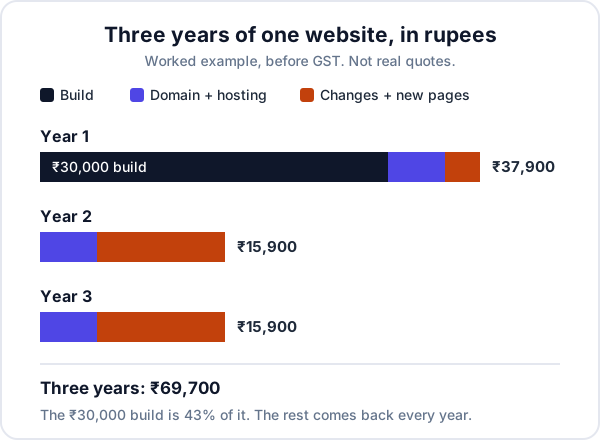
Three things come out of this.
- The build is 43% of the three-year cost. A quote that saves ₹10,000 on the build and then charges ₹2,000 for every small change is not the cheaper one.
- Domain and hosting are the small part. ₹4,900 a year here. Arguing over a few hundred rupees of hosting while ignoring the price of changes is the common mistake.
- The new pages are the part that earns. The ₹10,000 of new service pages is the money most likely to bring in enquiries from search. It is also the first thing cut.
A monthly care plan replaces the “small changes” and often the hosting line with one fixed figure. Ours starts at ₹5,000 a month, which includes hosting, the certificate, daily backups, updates and small changes. For a brochure site that changes twice a year, paying per change can be cheaper; a plan earns its place when the site changes every month, sells online, or is joined to a system that must not go down.
Red flags in a very cheap website quote
A low price is not a problem in itself. A template site from a freelancer can be the right answer for a new business. These are the signs that the low price will be made back later, or that the site will have to be redone:
- “Free domain and hosting included”, with no renewal price. Ask what year two costs, in writing, and whose name the domain will be registered in.
- The domain in the developer’s account. The most common reason a business cannot move or even renew its own website. You should hold the domain and hosting logins.
- No page list. If the quote does not list the pages and features, you cannot tell what was left out until it is missing.
- “Content to be provided by client” in small print. Fine if you know it, but it means writing every page yourself.
- A guaranteed position on Google. Nobody controls rankings. A guarantee usually means ranking for a phrase nobody searches.
- Nothing about the enquiry form. Where do submissions go, and who tested it? A form that posts into nothing is how a website gets visitors and no enquiries.
- Full payment upfront. Paying in stages, against work you can see, protects both sides.
- No source files or admin login at handover. Without them, the next developer starts from nothing.
- A large yearly charge for the certificate on a plain business site, when free certificates exist.
When spending more on a website is not worth it
More money does not always buy more enquiries. Some honest cases:
- Most of your work comes from portals or referrals. If IndiaMART and word of mouth bring nearly all your enquiries, a small, fast site with your services, photos and phone number is enough. Spend the rest on answering faster.
- You sell by quotation. Do not pay for a shopping cart for products whose price depends on the job. A catalogue with an enquiry button fits better.
- You want to edit everything yourself. A website builder or a simple WordPress theme may suit you better than a hand-built site, as long as the domain is in your name.
- The design brief is “like Apple”. Animation and large videos cost money to build and slow the site on mobile data. Business visitors want the phone number.
What to send before you ask for quotes
You get comparable quotes only if every developer prices the same thing. Send each one a single page with:
- What you sell, and which services or product groups need their own page. Our list of the pages a business website needs helps here.
- The areas you cover.
- What a visitor should do: call, WhatsApp, fill in a form, or buy.
- Who will write the text and supply the photos.
- Where enquiries should go: an email, a phone, a CRM.
- Any extras: languages, catalogue, payments, bookings, logins.
- A request to list the year-two running costs and who owns the domain.
Where Enkay Technologies fits
Enkay Technologies builds business websites from about ₹25,000 before GST, usually in 2 to 4 weeks once the content is in. You get a written scope and a fixed price first, the domain and hosting are set up in your name, the source files are handed over, and the first 30 days of fixes are free. After that you can take a care plan or pay for changes as you need them.
Separately, we make Enkay CRM. Your website’s enquiry form can post straight into it, so each submission becomes a lead with a follow-up date instead of an email; connecting a form to a CRM shows how. It has a free plan for one user. It does not build or host your website, does not read WhatsApp messages or phone calls by itself, and a lead in it has no email field, so ask for a phone number on your form.
The short version
Website development cost is the build plus every year after it. Compare quotes line by line, ask for the year-two cost in writing, keep the domain in your own name, and set money aside for new pages, because that is the part that brings enquiries. A website that costs ₹70,000 over three years and brings two jobs a month is cheaper than one that costs ₹20,000 and brings none.
Frequently asked questions
How much does a website cost for a small business?
It is a one-time build fee plus running costs every year. The build depends mostly on what the site has to do: a few service pages with an enquiry form sit at the bottom, a product catalogue, online payments or customer logins cost more. Our own quotes at Enkay Technologies start at about ₹25,000 before GST. Budget separately for the domain, hosting and upkeep, which recur every year.
Is it fair to charge for a website per page?
Only as a rough guide. A contact page and a service page with photos, prices and questions are not the same amount of work, and the expensive parts of a website, such as a catalogue, payments or logins, are not pages at all. Ask for a quote built from a page list and a feature list, with the content work stated separately.
What does a website cost every year after it is built?
Domain renewal, hosting, the security certificate (often free), updates and backups, small changes, and new content. For an ordinary business site the domain and shared hosting are a few thousand rupees a year; upkeep and content usually cost more than both. If you sell online, add the payment gateway’s fee on every sale.
Is a free or ₹1 domain really free?
For the first year. As of October 2026, Hostinger’s rupee price page lists a .in domain at ₹1 for the first year and ₹899 a year at renewal, and its shared hosting at an introductory monthly price on a 48-month term with a higher renewal price. Compare renewal prices, not first-year prices.
Why are some website quotes so cheap?
Usually because something is left out: the content, the search setup, a tested enquiry form, the source files, or anything after launch. Sometimes the domain and hosting stay in the developer’s name so the money is made at renewal. Ask what is excluded and whose name the accounts are in before comparing prices.
Who should own the domain and hosting?
Your business. The domain should be registered in your business’s name with an email address you control, and you should hold the hosting login. If a developer holds them, moving or even renewing your own website depends on that developer answering the phone.
Keep reading
Want a written quote with the running costs in it?
Tell us what you sell and what the website has to do. The scoping call and the quote are free, and the yearly costs are listed next to the build.