A CRM for manufacturers does two jobs. It tracks the long first sale, from an enquiry or RFQ through costing, samples, quotation and revisions to a purchase order. And it keeps the repeat orders coming from buyers who already trust you, which is where most of a supplier’s revenue sits. It does not plan production, explode a bill of materials or count raw material. That is ERP or MRP work.
For a small manufacturer or B2B supplier, the money usually leaks in two places: between “please send your best rate” and a PO, and in regular accounts that quietly stop ordering without anyone noticing. This post shows where those leaks are, what a CRM should record, a worked example of what one quiet account costs, and when you need an ERP instead.
Why a CRM for manufacturers has to fit a different sale
Most CRM advice is written for businesses that sell a fixed product to a one-time buyer. A supplier of packaging, fasteners, castings, garments or chemicals sells differently:
- Somebody else has to price it. The salesperson cannot quote until production or the owner has costed the drawing, the material and the quantity.
- Samples come before orders. A buyer’s quality team tests a sample or a trial lot, and that can take weeks.
- Prices move under you. A quote built on this month’s steel, paper or resin price may be a loss three weeks later.
- More than one person decides. Purchase asks for the quote, quality approves the sample, the owner or accounts signs off the vendor.
- The second order matters more than the first. A buyer who reorders every six weeks for three years is worth far more than the opening PO.
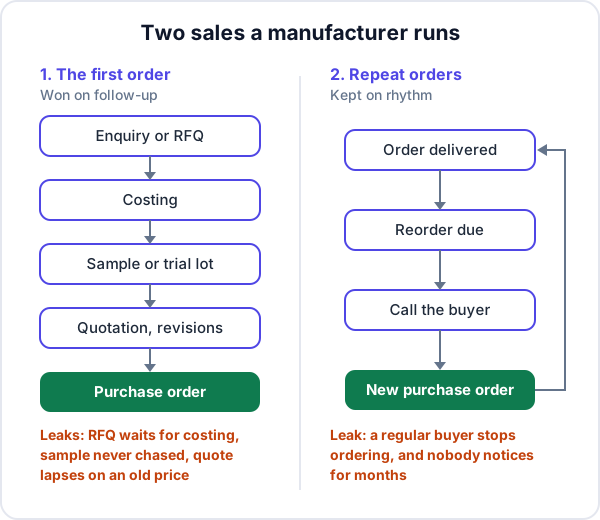
Where small manufacturers lose orders
The RFQ waits for costing
An enquiry arrives, the salesperson forwards the drawing to the factory, and it sits in someone’s WhatsApp for a week. By the time the rate goes out, the buyer has placed the order with whoever replied first. The fix is not software on its own. It is a rule that every RFQ has a named person doing the costing and a date it is due, and someone who looks at the overdue ones each morning.
The sample goes out and nobody asks what happened
Samples are expensive and slow, so they feel like progress. Then nobody calls the buyer’s quality team. Book a follow-up for the day the sample should arrive, and another for when the trial should be finished. Ask what they tested and what failed. A rejected sample with a reason is still useful; silence is not.
The quote lapses on a price you cannot honour
Put a validity date on every quotation, short when material prices are moving. Call the buyer a couple of days before it ends, not after. That call either brings the PO forward or gives you a clean reason to requote at the new rate. The guide to writing a quotation that gets accepted covers validity, payment terms and the other lines buyers check.
The regular buyer stops ordering, and nobody notices
This is the expensive one. A buyer who has ordered every month does not cancel. They just stop. Maybe a competitor came in cheaper, a delivery was late, or their purchase manager changed. Unless someone is watching the gap since the last order, you find out months later.
Marketplace enquiries treated like RFQs
Enquiries from IndiaMART and similar B2B marketplaces mix serious buyers with traders collecting rates. Treating every one like a costed RFQ wastes the factory’s time; ignoring them loses the real ones. Qualify first, with three questions on the first call: quantity, required-by date, and whether they are the end user. If your enquiries come from IndiaMART, see how to get IndiaMART leads into a CRM so none are lost in the inbox.
A worked example: what one quiet account costs
This is a made-up example, not data from a real business. Say a corrugated box maker has 60 regular buyers, and an average buyer orders ₹40,000 of boxes a month.
| Item | Figure |
|---|---|
| One average buyer, per year | ₹40,000 × 12 = ₹4,80,000 |
| Buyers who drift away in a year, unnoticed for months | 6 of 60 |
| Revenue that leaves with them | 6 × ₹4,80,000 = ₹28,80,000 a year |
| If a monthly check catches half of them in time | ₹14,40,000 kept |
Compare that with chasing new RFQs. To replace ₹14.4 lakh a year of repeat business with new buyers, you need enough new accounts to cover it, each one costed, sampled and won. Keeping an existing buyer usually costs a phone call. Put your own numbers in: your count of regular buyers, their average monthly order, and how many stopped last year.
What to record on every B2B enquiry
A good record lets anyone pick up the enquiry without calling the salesperson. For a supplier, that means:
- Product and spec: item, size, grade or material, drawing reference
- Quantity: this order, expected monthly volume, and your minimum order quantity
- Target price if the buyer gave one, and the required-by date
- Application: what they use it for. It changes the spec and the price
- Who decides: the purchase contact, the quality contact, and who signs off a new vendor
- Source: marketplace, website, referral, trade fair, existing buyer
- Sample: date sent, expected trial result date, outcome
- Quote validity, and for regular buyers, the usual reorder interval
The guide to building a customer database covers what to keep once the enquiry becomes a buyer.
Pipeline stages for a manufacturer
You do not need a new stage for every step. Seven is plenty, as long as each one has a clear exit:
| Stage | What it means for a supplier | Move on when |
|---|---|---|
| New | Enquiry or RFQ received | First call made |
| Contacted | Spoke to the buyer | Quantity, date and end use known |
| Qualified | A real requirement, sent for costing | Costing done |
| Site visit | Sample sent, or plant visit or audit | Sample approved |
| Quotation | Rate sent, with validity | Buyer comes back on price or terms |
| Negotiation | Price, payment terms or lead time being discussed | PO received, or a clear no |
| Won / Lost | PO received, or lost with a reason | — |
Always record the lost reason: price, lead time, sample failed, bought elsewhere, no reply. After a quarter, that list tells you more about your pricing than any competitor research. The sales pipeline page shows how a board like this looks.
CRM, ERP or both?
Start from the problem, not the software category:
| If the problem is… | You need |
|---|---|
| Enquiries and RFQs not answered or chased | A CRM |
| Samples and quotes going cold | A CRM |
| Regular buyers drifting away unnoticed | A CRM, and a monthly habit |
| Production schedules, BOM, work orders, raw material planning | ERP or MRP software |
| Invoices, GST returns, ledgers | Accounting software you probably already have |
| Dealer schemes, secondary sales, stock at distributors | Dealer management software |
Most small manufacturers already have the accounting part and lose orders at the front, so a CRM comes first. The longer comparison of CRM vs ERP covers how the two can share data.
What a CRM will not fix
- Slow costing. A CRM shows that an RFQ is overdue. It cannot cost the drawing. If one person does all the costing, that person is the bottleneck.
- An unreliable delivery record. Buyers who leave because shipments were late will not come back because of a follow-up call.
- A team that does not update it. If salespeople keep the real status in their heads, the CRM shows a tidy board that is wrong.
- Channel sales. If dealers carry most of your volume, a general CRM covers only part of the job.
Where Enkay CRM fits, and where it does not
Enkay CRM, made by Enkay Technologies, is a general CRM for businesses that run on enquiries. For a supplier it does these things:
- IndiaMART and website form enquiries arrive automatically once connected. Calls, trade-fair contacts and referrals are added by hand; a phone number is the only required field.
- Each enquiry has an assigned person, a requirement note for the spec and quantity, a value, a stage and a next follow-up date. The Today screen lists overdue follow-ups first, and open enquiries with no follow-up at all.
- On the Business plan, GST quotations have line items, a discount and revisions, and a share link the buyer can accept or decline on their phone. Sending a quote books a follow-up two days later; the buyer’s first opening of the link moves it to today; a quote close to its valid-until date brings a follow-up forward.
- Customer records hold the company, GSTIN, address and a tag, with their quotations, orders and invoices. Products and stock, GST invoices and payments are on the Business plan.
- On the Business plan, an accepted quotation becomes a sales order. Delivery challans and invoices draw it down line by line, so a part dispatch leaves the balance open until the order is complete or closed short, and stock leaves when the goods go out.
- Reports show win rate by source, quotation acceptance rate, why deals were lost, money owed by age, and best sellers.
And these it does not do:
- No production planning, bill of materials, work orders or raw material planning.
- No reorder alert. It will not tell you a buyer has gone quiet. Keep a follow-up date on each regular buyer instead, by opening a lead linked to their customer record for the next expected order.
- No dealer management: no dealer portal, schemes, beat plans or location tracking.
- No email inbox sync. A lead can hold an email address, but buyer emails are not pulled in. Reminders appear inside the app only, not by WhatsApp, SMS or email.
- No purchase orders to your own suppliers, goods received notes or e-way bills.
- Fixed pipeline stages, the seven above. You cannot rename Site visit to Sample, so use it that way.
The Free plan is a real plan for one user. Business is ₹499 a month for the whole business with unlimited users. See pricing.
Start with three things this week
Whatever CRM for manufacturers you choose, or none, these three habits recover the most orders:
- Give every open RFQ a costing owner and a due date, and look at the overdue list each morning.
- Book a follow-up for every sample and every quote, including one before the quote expires.
- List your regular buyers with their usual reorder interval, and call anyone past one and a half times that gap. If some have already gone quiet, reviving old leads and accounts covers how to give them a reason to talk again.
Frequently asked questions
What is a CRM for manufacturers?
It is software that keeps every buyer enquiry, request for quotation, sample, quotation and repeat customer in one shared list, with a person and a next date against each. It covers the sales side of a manufacturing business: winning the first order and keeping the reorders coming. Production planning, bills of materials and stock of raw material belong to ERP or MRP software.
Does a small manufacturer need a CRM if it already uses Tally or an ERP?
Usually, yes. Accounting software and most small ERPs start working once an order exists. They do not tell anyone which RFQ is waiting for costing, which sample nobody has chased, or which regular buyer has not ordered for three months. If those leaks cost you orders, a CRM fills that gap and the accounts software carries on as before.
What features should a CRM for a manufacturer have?
At minimum: enquiries captured from your sources (marketplaces, website, calls), a requirement field for specs and quantity, a pipeline with stages for sampling and quotation, quotations with revisions, a next follow-up date on every open enquiry, customer records with company and tax details, and reports on win rate and lost reasons. Dealer portals and beat plans matter only if you sell through a dealer network.
How do I track repeat orders and reorders in a CRM?
Write each regular buyer’s usual reorder interval on their record, then keep one open follow-up for the next expected order. When the order comes in, book the next one. Once a month, list buyers whose last order is older than one and a half times their usual interval and call them first. Few small-business CRMs send reorder alerts on their own, so the habit matters more than the feature.
Can a CRM manage dealers and distributors?
A general CRM can hold dealers as customers and track their enquiries and orders. It will not usually run a dealer portal, dealer-wise schemes and targets, secondary sales or stock at the dealer. If most of your sales go through a distributor network, look at dealer management software, or a CRM built for channel sales, alongside or instead of a general CRM.
Keep reading
Try Enkay CRM free
Every enquiry in one list, a follow-up date on each one, and your whole team on the same page. Free for one user — not a trial, no credit card.