How long does it take to build a custom CRM? For a small business, a working first version usually takes 6 to 10 weeks from the day the written scope is agreed. That is the developer’s part. Add one to three weeks before it, when you gather documents and agree the scope, and about a month after launch, when your staff stop working around the new system and start working in it. From first call to everyday use, three months is a fair plan.
Vendor guides quote anything from two weeks to over a year, and they are not all wrong: they are counting different things. Below is what each phase involves, which weeks belong to you rather than the developer, what actually stretches a build, and how to shorten it without cutting the parts that matter.
Custom CRM timelines by size of project
These are rough guides for a first version, counted from an agreed written scope. They are not quotes.
| What you are building | First version | What pushes it longer |
|---|---|---|
| One team, one process: leads, follow-ups, quotations, jobs, a few reports, one or two lead sources | 6 to 10 weeks | Unusual pricing rules, many document formats |
| The same, plus an app in the Play Store and App Store | 10 to 16 weeks | Store review, offline working, device features |
| Several branches, dealer or customer logins, many integrations | Several months, best delivered in stages | Each outside system, each new kind of user |
| A ready-made CRM, set up for you | Days to two weeks | Moving old data in |
Anything quoted in days for a system written from scratch is either a template being renamed or an estimate that will move. A template can be the right answer; just know which one you are buying.
The custom CRM development timeline, phase by phase
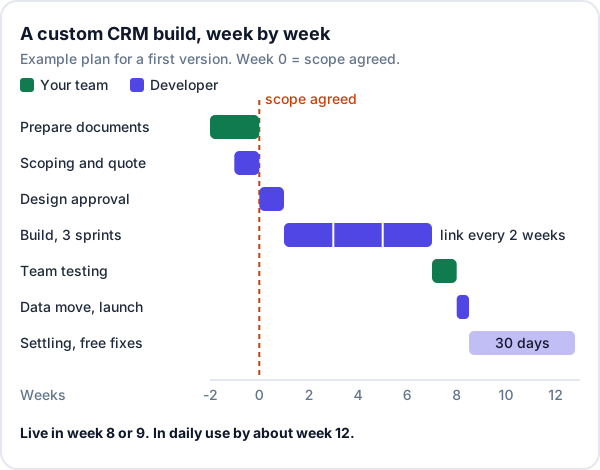
1. Prepare (you, 1 to 2 weeks)
Collect a real quotation, a job sheet or work order, the spreadsheet your team uses today, and a list of the five things that go wrong most often. Decide who in the business will answer the developer’s questions and approve the screens. How to write a CRM requirements document has a template for this; half a page is enough to start.
2. Scoping and a written quote (a few days)
A call about how work moves through your business and where it gets stuck, then a written scope listing every screen, field, rule and report, with a price and a dated plan. This is the step that decides whether the rest runs on time. A scope agreed on the phone cannot be checked six weeks later.
3. Design you approve (about a week)
You see the real screens before they are built. Changing a screen at this point costs an afternoon; changing it after it is built costs days. Look at it with the person who will use it most, not only the owner.
4. Build in short sprints (4 to 6 weeks)
The developer builds in blocks of about two weeks and gives you a working link at the end of each, something you can open on your phone and click through. If all you get is a status report, you have no way to tell whether week six is really week six.
5. Your team tests it on real work (about a week)
Staff enter real enquiries and raise real quotations in a test copy. This is where you find that the field everyone agreed on is called something else on the shop floor. Book this week in a quiet period, not in your peak season.
6. Data move and launch (a few days)
Customers, open leads, products and past invoices are cleaned, imported into the test copy, checked, then moved to the live system. The CRM data migration checklist covers each step.
7. Settling (about a month)
The first month after launch is when small fixes pile up: a report sorted the wrong way, a missing field on the invoice. This is normal. Agree before you start who fixes these and whether they are free for a period.
Where the weeks actually go
When a CRM build runs late, the code is rarely the main reason. These are the usual causes, roughly in order of how often they happen.
- Waiting for decisions. The developer asks whether a quotation can be edited after it is sent. The question sits for a week. Each unanswered question can hold up a whole screen, and a week of silence often moves the end date by a week.
- Features added halfway. “While you are at it” is the most expensive phrase in a software project. Each addition needs design, building and testing, and it pushes everything behind it.
- Data in poor shape. Three spellings of the same customer, phone numbers in the name column, quotations in a WhatsApp group. Cleaning it is slow and usually needs someone from your side who knows the customers.
- Outside approvals. Some parts depend on other companies. Meta says WhatsApp message template review can take up to 24 hours, and a rejected template has to be fixed and sent again. Apple says it reviews 90% of app submissions in under 48 hours, but an incomplete submission takes longer. Business verification, payment gateway onboarding and lead source keys each have their own forms and waits.
- Nobody can decide. Two partners disagree about how discounts should work, and the developer is caught in the middle. Settle it before the build, not during it.
- Testing that never happens. The test week arrives in the middle of a busy month, nobody logs in, and the problems surface after launch instead.
A worked example: one first version, week by week
This is a made-up example, not a real client. Say a water purifier dealer with eight staff wants a CRM for enquiries from their website and IndiaMART, quotations, installation jobs and yearly service visits.
| Week | What happens | Who is waiting on whom |
|---|---|---|
| −2 to 0 | Owner gathers a quotation, a job card and the service spreadsheet; scoping call; written scope and quote | Developer waits on documents |
| 1 | Screens designed and approved; IndiaMART key and a business email for sending requested | Developer waits on approval |
| 2 to 3 | Sprint 1: leads, follow-ups, lead capture. First working link | Owner reviews the link |
| 4 to 5 | Sprint 2: quotations with the dealer’s pricing, share link, PDF | Owner confirms pricing rules |
| 6 to 7 | Sprint 3: installation and service jobs, reports, roles | Office staff clean the customer list in parallel |
| 8 | Staff test on real enquiries; fixes; data moved; launch | Developer waits on test feedback |
| 9 to 12 | Daily use; small fixes; one short training refresh | Both |
Now suppose the owner takes eight days to approve the designs instead of two, and asks for a dealer login in week five. Neither is unreasonable. Together they can easily push launch from week 8 to week 11, and the dealer login probably belonged in a second version anyway.
How to shorten a custom CRM build without cutting corners
- Name one decision-maker and agree that questions get an answer within two working days.
- Bring real documents to the scoping call. A sample quotation answers twenty questions at once.
- Keep version one small. Fix the problem that made you call, and park everything else on a list for version two.
- Start the outside paperwork in week one: domain, business email, WhatsApp Business account, payment gateway, store developer accounts. Their waits then run alongside the build instead of after it.
- Clean your data while the build runs, not after it.
- Book the test week now, in a quiet period, with the staff who will use the system daily.
- Treat changes as change requests, with a price and a date, so you decide knowingly. Fixed price vs time and material explains how each pricing model handles them.
Ask for the plan as dates, with what you will be able to click on at each one. A developer who can give you that has thought about the work. One who can only give a total number of weeks has not yet.
When a ready-made CRM is the faster answer
If your work is leads, follow-ups, quotations and invoices, a product will be in use long before a custom build is designed. Our own product, Enkay CRM, has a free plan, and a small team can follow the two-week plan in our CRM implementation guide. It has fixed pipeline stages and no custom workflows, so it will not bend to an unusual process. That is the trade: weeks saved against fit. Buy or build sets out three questions that settle which side of it you are on.
How Enkay Technologies runs a custom CRM build
Enkay Technologies builds custom CRMs on the plan described above. A free 30 to 45 minute scoping call; a written scope with a fixed price and a dated plan within two to three days; screens you approve before they are built; a working link every two weeks; about a week of testing by your team; then launch, with your data moved across, the code and accounts transferred to you, and 30 days of free fixes. A working first version usually takes 6 to 10 weeks from the agreed scope, and quotes start at about ₹1,50,000 before GST. If we underestimate something that was in the scope, that is our cost, not yours.
The short version
How long does it take to build a CRM? Six to ten weeks for a focused first version, once the scope is written down, plus a couple of weeks of preparation before it and a month of settling after it. The developer controls the middle. You control the start, the decisions and the testing, and those are where most projects lose their weeks.
Frequently asked questions
How long does it take to build a custom CRM?
For a small business, a working first version usually takes 6 to 10 weeks from the day the written scope is agreed. Add one to three weeks before that for gathering documents and scoping, and about a month after launch for the team to settle into it. Systems with dealer or customer logins, several integrations or a native app take longer.
Can a CRM really be built in two weeks?
A ready-made CRM, a no-code tool or a template can be set up in two weeks or less, and that is often the right choice. A system written for your process, with your own documents and rules, cannot be designed, built and tested properly in two weeks. Ask which of the two a quote describes.
What slows down a custom CRM project the most?
Usually not the coding. The common causes are slow decisions on the owner's side, new features added halfway through, messy data that has to be cleaned before it can be moved, and outside approvals such as WhatsApp templates, payment gateway onboarding or app store review that the developer does not control.
How much of my time does a custom CRM build need?
Plan for a couple of hours in the first week to gather sample documents and attend the scoping call, a short review every two weeks when a new working link arrives, quick answers to questions in between, and a week where your staff use the test system on real work. One person who can decide matters more than the hours.
Is it faster to buy a CRM than to build one?
Yes. A ready-made CRM can be in use within days, and a small team can roll one out in about two weeks. Build only when a specific part of your process is not handled by any product you have tried and is costing you time or money every week.
Keep reading
Get a dated plan, not a guess
Tell us what keeps slipping. The scoping call and the written scope with a fixed quote and dated plan are free, and if a ready-made CRM would do the job, we will say so.