Sales pipeline stages are the steps a deal passes through between the first enquiry and a final yes or no. For a business that sells through enquiries, the list is usually seven: New, Contacted, Qualified, a step where you look before you price (a site visit, survey, demo or sample), Quotation, Negotiation, and Won or Lost.
The names change from trade to trade. The order hardly does. What makes the stages useful is not the names but the rule for moving a deal from one to the next. This post gives six ready-made lists, each with those rules written out, for solar, real estate, interiors, coaching admissions, service contracts and B2B supply, and shows how to adapt one to your own business.
What makes a good stage
Three tests, and a stage has to pass all of them:
- Something different happens here. A deal in Site visit needs a date fixed; a deal in Quotation needs a follow-up. If two stages need the same action, merge them.
- It is entered on a fact, not a feeling. “Customer seems interested” is a feeling. “Customer confirmed a budget range” is a fact anyone can check.
- It describes the buyer, not your office. “Waiting for manager approval” is an internal task. Put it on a task list, not in the pipeline.
Setting stages up is half the job; keeping them honest is the other half. For the weekly review, deal values and stuck deals, see how to track your sales pipeline. This post stays on the stages themselves.
The common shape, and the gate between each stage
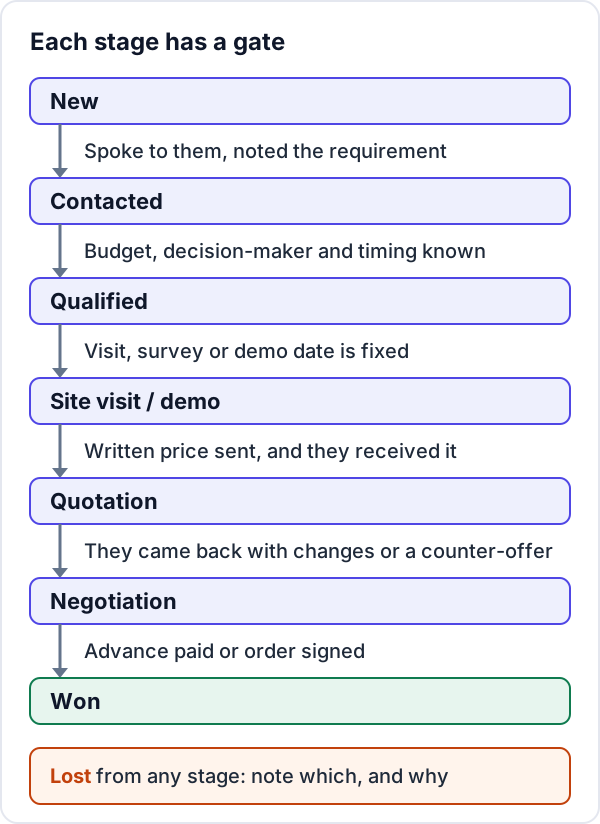
The six lists below all follow this shape. That is deliberate: it makes the stages easy to compare across a team, and easy to fit into most CRMs, which come with a similar set.
Six examples of sales pipeline stages
1. Rooftop solar installer
| Stage | Moves on when… |
|---|---|
| New enquiry | Someone has called them back, not just sent a WhatsApp |
| Contacted | You know their monthly electricity bill and roof type |
| Qualified | They own the roof, it is not shaded, and the person deciding is on the call |
| Site survey | The survey is done and the system size is worked out |
| Proposal sent | The customer confirms they received it and has looked at the savings |
| Negotiation | They are comparing panel brands, financing or a competitor’s price |
| Won | Advance paid |
Watch for deals that sit in Qualified because nobody books the survey. Installation and the net-metering paperwork come after Won and belong in your installation tracking, not the sales pipeline. More on the trade in how to generate leads for a solar business.
2. Real estate broker or developer
| Stage | Moves on when… |
|---|---|
| New enquiry | Spoken to on the phone |
| Contacted | You know the budget, preferred area and flat size |
| Qualified | You know how they will pay (own funds or loan) and when they want to move |
| Site visit | They have visited and shortlisted a unit |
| Cost sheet shared | They have the full price breakdown for that unit |
| Negotiation | They have asked for a discount, a different floor or a payment plan |
| Won | Booking amount paid |
A buyer may visit three times before deciding. That is still one stage; note each visit on the deal rather than inventing “Second visit”. See real estate lead management from site visit to booking.
3. Interior design studio
| Stage | Moves on when… |
|---|---|
| New enquiry | Spoken to on the phone |
| Contacted | You know the property type, scope (full home or just the kitchen) and possession date |
| Qualified | The budget range fits the scope, and both decision-makers are involved |
| Measurement | The site is measured and the client has seen first ideas |
| Design and quote | The quotation and layout have been sent and walked through |
| Negotiation | They are changing materials, scope or price |
| Won | Design or booking advance paid |
In interiors, deals often go quiet between Measurement and Design and quote, when the studio takes two weeks to send a design. If you charge a design fee at measurement, treat that as a strong qualifier, not a win. More in why most interior design leads never turn into projects.
4. Coaching institute admissions
| Stage | Moves on when… |
|---|---|
| New enquiry | A counsellor has spoken to the student or parent |
| Counselled | You know the course, target exam and preferred batch timing |
| Qualified | The parent who pays is involved and the course fits the student |
| Demo class or visit | The student has attended a demo or visited the centre |
| Fee shared | The fee structure and instalment options are in writing |
| Negotiation | They have asked about a scholarship, sibling discount or instalments |
| Won | Admission fee or first instalment paid |
Admissions run in seasons, so a deal that sits two weeks in Fee shared during peak season is usually gone. See how to follow up every admission enquiry.
5. Service business selling maintenance contracts
| Stage | Moves on when… |
|---|---|
| New enquiry | Spoken to on the phone |
| Contacted | You know the number and age of the units (ACs, lifts, RO plants, cameras) |
| Qualified | The person who signs is known, and the current contract end date is known |
| Inspection | A technician has checked the units and noted their condition |
| Quotation | The contract price and visit schedule have been sent |
| Negotiation | They are discussing visit count, parts cover or price |
| Won | Contract signed and first payment received |
For contracts, the “Qualified” gate matters most: a society or office with a contract running another nine months is a follow-up date, not a live deal.
6. B2B supplier or manufacturer
| Stage | Moves on when… |
|---|---|
| New enquiry | Spoken to the buyer, not just replied to an IndiaMART buy-lead |
| Contacted | You have the specification, quantity and delivery location |
| Qualified | It is a real requirement with a date, and you can make or supply it |
| Sample or technical call | The sample is approved or the specification is agreed |
| Quotation | The rate, taxes, freight and payment terms are in writing |
| Negotiation | They have asked for a revised rate, credit days or a delivery change |
| Won | Purchase order received |
B2B deals loop: a revised quotation sends the deal back to Negotiation, not to the start. Repeat orders from an existing customer usually skip the first four stages. See what a CRM for manufacturers and B2B suppliers needs to do.
How to adapt a list to your business
- Write down how your last ten customers actually bought. Not how you would like them to. Note each step where they had to do something.
- Mark where money or a signature happens. That is Won. Everything before it is a stage or a step inside one.
- Find your look-before-you-price step. Every trade above has one. If you price straight from the phone call, you may not need it; skip the stage rather than invent one.
- Write the gate for each stage in one line, as in the tables. Show it to whoever sells, and change the words until everyone would put the same deal in the same place.
- Write five or six lost reasons for your trade: price, chose a competitor, no response, postponed, not the decision-maker, out of our range. A deal lost without a reason teaches nothing.
Common mistakes with pipeline stages
- A “Follow-up” stage. Following up happens at every stage. Give each deal a next date instead.
- Post-sale work in the sales pipeline. Installation, delivery and documents make Won deals look open and clutter the board.
- A stage per small step. Ten stages means nobody updates them, and the board stops matching reality within a month.
- Counting a verbal yes as Won. It belongs in Negotiation until the advance or order arrives.
- No stage recorded on lost deals. Losing at Quotation and losing at Qualified are different problems: one is price or follow-up, the other is lead quality.
Pipeline stages in Enkay CRM
The sales pipeline in Enkay CRM uses the common shape above: New, Contacted, Qualified, Site visit, Quotation, Negotiation, then Won or Lost, each with a win probability. Every open lead appears on a board with one column per stage, and you move it with the stage menu or an advance button (it is not drag-and-drop). Sending a quotation moves a lead to Quotation, accepting the quotation marks it Won, and marking a lead Lost asks for the reason. On the Business plan, reports show conversion and why deals were lost.
What it does not do: the stages are fixed. You cannot rename them or add your own. In practice the six lists above fit, because they were written on the same shape: a coaching institute reads Site visit as “Demo class”, a supplier reads it as “Sample”. Keep your one-page list of gates next to the board, and use lead tags for detail such as “Loan pending”. If your rule is that Won means the advance is in, accept the quotation when the advance arrives.
Some processes genuinely do not fit seven fixed stages: tenders with technical and commercial rounds, several product lines with different pipelines, or approvals that need their own records. For those, Enkay Technologies also builds custom CRM software around your own stages. And if your stages are fine but too few enquiries reach New, the problem is often the website; we do business website development with the enquiry form sending leads straight into a CRM.
Start with the gates, not the names
Any business can copy a list of sales pipeline stages. What makes the list work is the one-line rule for each gate, applied the same way by everyone who sells. Pick the example closest to your trade, rewrite the gates in your own words, and look at where deals pile up after a month. That column is where your next sale is being lost.
Frequently asked questions
What are the stages of a sales pipeline?
For most businesses that sell through enquiries, seven: New, Contacted, Qualified, a look-before-you-price step (site visit, survey, demo or sample), Quotation, Negotiation, and Won or Lost. The names change by trade. The order rarely does, because almost every buyer has to be reached, checked, shown something and priced before they say yes.
How many pipeline stages should a small business have?
Five to seven, counting Won and Lost. Fewer and you cannot see where deals stall; more and nobody keeps the stages up to date. A stage earns its place only if something different happens to a deal while it sits there.
What is an exit criterion in a sales pipeline?
It is the fact that must be true before a deal moves to the next stage, such as “a written quotation has been sent and the customer confirmed they received it”. It turns stages from opinions into checks, so two salespeople put the same deal in the same place.
Should follow-up be a pipeline stage?
No. Following up is something you do at every stage, not a place a deal sits. A “Follow-up” column fills up with deals at very different points and tells you nothing. Keep the stage, and put a follow-up date on the deal instead.
When does a deal count as won?
When money or a signature arrives: an advance, a booking amount, an admission fee or a purchase order. A verbal yes is still Negotiation. Counting it early makes the pipeline look healthier than the bank account.
Do installation and delivery belong in the sales pipeline?
Not usually. The sales pipeline ends at Won or Lost. Installation, delivery, paperwork and handover are the work that follows, and belong in your job, order or project tracking, where different people own them.
Keep reading
Try Enkay CRM free
Every enquiry in one list, a follow-up date on each one, and your whole team on the same page. Free for one user — not a trial, no credit card.