How long does it take to build a website? For a small business site of five to ten pages, the developer’s part usually takes 2 to 4 weeks, counted from the day your text, photos and logo are ready. Getting that content together often takes one to three weeks before it. So from the first call to a site that is live and working, plan on about a month to six weeks.
The build itself is rarely what makes a website late. The content is. This post walks through a realistic plan week by week, says what you have to supply and when, and ends with a checklist you can send your developer on day one.
The short answer, by type of site
These are planning ranges for a site with its own design, built by a small team, measured from the day the content is in. They are not promises, and a template filled in with your logo will be quicker.
| Type of site | Build time once content is in | What adds time |
|---|---|---|
| Five to ten page business site with an enquiry form | 2 to 4 weeks | Writing the service pages from scratch |
| Catalogue with dozens or hundreds of products | 4 to 8 weeks | Product names, specifications and photos arriving in pieces |
| Business site with forms wired to a CRM | About the same as a business site, plus a few days of testing | Getting access to the CRM and testing every form end to end |
| Online shop with payments | 6 to 12 weeks or more | Payment gateway approval, shipping and tax rules, returns policy pages |
Most of the difference between a three-week site and a three-month site is decided before anyone writes code: how many pages, how much of the content exists, and how quickly someone on your side says yes.
The website development timeline, week by week
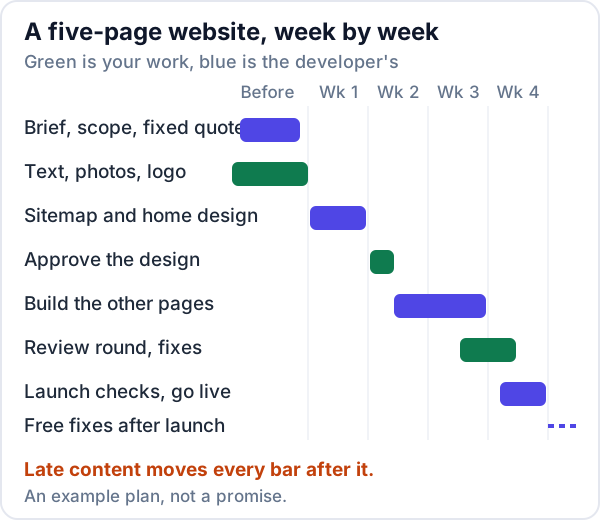
Before week 1: brief, scope and content (you, 1 to 3 weeks)
Agree in writing what the site includes: the list of pages, the forms and where they send enquiries, who writes the text, and the price. At the same time, start collecting content. This is the step people underestimate. Writing a proper page for each service, with prices or price ranges, areas served and the questions customers ask on the phone, takes an owner several evenings. The pages a business website needs lists what each page should say.
Week 1: structure and the home page design
The developer turns the page list into a sitemap and designs the home page and one inner page, on a phone first. You see it as a link, not a PDF, so you can open it on your own phone.
Week 2: approval, then the build
One person approves the design, ideally within a day or two. Once it is approved, the remaining pages are built in that style: services, about, contact, any area or product pages, the enquiry form and the WhatsApp button.
Week 3: your review round
You get the whole site on a test link. Go through it on a phone, page by page, and send one consolidated list of changes rather than a message every hour. Check prices, phone numbers, spellings of names and places, and whether the photos are really yours. This is where a project slips if five people each send their own opinions.
Week 4: launch checks and go-live
Before the site goes live, someone should check that every form actually delivers an enquiry, that each page has a sensible title and description, that the site loads quickly on a phone, and that old addresses redirect if you are replacing a site. If you are, read how to redesign a website without losing SEO first. Then the domain is pointed at the new hosting. Cloudflare, for example, tells you to wait up to 24 hours for a nameserver change to take effect, so do it early in the week, not on a Friday evening.
After launch: fixes and Google
Expect a few small fixes in the first weeks, once real customers use the site. Showing up on Google takes longer than building the site. Google’s own guidance says crawling can take anywhere from a few days to a few weeks, and asking again for the same page does not make it faster. Ranking for searches your competitors also want takes months of useful pages, not a launch date.
What actually causes delays
- Content that does not exist yet. “I will send the text next week” is the most common reason a site is late. A developer can design around placeholder text, but cannot launch with it.
- Photos. Stock photos are quick but make you look like everyone else. Real photos of your work, team or premises are better, and someone has to take them. Book that in week one.
- Approvals by committee. If a partner, a relative and the sales manager each need to approve the design, add a week. Name one person who decides.
- New pages halfway through. Adding a catalogue or a second language after the design is approved is a new piece of work, with new time and often a new price.
- Domain and hosting logins. If the domain was registered by a previous developer, getting control of it can take days of chasing. A registrar can also refuse to move a domain to another registrar within 60 days of it being registered or last transferred, under ICANN’s transfer rules. Who owns my website domain? shows how to check and get it back.
- Outside approvals. For an online shop, the payment gateway has to approve your business before you can take real payments. That runs on their timetable, not the developer’s.
Have the services list, the logo file, ten real photos and the domain login ready before you sign. Nothing else you do shortens a website project as much.
How the timeline changes with what the site has to do
A five-page site
Home, services, about, contact and one page you will actually use, such as areas served or a price guide. This is the 2 to 4 week case. Whether you build it on WordPress or by hand changes the upkeep more than the build time; WordPress vs a custom website covers that choice.
A catalogue site
Fifty products with names, sizes, specifications and photos is a data project as much as a design one. Put the products in one spreadsheet, one row per product, before the build starts. Sites that get product details one WhatsApp message at a time drag on for weeks.
A site with forms wired to a CRM
A form that only sends an email is easy to build and easy to lose: enquiries sit in an inbox that nobody owns. Sending each enquiry straight into a CRM, where it is assigned and followed up, adds little build time if the CRM accepts web form submissions. Most of the extra time is testing every form end to end. Connecting a website enquiry form to a CRM explains the options.
An online shop
Payments, stock, shipping charges, tax on invoices, order emails, and the policy pages a payment gateway asks for. Plan in months rather than weeks, and launch with a smaller range of products if you need to be live by a date.
The checklist to send your developer on day one
- Your logo as an original file, not a screenshot from WhatsApp
- The list of services or products, in the order you want them shown
- Any text you already have, even rough, and prices or price ranges you are happy to publish
- Ten or more real photos of your work, team or premises
- The towns or areas you serve
- Phone, WhatsApp number, email, address and opening hours, exactly as they should appear
- Login to the domain registrar, or the name of whoever holds it
- Where enquiries should go: an email address, a CRM, or both
- Two or three websites you like, and one thing you like about each
- The one person who will approve the design and the final site
If a developer quotes a date without asking for most of this, the date is a guess.
How we build websites at Enkay Technologies
Enkay Technologies builds business websites from about ₹25,000 before GST, usually in 2 to 4 weeks once the content is in. You get a written scope and a fixed price before work starts, and the content checklist on the first day. The domain and hosting are set up in your name, the source files are handed over, and the first 30 days of fixes are free. A care plan with hosting, backups and small changes starts at ₹5,000 a month, and you can take it or not. Website development cost breaks down what the money buys.
The enquiry form can send each enquiry straight into Enkay CRM, where it becomes a lead with its source, ready to assign and follow up. What a website cannot do is answer the enquiry for you. If your follow-up needs more than a ready-made CRM handles, such as your own quotation format or job process, we also do custom CRM development; how long a custom CRM takes sets out that timeline the same way.
Frequently asked questions
How long does it take to build a website for a small business?
A five to ten page business website usually takes 2 to 4 weeks of the developer’s time once your text, photos and logo are ready. Gathering that content often takes another one to three weeks before the build starts. A product catalogue, online payments or bookings add weeks on top.
What delays a website project the most?
Missing content. The text for each service, real photos, the logo file and the list of products are the usual hold-up. After that come slow design approvals, changes to the page list halfway through, and access to the domain or old hosting that sits with a previous developer.
Can a website be built in a few days?
A template or website builder can put a simple site online in a few days if the content is ready. A site with your own design, proper service pages, working forms and launch checks needs more than that. Ask whether a quote measured in days is a template being filled in.
How long after launch will my website show on Google?
Google says crawling can take anywhere from a few days to a few weeks. Submitting a sitemap and requesting indexing for the main pages in Search Console helps Google find them, but repeating the request does not speed it up. Ranking for competitive searches takes months of useful pages.
What should I send my web developer on the first day?
Your logo file, a list of the services or products you want shown, any text you already have, real photos, the areas you serve, your phone, WhatsApp and address details, login access to the domain registrar, and the name of the one person who will approve designs.
Keep reading
Get a dated plan for your website
Tell us what the site needs to do. You get a written scope, a fixed price and a dated plan, and the content checklist on the first day so nothing waits.